
Assessing the Case for 2026 Fed Rate Cuts and Bond Market Implications
The Federal Reserve's December 2025 policy decision marked a pivotal shift in its approach to inflation and economic stability. According to a report by the Federal Reserve, the central bank reduced the federal funds rate by 25 basis points to a range of 3.50%-3.75%, reflecting its acknowledgment of a "moderate economic expansion" and "elevated inflation risks". This adjustment followed November 2025 inflation data, which showed the consumer price index rising at a 2.7% annualized rate-below economists' forecasts of 3.1%-and core CPI increasing by 2.6% year-over-year. While these figures suggest progress toward the 2% inflation target, the Fed emphasized that "inflation remains somewhat elevated," underscoring its cautious stance as reported in the monetary policy statement.
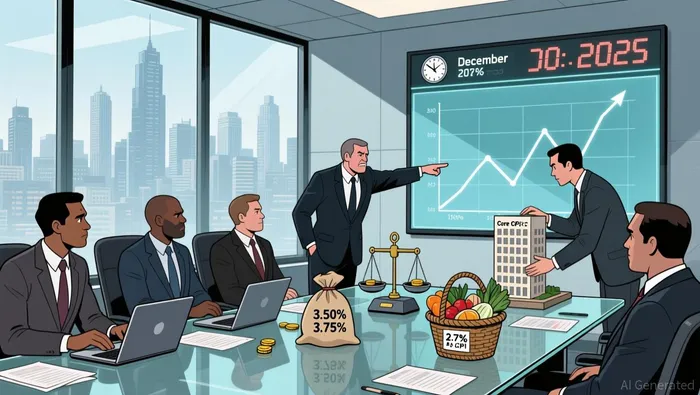 The bond market has already begun to price in the Fed's pivot. Short-term Treasury yields have fallen sharply in response to the December rate cut, with analysts projecting further declines as markets anticipate additional easing in 2026. In contrast, long-term yields, such as the 10-year Treasury, have remained stubbornly near 4.00%-4.06%, constrained by persistent inflation expectations and fiscal uncertainty. This divergence has led to a gradually steepening yield curve, a development that could influence loan pricing and institutional investment strategies. Structural factors, including heavy Treasury issuance and the anticipated fiscal implications of the "One Big Beautiful Bill Act," are also exerting upward pressure on long-term yields, complicating the Fed's task of balancing price stability with growth.
Looking ahead, the case for rate cuts in early 2026 hinges on the interplay between inflation trends and labor market dynamics. Goldman Sachs analysts project that the Fed will likely pause its rate-cutting cycle early in 2026 before implementing one or two reductions to bring the federal funds rate closer to 3%-3.25%. This conditional approach reflects Chair Jerome Powell's acknowledgment of "significant downside risks" to employment and the central bank's preference for data-dependent policymaking as noted in recent policy statements. However, the bond market's forward-looking nature suggests that investors are already pricing in a higher probability of cuts, as evidenced by the 2-year Treasury yield's decline to 3.34% according to market data.
For bond investors, the evolving policy landscape demands a nuanced strategy. While short-term yields offer attractive returns in a low-volatility environment, long-term bonds remain vulnerable to inflation surprises and fiscal headwinds. The Fed's commitment to returning inflation to 2% provides a floor for rate cuts, but structural pressures could limit the extent of yield declines. Institutions must also contend with the anomalous behavior of long-term yields, which now exhibit characteristics more akin to risk-sensitive assets, than traditional safe havens.
In conclusion, the Fed's December 2025 rate cut and its forward guidance have set the stage for a measured easing cycle in 2026. While inflation data and labor market risks will dictate the pace and magnitude of future adjustments, the bond market's mixed signals highlight the challenges of navigating a post-pandemic economy. Investors must remain vigilant to both the opportunities and risks inherent in this evolving landscape, balancing the allure of short-term gains with the uncertainties of long-term inflation and fiscal policy.







Comentarios
Aún no hay comentarios