
Apple's Strategic Restraint in AI: A Defensive Play in a Volatile Sector?
The Financial Foundations of Restraint
Apple's Q3 2025 financials, disclosed in its 10-Q filing, reveal a company prioritizing stability over recklessness. Cash and cash equivalents totaled $36.269 billion as of June 28, 2025, a figure that underscores its ability to fund innovation without resorting to debt-heavy strategies, according to the SEC filing. Research and development (R&D) expenses for the quarter amounted to $8.866 billion, or approximately 9.45% of revenue ($94.0 billion). While this is a healthy allocation for long-term innovation, it pales in comparison to the exorbitant R&D outlays of AI-focused peers. For context, NVIDIA's R&D expenses in Q3 2025 reportedly exceeded 25% of its revenue, as noted in a Benzinga report.
Apple's debt-to-equity ratio, calculated using its total term debt ($91.775 billion) and shareholders' equity ($65.830 billion), stands at roughly 1.4. This is a conservative leverage profile for a company of its size, particularly when contrasted with the ballooning debt of AI startups and even some established tech giants. The firm's commitment to shareholder returns-evidenced by its $0.26 per share dividend and robust buyback programs-further reinforces its disciplined capital allocation, as reported in a separate Apple newsroom announcement.
Strategic Prudence in Semiconductor Sourcing
One of Apple's most striking moves in Q3 2025 was its securing of over half of TSMC's 2026 capacity for 2-nanometer (2nm) chips, as reported in a Benzinga report. This maneuver ensures the company remains at the forefront of semiconductor innovation without overcommitting to speculative AI-specific hardware. By locking in advanced chip production before competitors can access similar capabilities, AppleAAPL-- is hedging against obsolescence while avoiding the capital-intensive risks of building in-house AI infrastructure.
This approach contrasts sharply with NVIDIA's strategy of aggressively scaling AI chip production, which has led to concerns about oversupply and margin compression. Apple's focus on vertical integration-designing custom silicon for its devices-allows it to optimize performance for AI applications without the need for standalone AI hardware. The result is a balanced portfolio that leverages AI's potential without exposing the company to the volatility of the broader AI market.
A Defensive Play in a Cyclical Sector
The AI sector's current euphoria echoes the dot-com bubble of the late 1990s, where speculative overinvestment led to catastrophic corrections. Apple's restraint, therefore, is not a lack of ambition but a recognition of the sector's inherent risks. Its balance sheet, fortified by $36.269 billion in liquidity, provides a buffer against potential downturns. This financial flexibility allows Apple to pivot quickly, whether by accelerating AI integration in existing products or acquiring niche AI startups at favorable valuations during market corrections.
Moreover, Apple's institutional ownership structure-held by 67.73% of institutional investors-suggests confidence in its long-term strategy, as noted in a separate Apple newsroom announcement. While some funds, like Mitchell Capital Management, have trimmed stakes, others, including UBS AM and Northern Trust, have increased positions, signaling a consensus that Apple's disciplined approach is a sustainable competitive advantage.
Conclusion: The Paradox of Strength
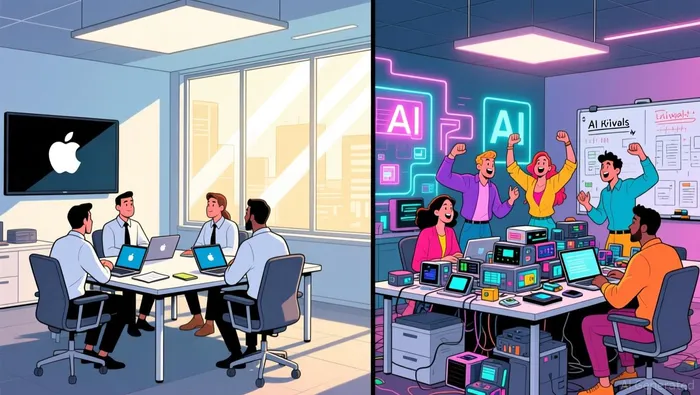
Apple's approach to AI is a masterclass in capital discipline. By avoiding the "AI arms race" and focusing on incremental, product-driven innovation, the company is positioning itself as a defensive play in an otherwise volatile sector. Its balance sheet strength, coupled with strategic foresight in semiconductor sourcing, ensures it can navigate both technological and market uncertainties without sacrificing long-term value. For investors, this restraint is not a weakness but a testament to Apple's enduring commitment to prudence-a quality that may prove invaluable as the AI hype cycle matures.





Comentarios
Aún no hay comentarios