
Apple's 2027 iPhone Expansion: A Strategic Catalyst for Long-Term Growth in a Saturated Market
In an era where global smartphone markets are increasingly saturated, Apple Inc.AAPL-- (AAPL) faces the dual challenge of sustaining revenue growth while maintaining its premium brand positioning. The company's planned 2027 iPhone expansion, however, represents a calculated and multifaceted strategy to address these pressures. By diversifying its product lineup, innovating design paradigms, and leveraging high-margin services, AppleAAPL-- aims to stabilize its revenue streams and reinforce its dominance in a fiercely competitive landscape.
Product Diversification: Broadening Appeal and Mitigating Risk
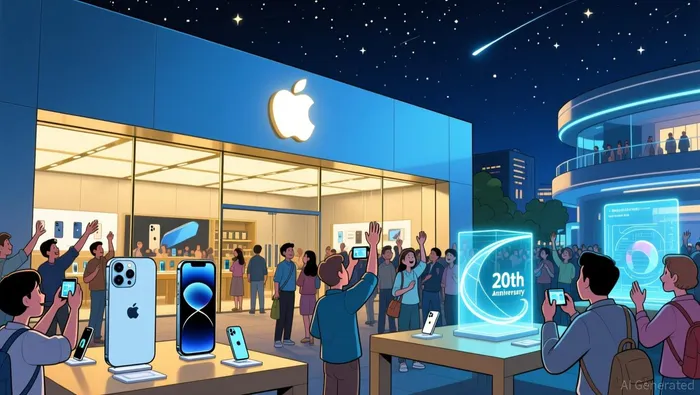
Apple's decision to expand its iPhone lineup from five to at least seven models by 2027 is a direct response to evolving consumer preferences and intensifying competition. The inclusion of a foldable iPhone, set to debut in 2026, and a 20th-anniversary edition with a curved, edge-to-edge design underscores the company's commitment to technological differentiation. These models are not merely incremental updates but represent a strategic pivot to capture new customer segments, including price-sensitive buyers and early adopters of emerging form factors according to analysts.
This diversification also serves as a hedge against market volatility. For instance, the introduction of budget-friendly models ensures that Apple can maintain its presence in price-sensitive markets such as India and Southeast Asia, where competitors like Samsung and Xiaomi have gained traction according to market research. By catering to a broader spectrum of consumers, Apple reduces its reliance on any single product tier, thereby stabilizing revenue even if demand for flagship models fluctuates.
Revenue Stability: The iPhone's Enduring Dominance and Services as a Buffer
 Despite the proliferation of models, the iPhone remains Apple's cornerstone revenue driver. In fiscal 2025, the segment accounted for over 50% of total revenue, contributing $44.6 billion in Q3 alone. The success of the iPhone 17, which drove double-digit sales growth in key markets like the U.S. and China, further validates the potential of a diversified product portfolio to sustain momentum.
However, Apple's revenue stability is not solely dependent on hardware. The Services segment, which generated $27.4 billion in Q3 2025, has emerged as a critical buffer. High-margin offerings such as the App Store, Apple Music, and iCloud subscriptions provide recurring revenue streams that are less susceptible to cyclical demand shifts. As the company integrates on-device AI features into its hardware, the ecosystem's stickiness is likely to deepen, reinforcing cross-selling opportunities and customer lifetime value.
Supply Chain Resilience: A Strategic Imperative
Beyond product diversification, Apple's supply chain strategy is equally pivotal to its long-term growth. The company's plan to shift 25% of iPhone production to India by 2027 is a deliberate move to mitigate geopolitical risks and reduce exposure to tariffs according to industry analysts. This geographic diversification not only insulates Apple from potential disruptions in China but also aligns with its broader goal of tapping into emerging markets.
The financial implications are clear: in Q3 2025, tariffs alone were projected to reduce gross margins by $900 million. By decentralizing manufacturing, Apple can better manage costs and maintain margin integrity, even in a macroeconomic environment marked by inflationary pressures.
Projected Outcomes and Strategic Risks
Analysts project that Apple's 2027 expansion will drive a 10% to 12% year-over-year revenue increase for the December quarter. However, the success of this strategy hinges on execution. The foldable iPhone, for example, must overcome technical challenges such as durability and cost, while the 20th-anniversary edition must justify its premium pricing in a market increasingly saturated with high-end alternatives.
Moreover, the company's reliance on the iPhone exposes it to risks such as supply chain bottlenecks and shifting consumer trends. Yet, Apple's track record of innovation-coupled with its robust ecosystem and brand loyalty-positions it to navigate these challenges more effectively than its peers.
Conclusion: A Calculated Path to Sustained Growth
Apple's 2027 iPhone expansion is not merely a response to market saturation but a proactive strategy to redefine its product portfolio and revenue dynamics. By diversifying models, investing in design innovation, and strengthening supply chain resilience, the company is laying the groundwork for long-term stability. While risks remain, the interplay between hardware, services, and ecosystem lock-in suggests that Apple is well-positioned to maintain its leadership in the global tech sector. For investors, this expansion represents a compelling catalyst for value creation in an increasingly unpredictable market.





Comentarios
Aún no hay comentarios