
Amylyx Pharmaceuticals' S&P Index Inclusion: A Catalyst for Market Visibility and Institutional Adoption
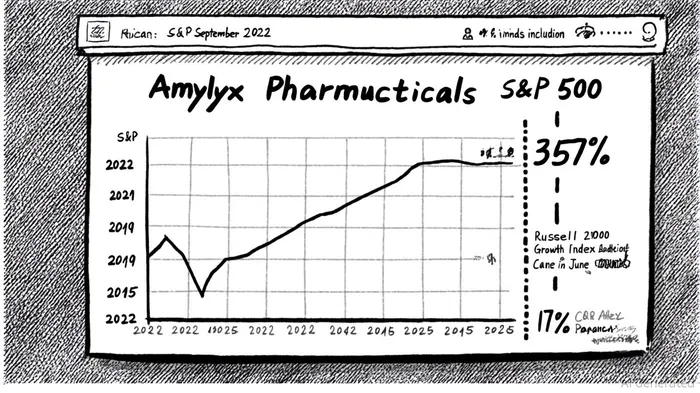
The inclusion of AmylyxAMLX-- Pharmaceuticals, Inc. (NASDAQ: AMLX) in the S&P Pharmaceuticals Select Industry Index on September 19, 2022, marked a pivotal moment for the biopharmaceutical firm. This milestone, as reported by Marketscreener, underscored the company's growing prominence in the neurodegenerative disease treatment space, particularly for conditions such as Wolfram syndrome and progressive supranuclear palsy [3]. Three years later, the strategic implications of this inclusion remain profound, reshaping both market visibility and institutional adoption dynamics.
Market Visibility: A Surge in Institutional Interest
Index inclusion often acts as a magnet for institutional capital, as passive and active fund managers are compelled to align their portfolios with benchmark indices. According to data from StockAnalysis, Amylyx's market capitalization ballooned from $1.07 billion at its January 2022 IPO to $1.42 billion by September 2025, despite a recent dip to $1.14 billion [1]. This trajectory, while volatile, reflects heightened investor confidence. Analysts have consistently rated the stock as a “Buy,” with a 12-month average price target of $12.25—22.87% above its current price of $9.97 [2]. Notably, Guggenheim's June 2025 initiation of coverage with a $17 price target—a 70% upside—catalyzed a 28% single-week surge in the stock, driven by optimism over phase 3 trial results for avexitide, a drug candidate for post-bariatric hypoglycemia [2].
The inclusion in the S&P index also amplified Amylyx's exposure to broader market trends. Over the past year, its stock has outperformed the S&P 500 by a staggering 357% versus 17% [4]. Such performance, while partly attributable to speculative momentum in the biotech sector, is reinforced by the company's pipeline of therapies, including AMX0035 and AMX0114, which target underserved neurodegenerative conditions [3].
Institutional Adoption: Capital Flows and Strategic Rationale
Institutional ownership of AMLXAMLX-- has evolved significantly since 2022. As of August 2025, PerceptivePCSC-- Advisors LLC and Adage Capital Partners GP L.L.C. hold stakes of 8.862% and 9.869%, respectively, while Saturn V Capital Management LP increased its position by 34.4% to 3.657% [1]. Conversely, Bridgeway Capital Management LLC drastically reduced its holdings by 83.5% to 0.029%, signaling divergent institutional views on risk and reward.
A critical inflection pointIPCX-- came in September 2025, when Amylyx raised $175 million through a follow-on equity offering, issuing 17.5 million shares at $10 apiece [5]. While this capital infusion aims to fund pivotal trials for avexitide and AMX0114, it has also sparked concerns about shareholder dilution. Yahoo Finance notes that such fundraising activities often test investor patience, yet the move appears to have bolstered institutional confidence in the company's financial flexibility [4].
Strategic Implications: A Dual-Edged Sword
The S&P index inclusion has not only enhanced Amylyx's visibility but also positioned it as a bellwether for innovation in neurodegenerative therapeutics. However, the company's reliance on speculative momentum and institutional sentiment introduces volatility. For instance, its addition to the Russell 2000 Growth Index in June 2025 further amplified exposure to growth-oriented investors, yet trading volume data post-index inclusion remains inconclusive [5].
From a strategic standpoint, Amylyx's dual focus on clinical innovation and capital efficiency will determine its long-term trajectory. The recent 95.84% institutional ownership ratio [3] suggests that large investors view the firm as a high-risk, high-reward proposition. Yet, with a 52-week high of $10.55 achieved in September 2025 [3], the stock's ability to sustain momentum hinges on the success of its late-stage trials and regulatory milestones.
Conclusion
Amylyx Pharmaceuticals' inclusion in the S&P Pharmaceuticals Select Industry Index has undeniably elevated its profile in the biopharma sector. While institutional adoption remains fragmented, the company's aggressive capital-raising and robust analyst ratings indicate a strategic pivot toward scaling its pipeline. For investors, the key question is whether Amylyx can translate its scientific promise into durable market value—a challenge that will test both its therapeutic innovations and its financial discipline in the years ahead.





Comentarios
Aún no hay comentarios