
The Alignment of Growth, Inflation, and Policy: Can the Eurozone Sustain a Hawkish Turn?
The Eurozone stands at a crossroads. For years, its policymakers have grappled with the delicate balance between fostering growth and curbing inflation. In 2025, this tension has sharpened as the European Central Bank (ECB) faces the question of whether to pivot toward a more hawkish stance. The answer hinges on two critical factors: the structural vulnerabilities of the region's economy and the timing risks inherent in tightening monetary policy amid a fragile macroeconomic environment.
A Modest Macroeconomic Environment
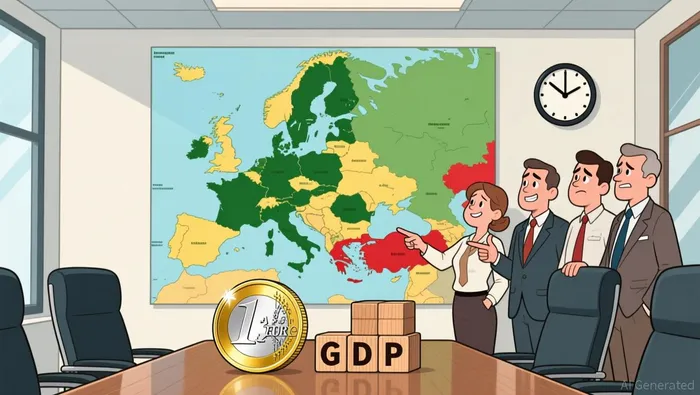 The Eurozone's Q3 2025 GDP growth rate of 0.2% quarter-on-quarter, translating to 1.3% annual growth, suggests a resilient but tepid recovery. Inflation, at 2.1%, remains close to the ECB's 2% target, with projections of a decline to 1.7% in 2026 and a slight rebound to 1.9% in 2027. Unemployment, at 6.3%, has stabilized, supported by strong labor markets. The ECB has maintained its key interest rate at 2%, signaling no immediate tightening through 2026. This cautious approach reflects the central bank's recognition of the Eurozone's structural fragility.
Structural Vulnerabilities: Productivity and Debt
Despite these modest gains, the Eurozone's structural weaknesses loom large. Productivity growth remains stubbornly weak, with the region lagging behind the United States by a stark margin. Between 2019 and 2024, the Eurozone's labor productivity per hour rose by just 0.9%, compared to 6.7% in the U.S. This divergence is driven by rigid labor markets, a fragmented Single Market, and a financial system that prioritizes traditional banks over venture capital, stifling innovation in high-tech sectors like artificial intelligence.
Public debt, while near the 3% of GDP target, is not without risks. The European Commission forecasts a slight increase in the public deficit in 2025 and 2026, with moderate fiscal expansion planned for the latter. However, external headwinds-such as U.S. protectionism and Chinese competition threaten to weaken exports, complicating fiscal sustainability. These structural challenges underscore the Eurozone's limited capacity to absorb further monetary tightening.
The ECB's Policy Dilemma: Hawkish Signals and Market Sentiment
The ECB's forward guidance has been deliberately ambiguous, emphasizing a "data-dependent and meeting-by-meeting" approach. Yet recent statements from policymakers like Isabel Schnabel have injected uncertainty. Schnabel's suggestion that a rate hike might be on the table by December 2026 has shifted market expectations, with traders now pricing in a 13 basis point tightening by that date. This hawkish pivot, however, risks destabilizing a fragile recovery.
The ECB's dilemma lies in its dual mandate: maintaining price stability while supporting growth. With inflation near target and growth tepid, further tightening could exacerbate the Eurozone's structural weaknesses. For instance, higher rates might strain public finances in weaker economies or deter investment in innovation, already hampered by a risk-averse financial system.
Timing Risks: Global Uncertainties and Internal Fractures
Conclusion: A Precarious Balance
The Eurozone's ability to sustain a hawkish turn depends on its capacity to address these structural vulnerabilities. Without significant reforms-such as reducing market barriers, modernizing labor markets, and fostering innovation-the ECB's tightening could tip the economy into stagnation. For investors, the key takeaway is clear: while the ECB may inch toward higher rates in 2026, the risks of a misstep are substantial. The alignment of growth, inflation, and policy remains precarious, and the Eurozone's future hinges on whether structural reforms can keep pace with monetary tightening.







Comentarios
Aún no hay comentarios