
Albemarle's Strategic Resilience in a Lithium Winter: Navigating Oversupply and Index Benefits
The lithium market in mid-2025 is a study in contrasts: a "perfect storm" of oversupply, plummeting prices, and geopolitical tension, yet underpinned by long-term demand for energy transition technologies. For Albemarle CorporationALB-- (ALB), the world's largest lithium producer, this environment demands strategic agility. The company's recent moves—cost discipline, innovation in extraction technology, and leveraging its S&P 500 index inclusion—position it to weather the current downturn and capitalize on the lithium supercycle's eventual rebound.
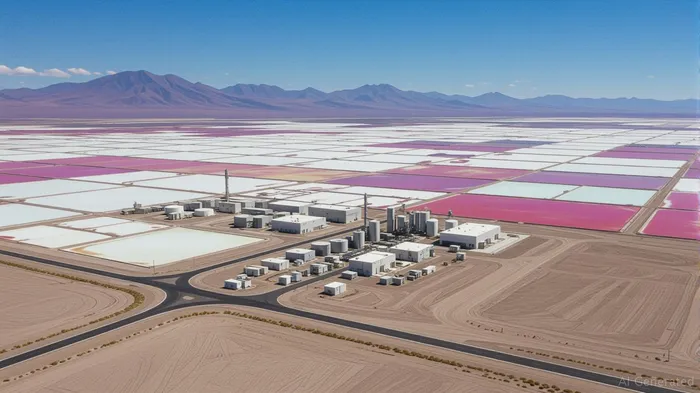
The Lithium Market Downturn: Challenges and Opportunities
Global lithium prices have collapsed from $80,000/ton in 2022 to below $12,000/ton in early 2025, driven by aggressive production expansions in Australia and China, battery inventory destocking, and sluggish EV demand growth. This oversupply—projected at 120,000 tons in 2025—has forced high-cost producers to mothball projects or exit the market. AlbemarleALB--, however, has moved decisively to insulate itself.
Key Strategic Levers:
1. Cost Leadership: Albemarle's Chilean brine operations, producing lithium at $5,000–$7,000/ton, are among the lowest-cost in the industry. By slashing capital expenditures by $1.2 billion in 2025 and achieving 90% of its $350 million cost-reduction target, the firm has maintained liquidity ($2.8 billion in cash) and operational flexibility.
2. Direct Lithium Extraction (DLE): Pilot programs in Chile and Nevada aim to reduce production costs by 30% while cutting water use by 70%. Successful commercialization by 2027 could solidify Albemarle's margin advantage, enabling profitability even at depressed prices.
3. Geopolitical Arbitrage: The Inflation Reduction Act (IRA) incentivizes U.S. lithium production, and Albemarle's Silver Peak facility (expanding to 10,000 tons/year by 2026) and paused South Carolina plant (restartable within 3–6 months) position it to meet North American sourcing mandates.
The Role of Index Inclusion: Passive Flows and Signaling
Albemarle's inclusion in the S&P 500 since 2025—despite its $6.7 billion market cap falling short of the index's $20.5 billion threshold—signals its enduring strategic importance. While the inconsistency in valuation criteria may raise questions, its inclusion likely reflects its role as a critical mineral supplier to EV and battery markets. S&P 500 membership attracts $14 trillion in passive index-tracking assets, which could stabilize ALB's stock price even amid lithium market volatility.
Risks and Considerations
- Lithium Price Recovery Timing: Analysts project a marginal deficit by 2026, but mothballed projects could restart quickly, delaying a sustained rebound.
- Execution Risk: DLE's success hinges on pilot outcomes and scalability; delays could erode Albemarle's cost edge.
- Policy Uncertainty: U.S.-China trade tensions and potential tariffs on lithium imports remain a wildcard.
Investment Thesis: A Contrarian Play on the Lithium Cycle
Albemarle's stock trades at a 38% discount to its five-year average P/E ratio, reflecting near-term pessimism. However, its low-cost Chilean assets, DLE pipeline, and IRA-aligned projects align it with the $800 billion EV battery market's 25% CAGR through 2030.
Recommendation:
- Buy: For investors with a 3–5 year horizon, ALBALB-- offers a compelling risk-reward profile. A lithium price rebound to $21,000/ton by 2026 would unlock its valuation upside.
- Hold: Short-term traders should await catalysts: DLE pilot results (2025), S&P 500 rebalancing updates, and lithium price stabilization above $12/kg.
Conclusion
Albemarle's strategic repositioning—combining cost discipline, innovation, and policy tailwinds—positions it to thrive as lithium demand recovers. While the current "winter" tests its resilience, the company's structural advantages make it a prime beneficiary of the energy transition's next phase. For investors willing to navigate near-term volatility, ALB presents a compelling contrarian opportunity in a sector ripe for consolidation.





Comentarios
Aún no hay comentarios