
AI’s Transformative Role in IT and the Future of Work: Investing in AI-Enabled Infrastructure and Upskilling Ecosystems
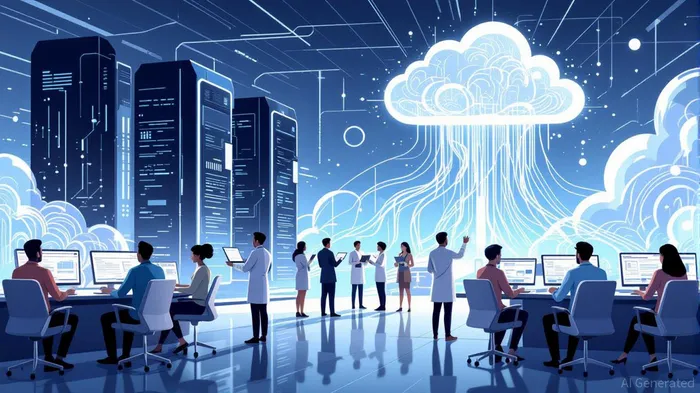
The artificial intelligence revolution is no longer a distant promise but a present-day reality reshaping global economies. By 2025, the AI-enabled IT infrastructure market has surged to $294.16 billion, with a projected compound annual growth rate (CAGR) of 29.20% over the next seven years, set to reach $1.77 trillion by 2032 [1]. This exponential growth is driven by the integration of AI into core business operations, from automating workflows to redefining decision-making. Yet, as enterprises race to adopt AI, a critical question emerges: How can investors align infrastructure investments with workforce readiness to maximize returns while mitigating risks?
The Infrastructure Revolution: Powering AI’s Ascent
AI’s transformative potential hinges on robust infrastructure capable of handling massive computational demands. NVIDIANVDA--, a dominant force in AI compute, has cemented its leadership with GPUs and specialized processors that underpin deep learning and model training [2]. Meanwhile, hyperscalers like MicrosoftMSFT-- and AmazonAMZN-- Web Services (AWS) are redefining the data center landscape. Microsoft’s $80 billion investment in AI-enabled data centers, coupled with AWS’s Trainium and Inferentia chips, underscores the urgency to scale infrastructure for AI workloads [3]. Google, too, is retrofitting facilities to meet the energy and cooling demands of AI-specific operations, a trend mirrored by traditional data center operators like Digital RealtyDLR-- and EquinixEQIX-- [4].
The Stargate Initiative, a $500 billion collaboration between OpenAI, SoftBank, and OracleORCL--, epitomizes the scale of these investments. This project includes 20 AI-ready data centers in Texas, reflecting a strategic push to secure computing power and infrastructure sovereignty [5]. Such initiatives highlight a clear trend: AI infrastructure is no longer a niche market but a foundational pillar of global economic competitiveness.
The Human Dimension: Bridging the Skills Gap
While infrastructure investments are critical, their success depends on a workforce equipped to harness AI’s potential. A McKinsey report reveals that 63% of organizations now use AI tools with embedded training features, while 62% have launched in-house programs to address skill gaps [6]. This shift is not merely about technical proficiency but about fostering a culture of continuous learning. Google’s "AI Works for America" initiative, for instance, combines $25 billion in infrastructure investments with free AI training for workers and small businesses, emphasizing accessibility and regional economic revitalization [7].
AI-driven training platforms are further personalizing upskilling. Adaptive learning systems, virtual mentors, and intelligent tutoring tools enable employees to progress at their own pace, addressing individual performance gaps [8]. For example, DHL Express and Bank of AmericaBAC-- have leveraged AI to create hyper-personalized learning experiences, resulting in measurable gains in engagement and productivity [9]. These case studies underscore a pivotal insight: AI’s value is amplified when paired with strategic workforce development.
Synergies for Investors: Where Infrastructure Meets Upskilling
The most compelling opportunities lie in the intersection of infrastructure and human capital. Consider Microsoft’s collaboration with EchoStarSATS-- Hughes, where AI automated sales call auditing and field services, saving 35,000 work hours and boosting productivity by 25% [10]. Similarly, McDonald’sMCD-- reduced training time by 70% using AI-driven platforms, while AdobeADBE-- reported a 40% increase in employee satisfaction through personalized learning paths [11]. These outcomes highlight a symbiotic relationship: AI infrastructure enables operational efficiency, while upskilling ensures employees can leverage these tools effectively.
However, challenges persist. Infrastructure constraints, such as data center shortages and energy demands, remain a top barrier for 44% of organizations [12]. Meanwhile, only 1% of companies consider their AI deployment mature, despite 92% increasing investments [13]. This gap between aspiration and execution underscores the need for a balanced approach. Investors must prioritize companies that not only build cutting-edge infrastructure but also integrate workforce training into their AI strategies.
The Path Forward: Strategic Recommendations
For investors, the key lies in identifying firms that align infrastructure innovation with upskilling ecosystems. NVIDIA and AMDAMD--, with their expanding AI chip portfolios, represent foundational bets. Meanwhile, hyperscalers like Microsoft and AWS offer exposure to both compute and cloud services. On the workforce front, platforms like SnowflakeSNOW-- and Scale AI, which enable data management and training, are critical enablers.
Public-private partnerships also warrant attention. Google’s Pittsburgh initiative, combining data center investments with localized training, demonstrates how infrastructure can catalyze regional economic growth [14]. Similarly, PwC’s emphasis on building trust in AI through comprehensive training programs highlights the importance of cultural adaptation [15].
Conclusion
AI’s transformative role in IT and the future of work is no longer speculative—it is a reality demanding strategic investment. As infrastructure scales and workforce upskilling accelerates, the winners will be those who recognize the interdependence of these two domains. For investors, the imperative is clear: back companies that not only build the engines of AI but also empower the people who will drive its potential.
Source:
[1] Artificial Intelligence Market Size, Growth & Trends by... [https://www.fortunebusinessinsights.com/industry-reports/artificial-intelligence-market-100114]
[2] Top 9 AI Infrastructure Companies & Applications [https://research.aimultiple.com/ai-infrastructure-companies/]
[3] What Companies Are Building AI-Ready Data Centers? [https://174powerglobal.com/blog/how-are-companies-building-ai-ready-data-centers-the-infrastructure-race-reshaping-digital-computing/]
[4] The 25 Hottest AI Companies For Data Center And Edge [https://www.crn.com/news/ai/2025/the-25-hottest-ai-companies-for-data-center-and-edge-the-2025-crn-ai-100]
[5] Inside 2025's Already Historic AI Infrastructure Investments [https://empirixpartners.com/the-trillion-dollar-horizon/]
[6] AI in the workplace: A report for 2025 [https://www.mckinsey.com/capabilities/mckinsey-digital/our-insights/superagency-in-the-workplace-empowering-people-to-unlock-ais-full-potential-at-work]
[7] AI Works for America, a Workforce Development Initiative [https://learnworkecosystemlibrary.com/initiatives/aiworksforamerica/]
[8] AI and the Future of Workplace Training: 2025's Game [https://www.shiftelearning.com/blog/ai-trends-elearning-workplace-learning]
[9] Case Studies: How Major Corporations Are Using AI to... [https://superagi.com/case-studies-how-major-corporations-are-using-ai-to-transform-their-training-programs-in-2025/]
[10] AI-powered success—with more than 1000 stories of... [https://www.microsoft.com/en-us/microsoft-cloud/blog/2025/07/24/ai-powered-success-with-1000-stories-of-customer-transformation-and-innovation/]
[11] Case Studies: How Top Companies Are Using AI Training Content Generators... [https://superagi.com/case-studies-how-top-companies-are-using-ai-training-content-generators-to-boost-employee-engagement-and-productivity-in-2025/]
[12] 2025 State of AI Infrastructure Report [https://www.flexential.com/resources/report/2025-state-ai-infrastructure]
[13] AI in the workplace: A report for 2025 [https://www.mckinsey.com/capabilities/mckinsey-digital/our-insights/superagency-in-the-workplace-empowering-people-to-unlock-ais-full-potential-at-work]
[14] AI Works for America, a Workforce Development Initiative [https://learnworkecosystemlibrary.com/initiatives/aiworksforamerica/]
[15] AI Integration and Upskilling - Workforce [https://www.pwc.com/gx/en/services/workforce/ai-integration-and-upskilling.html]





Comentarios
Aún no hay comentarios