
The AI Revolution and Copper's New Era: Strategic Implications for the Tiny Copper ETF
The artificial intelligence (AI) revolution is reshaping global commodity markets, with copper emerging as a critical linchpin in the infrastructure required to sustain this technological leap. As AI-driven data centers proliferate, their voracious appetite for copper is creating a structural shift in demand, outpacing traditional industrial consumption. This transformation has profound implications for investors, particularly those targeting the Tiny Copper ETF (COPJ), a vehicle uniquely positioned to capitalize on the confluence of AI infrastructure investment and copper's evolving role as a strategic commodity.
The AI-Driven Surge in Copper Demand
Hyperscale data centers, the backbone of AI infrastructure, are redefining copper consumption. A single such facility can require up to 50,000 tons of copper-far exceeding the 5,000 to 15,000 tons typical of conventional data centers. By 2030, AI-driven data centers could consume over 500,000 metric tons of copper annually, accounting for a significant share of global demand. This surge is inelastic, as copper's role in power transmission, cooling systems, and high-capacity wiring makes it indispensable for AI operations.
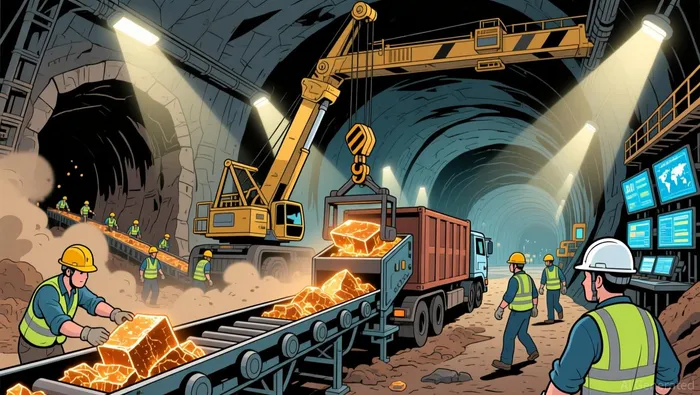 The structural nature of this demand is underscored by its indifference to price. Copper constitutes less than 0.50% of total data center project costs, enabling developers to absorb price increases without altering their investment strategies. As a result, copper prices have surged to record highs, exceeding $12,000 per metric ton on the London Metal Exchange in 2025. Analysts project this trend to persist, with JPMorgan forecasting an average of $12,075 per metric ton through 2026.
Supply Constraints and Structural Imbalances
The rapid acceleration of demand is colliding with a supply side ill-equipped to respond. Global copper supply faces a projected 30% deficit by 2035, driven by declining ore grades, lengthy mine development timelines (19 years in the U.S.), and geopolitical bottlenecks. Wood Mackenzie estimates that 8 million tons of new mining capacity and over $210 billion in investment are needed to meet rising demand. Meanwhile, discoveries of new copper deposits have dwindled, compounding the challenge.
These imbalances are not merely cyclical but structural. The U.S. has classified copper as a critical mineral for national security and energy reliability, signaling a global reorientation toward securing supply chains. Emerging markets, including India and Vietnam, are further amplifying demand through infrastructure and power grid expansion. Together, these factors reinforce copper's transition from a cyclical commodity to a cornerstone of long-term economic and technological growth.
Strategic Positioning of the Tiny Copper ETF
The Tiny Copper ETF (COPJ) is uniquely aligned with these dynamics. Unlike broad commodity indices, COPJCOPJ-- focuses on junior copper miners, which are more sensitive to price movements and supply-demand imbalances. Its equal-weight structure, spanning approximately 50 companies, amplifies exposure to smaller firms poised to benefit from the AI-driven copper boom. This strategy proved lucrative in 2025, with COPJ surging 109% year-to-date, outperforming even established ETFs like the Global X Copper Miners ETFCOPX-- (COPX), which gained 95.3%.
COPJ's performance reflects the operating leverage inherent in a tight copper market. As prices rise, junior miners with lower production costs and higher margins can scale rapidly, translating price gains into outsized returns for investors. This dynamic is further bolstered by AI's role in optimizing mining operations. AI-driven systems are projected to increase copper mining efficiency by 20% by 2025, enhancing productivity and safety while reducing operational bottlenecks.
Broader Implications for Commodity Markets
The AI-driven copper surge is part of a larger reconfiguration of commodity markets. Electrification, decarbonization, and digitalization are converging to create a "super-cycle" for base metals, with copper at its core. For investors, this necessitates a shift from short-term speculation to long-term strategic positioning. COPJ's focus on junior miners offers a liquid, diversified pathway to participate in this structural shift, mitigating the risks of individual stock exposure while aligning with macroeconomic trends.
However, the path is not without risks. Geopolitical tensions, regulatory hurdles, and environmental concerns could disrupt supply chains or delay new projects. Yet, given the inelasticity of AI-driven demand and the slow pace of supply-side adjustments, these risks are likely to be secondary to the overarching trend of copper's strategic importance.
Conclusion
The AI revolution is not merely a technological transformation but a redefinition of global commodity markets. Copper, once a cyclical industrial input, has become a strategic asset underpinning the infrastructure of the digital age. For investors, the Tiny Copper ETF represents a compelling vehicle to navigate this shift, offering exposure to a sector where demand is inelastic, supply is constrained, and growth is structural. As AI continues to reshape economies, COPJ's alignment with these forces positions it as a key player in the new era of commodity investing.







Comentarios
Aún no hay comentarios