
The AI-Driven Surge in Storage and Memory Stocks: A Strategic Buy for the Next Computing Era
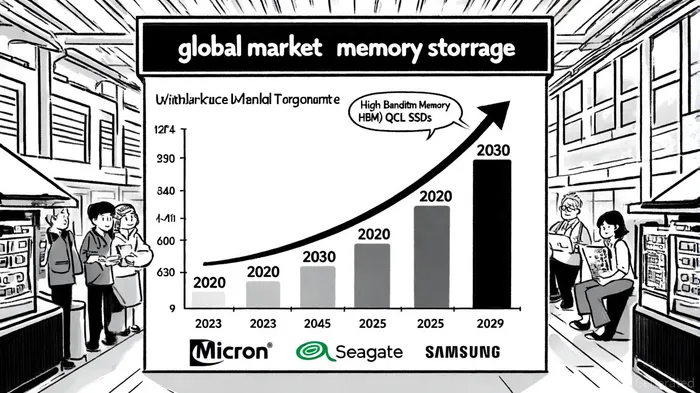
The artificial intelligence (AI) revolution is reshaping global infrastructure, and nowhere is this transformation more evident than in the storage and memory sectors. As AI models grow in complexity and data demands soar, companies specializing in high-capacity storage and high-performance memory are emerging as critical enablers of the next computing era. For investors, this presents a compelling opportunity: a long-term infrastructure play positioned to capitalize on the relentless expansion of AI-driven markets.
Storage Sector: Meeting the Appetite for Data
The surge in AI applications—from generative models to autonomous systems—has created an insatiable demand for storage solutions. Data storageDTST-- providers such as Western Digital (WDC), Seagate (STX), and SanDisk (SNDK) have seen their stocks surge in 2025, driven by the need for high-capacity hard disk drives (HDDs) and flash storage. According to a report by Investopedia, Seagate's stock has more than doubled in 2025, fueled by its leadership in supplying massive-capacity drives for hyperscale data centers[1]. Similarly, Western DigitalWDC-- has raised prices on its HDDs due to unprecedented demand, with its stock nearly doubling in the same period[1].
This growth is underpinned by the broader market's expansion. The global memory and storage technology market reached record revenues exceeding $200 billion in 2025, as AI workloads strain traditional storage architectures[2]. The shift toward QLC SSDs (quad-level cell solid-state drives) is particularly noteworthy, with hyperscale data centers adopting these cost-effective, high-performance solutions to replace traditional HDDs[3].
Memory Sector: High Bandwidth Memory (HBM) as the New Standard
While storage providers are reaping the rewards of AI's data hunger, the memory sector is witnessing a paradigm shift toward High Bandwidth Memory (HBM). HBM's ability to deliver ultra-low latency and high throughput makes it indispensable for AI training and inference tasks. As stated by a 2025 market research report from Storage Newsletter, HBMHBM-- revenue is projected to nearly double in 2025, with a 33% compound annual growth rate (CAGR) through 2030[2].
Key players like Micron Technology (MU), Samsung, and SK hynix are scaling production of advanced HBM variants (HBM3E and HBM4) to meet surging demand[2]. MicronMU--, in particular, has seen its stock soar in 2025, driven by its role in supplying HBM for AI models[3]. The sector's long-term potential is further amplified by HBM's anticipated dominance in the DRAM market, with forecasts suggesting it could capture 50% of the market by 2030[2].
Long-Term Infrastructure Investment: Why This Is a Strategic Buy
For investors seeking to position themselves for the next computing era, the storage and memory sectors offer a unique confluence of tangible demand and technological inevitability. Unlike speculative AI plays, these companies are foundational to the infrastructure enabling AI's growth.
- Market Resilience: The global memory and storage market's projected $200 billion revenue in 2025[2] underscores its resilience, even amid macroeconomic volatility.
- Scalability: QLC SSDs and HBM represent scalable solutions for AI's evolving needs, ensuring sustained relevance for early adopters.
- Diversification: Beyond data centers, AI's expansion into automotive and edge computing is creating new demand for storage solutions. For instance, AI-enabled vehicles require advanced storage for autonomous driving systems, a trend highlighted in 2025 market analyses[3].
Conclusion
The AI-driven surge in storage and memory stocks is not a fleeting trend but a structural shift in global infrastructure. As AI models grow more complex and data demands escalate, companies like SeagateSTX--, Western Digital, and Micron are poised to benefit from decades of sustained growth. For long-term investors, these stocks represent a strategic buy—a bet on the physical backbone of the AI revolution.





Comentarios
Aún no hay comentarios