
The Accelerating Tariff Pass-Through and Its Implications for US Consumer Stocks
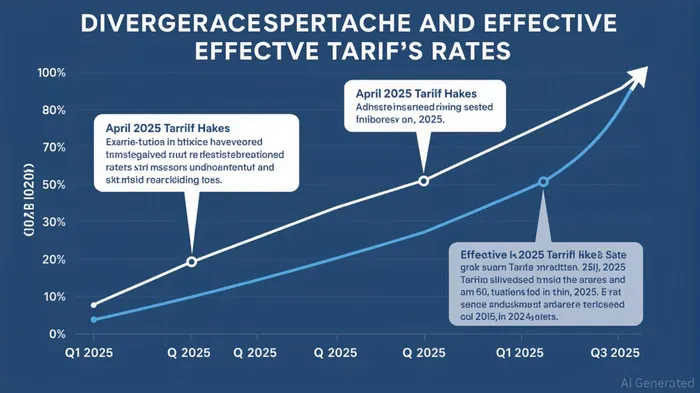
The United States is witnessing a sharp acceleration in the pass-through of tariffs to consumer prices, a trend with profound implications for equity markets. Recent data underscores a near-full transmission of tariff costs to domestic prices, with the Congressional Budget Office estimating that existing tariffs have raised overall consumer prices by 0.5%, effectively reducing average real household income by $1,300 annually . By Q3 2025, the effective tariff rate had climbed to 18%, closing the gapGAP-- with the announced rate of 16.5% by August 2025, though consumers now bear only a third of the burden, compared to 80%-90% in earlier rounds . This shift reflects a complex interplay of corporate cost absorption, global supply chain adjustments, and evolving inflationary pressures.
The Mechanism of Tariff Pass-Through
The pass-through effect has been most pronounced in sectors with thin margins and high import dependence. For instance, the Yale Budget Lab found that the 2025 tariff hikes led to a 2.1% short-term increase in the average price level, with shoe prices surging 44% and apparel prices rising 40% . These sectors, characterized by low pricing power, have little choice but to pass costs to consumers. However, the inflationary impact was initially muted by inventory stockpiling and corporate cost absorption, delaying the full effect until June 2025 . This lag highlights the importance of monitoring intermediate indicators—such as input cost inflation and corporate profit margins—to anticipate sector-specific vulnerabilities.
Sector Rotation and Supply Chain Inflation
While tariffs have traditionally been a blunt instrument, their heterogeneous effects across sectors create opportunities for strategic rotation. The Federal Reserve's June 2025 Monetary Policy Report notes that core goods inflation has reaccelerated, driven by tariffs on consumer electronics and household appliances . These sectors face dual pressures: higher input costs from imported components and reduced pricing power amid competitive markets. Conversely, sectors with strong pricing power, such as premium retail or essential goods, may fare better. For example, luxury apparel brands with brand equity could absorb some cost increases without losing market share, whereas discount retailers might struggle.
Automotive and electronics manufacturers, meanwhile, face a more nuanced landscape. While tariffs on intermediate goods raise production costs, domestic content requirements could incentivize reshoring and long-term efficiency gains. Investors must weigh these factors against near-term margin compression. The automotive sector, for instance, may benefit from government subsidies for domestic production, offsetting some tariff-driven costs.
Investment Implications
The evolving tariff landscape demands a dynamic approach to portfolio construction. Sectors with high import exposure and low pricing power—such as textiles and consumer electronics—are likely to see continued pressure on margins and stock valuations. Conversely, companies with supply chain resilience, such as those investing in automation or nearshoring, may outperform. Additionally, sectors insulated from global trade, like healthcare or services, could serve as hedges against tariff-driven volatility.
The delayed inflationary response observed in 2025 also suggests that the full impact of recent tariff hikes may not yet be priced into markets. As corporate cost absorption wanes and inventory buffers deplete, further upward pressure on consumer prices is likely, particularly in Q4 2025. This could trigger a repricing of sector valuations, favoring those with defensible margins and strategic adaptability.
Conclusion
The accelerating tariff pass-through is reshaping the US consumer landscape, with supply chain inflation acting as both a headwind and a catalyst for structural change. For investors, the key lies in identifying sectors poised to navigate these challenges through innovation, pricing power, or policy alignment. As the Federal Reserve and corporate strategists grapple with the new normal, agility in sector rotation will be paramount to capitalizing on emerging opportunities.
Source:
State of U.S. Tariffs: July 14, 2025 [https://budgetlab.yale.edu/research/state-us-tariffs-july-14-2025]
Skyrocketing tariffs: Why did inflation take so long to react? [https://blog.rangvid.com/2025/07/20/skyrocketing-tariffs-why-did-inflation-take-so-long-to-react/]
Monetary Policy Report – June 2025 [https://www.federalreserve.gov/monetarypolicy/2025-06-mpr-part1.htm]
Defying the tariff drag: 3 reasons markets are moving forward [https://privatebank.jpmorganJPM--.com/nam/en/insights/markets-and-investing/tmt/defying-the-tariff-drag-3-reasons-markets-are-moving-forward]





Comentarios
Aún no hay comentarios