
The 2026 AI Supercycle and Its Implications for the Semiconductor Sector
The global semiconductor industry is on the cusp of a transformative era, driven by the accelerating demands of artificial intelligence (AI). By 2026, the sector is projected to approach a $1 trillion valuation, with memory semiconductors-particularly high-bandwidth memory (HBM)- emerging as the linchpin of this "AI supercycle". This shift reflects not merely a technological revolution but a profound realignment of global industrial priorities, as nations and corporations vie to dominate the infrastructure underpinning the next generation of computing. For investors, understanding the strategic positioning of key players in this evolving landscape is critical to navigating both the opportunities and risks ahead.
The Memory Revolution: HBM as the New Gold Standard
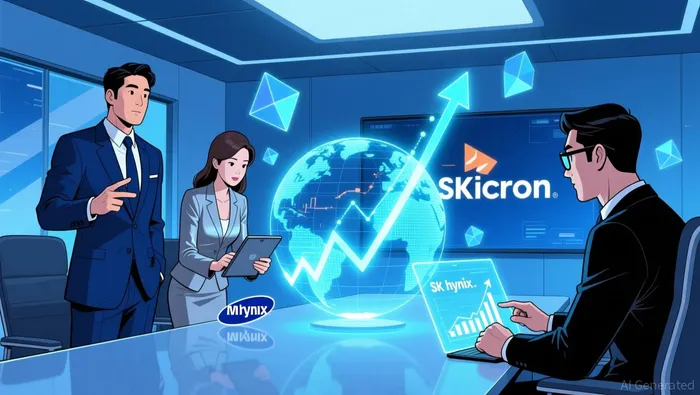
The most striking feature of the 2026 semiconductor landscape is the meteoric rise of HBM, a memory technology uniquely suited to the parallel processing demands of AI workloads. According to a report by Deloitte, the HBM market alone is expected to reach $54.6 billion in 2026, driven by hyperscalers and Big Tech companies racing to deploy AI-centric data centers. SK hynix has emerged as the dominant force in this space, commanding over 50% of the HBM market share with its leadership in HBM3E and the nascent HBM4. This dominance is underpinned by the company's aggressive investment in advanced manufacturing nodes and packaging technologies, ensuring it remains at the forefront of a sector where technical superiority translates directly into market power.
Samsung and MicronMU-- are not far behind. Samsung plans to increase its HBM production capacity by 50% in 2026, with a new fabrication facility (P5) in Pyeongtaek set to come online by 2028. Micron, meanwhile, has pivoted strategically, exiting the consumer memory and storage market to focus exclusively on AI data center customers. These moves highlight a sector-wide recalibration, as companies trade short-term diversification for long-term specialization in high-margin, AI-driven segments.
The DRAM Dilemma: Supply Constraints and Price Volatility
While HBM commands the spotlight, the broader memory market is grappling with structural imbalances. The reallocation of wafer capacity toward HBM has triggered a DRAM shortage, particularly in automotive applications, where demand for DDR5 is expected to surge by 2028. Analysts project that DRAM prices will rise by 70–100% compared to 2025 levels, creating both challenges and opportunities. For instance, Lam ResearchLRCX--, a supplier of capital equipment for HBM production, has seen its stock rally as demand for advanced manufacturing tools intensifies.
This price volatility underscores a broader theme: the semiconductor industry is transitioning from a cyclical commodity business to a capital-intensive, technology-driven sector. Companies that can secure access to cutting-edge tools and maintain tight control over their supply chains- such as SK hynix, which has received U.S. government approval for continued shipments of chipmaking equipment to China-will be best positioned to capitalize on these dynamics.
Foundries and Lithography: TSMCTSM-- and ASMLASML-- as Enablers of the Supercycle
The AI supercycle would be impossible without the foundational role of foundries and lithography equipment. TSMC, the world's largest contract chipmaker, is expanding its capacity for advanced packaging technologies like CoWoS and SoIC to meet surging demand for AI accelerators. The company's planned N2P and A16 process nodes, optimized for high-performance computing (HPC), will further solidify its leadership in the 2nm era. Meanwhile, ASML's High-NA EUV lithography systems, expected to ship in 2026, will be critical to enabling the next generation of AI chips, reducing costs and improving energy efficiency.
These developments highlight a symbiotic relationship between foundries and equipment manufacturers. TSMC's ability to scale advanced packaging and process nodes is contingent on ASML's lithography innovations, while ASML's revenue growth depends on TSMC's capacity expansion. For investors, this interdependence suggests that both companies are essential components of the AI infrastructure value chain.
Geopolitical Risks and Strategic Resilience
Despite the sector's optimism, geopolitical risks loom large. The U.S. government's temporary approval of chipmaking tool shipments to China for Samsung and SK hynix in 2026 illustrates the fragility of global supply chains. While this reprieve allows these firms to maintain production in China, long-term uncertainties-such as export restrictions on deep-ultraviolet (DUV) tools-could disrupt their operations. Similarly, China's own semiconductor ambitions, particularly in DDR5 memory, pose a potential threat to the dominance of Western firms.
Strategic resilience, therefore, is not just about technological leadership but also about geopolitical agility. Companies that diversify their manufacturing footprints, secure access to critical materials, and navigate regulatory hurdles with foresight will outperform peers in this high-stakes environment.
Conclusion: Strategic Positioning for the AI Era
The 2026 AI supercycle represents a defining moment for the semiconductor industry. For investors, the key to success lies in identifying firms that are not merely riding the wave but actively shaping its trajectory. SK hynix's dominance in HBM, Samsung's and Micron's strategic realignments, TSMC's foundry leadership, and ASML's lithography innovations collectively form a mosaic of competitive advantage. Yet, these opportunities come with risks-supply constraints, price volatility, and geopolitical tensions-that demand careful scrutiny.
As the sector transitions from speculative hype to structural expansion, the companies that combine technical excellence with strategic foresight will emerge as the true beneficiaries of the AI supercycle. For those willing to look beyond short-term noise, the semiconductor sector offers a compelling case for long-term investment.





Comentarios
Aún no hay comentarios