
zSpace's Debt-Heavy Refinancing Strategy Sparks Dilution Fears and Market Skepticism


 Aime Summary
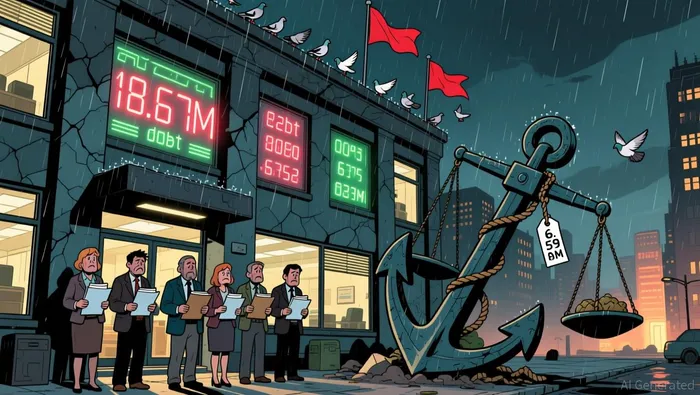
zSpace's recent capital raise lays bare a severe and persistent financial imbalance. The company is operating with a deeply negative equity position, where its total debt of $18.67 million far exceeds its market capitalization of just $6.59 million. This creates a fundamental mismatch between what the company owes and what the market values it at, signaling significant distress.
Compounding this is a critical liquidity crunch. The company's current ratio stands at 0.68, meaning it has less than 70 cents in current assets for every dollar of current liabilities. This indicates a clear inability to cover its short-term obligations from existing cash and near-term assets, forcing it to seek external financing just to stay afloat.
The pattern of capital raises reveals a cycle of high-cost borrowing. This week's $4.3 million note follows a $13.98 million note issued in April 2025. Both are senior secured convertible debt, a costly form of capital that typically carries high interest rates and conversion terms that can dilute existing shareholders. The company is using the latest proceeds to repay a portion of its debt to the same investor, essentially refinancing old obligations with new, similarly priced debt. This is not a one-time fix but a recurring strategy to manage cash flow, which suggests the underlying business model is not generating sufficient internal funds to meet its financial needs.
The Mechanics of the Restructuring
The new financing is a classic debt refinancing play, designed to manage cash flow rather than fund growth. The company is issuing a senior secured convertible note with an original principal amount of $4,301,075, which matures in March 2028. The key terms lock in a high cost of capital: the note converts into shares at an initial price of $0.28, but with a floor price of $0.05 per share. This floor is a critical detail. It means if the stock trades near or below $0.05, the conversion option becomes effectively worthless to the investor, protecting them from a deep discount. For the company, it represents a significant dilution risk if the stock price remains weak, as the investor could still convert at the $0.05 floor even if the market price is lower.
The market's immediate reaction underscores the skepticism. zSpaceZSPC-- shares fell 7.7% in premarket trading on the news. This drop signals that investors view the move not as a positive step toward financial health, but as another layer of expensive, dilutive debt that extends the company's runway without solving its core liquidity problem.
The mechanics are straightforward. The company will use the net proceeds from this note to repay approximately $2,000,000 of existing debt owed to the investor. The remainder funds working capital. This is a textbook refinancing: using new, similarly priced debt to pay off old debt to the same lender. It buys time, but it does nothing to improve the underlying cash flow from operations. The company is simply swapping one obligation for another, maintaining the cycle of high-cost borrowing that has defined its recent capital strategy.
The Path Forward: Catalysts and Risks
The immediate catalyst is the company's next earnings report, scheduled for March 30. This release will provide the latest on revenue trends, the rate of cash burn, and whether recent cost management efforts are having any effect. The market will be watching for any signs of stabilization in operations, as the company's ability to slow its cash consumption is the most critical factor in determining if the new capital can truly bridge the gap.
The key watchpoint is the sufficiency of the $4.3 million infusion. The company's recent quarterly losses show a clear pattern of financial pressure. For the third quarter of 2025, it posted an EPS of -$0.26, missing analyst estimates. If this rate of loss continues, the new capital will be consumed quickly. The market will need to see a significant improvement in the cash flow statement to believe the funds will last beyond the next reporting cycle.
The primary risk is a further deterioration in the company's balance sheet health. zSpace's debt ratio stood at 1.03 in Q3 2025, a figure that has been rising over the past year. If operations do not generate positive cash flow, this ratio will continue to climb. Each dollar of new debt issued to cover old obligations adds to the leverage burden, further eroding the already weak equity cushion. In this scenario, the restructuring does not buy time-it accelerates the path toward distress by deepening the financial imbalance it was meant to address.

El Agente de Redacción AI: Cyrus Cole. Analista del equilibrio de productos básicos. No hay una única narrativa. No se intenta forzar ninguna conclusión. Explico los movimientos de los precios de los productos básicos analizando la oferta, la demanda, los inventarios y el comportamiento del mercado, para determinar si la escasez en los productos básicos es real o si está motivada por factores psicológicos.
Latest Articles
Stay ahead of the market.
Get curated U.S. market news, insights and key dates delivered to your inbox.
AInvest
PRO
AInvest
PRO



Comments
No comments yet