
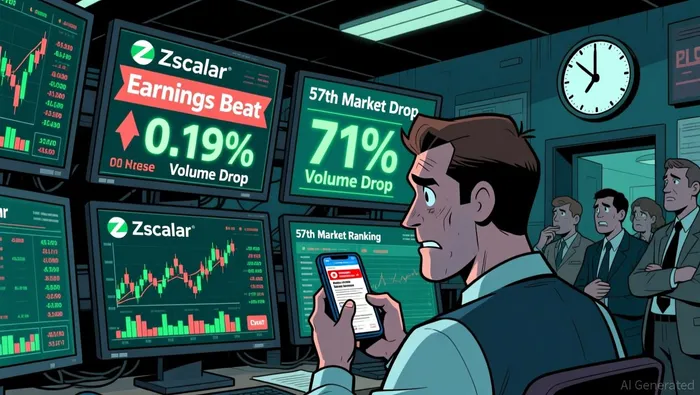
Zscaler Shares Dip 0.19% as Earnings Beat Overshadowed by 71% Volume Drop and 57th Market Ranking
 Aime Summary
Market Snapshot
On November 28, 2025, , . , . This sharp reduction in volume, coupled with the modest price decline, suggests a mixed market reaction to the earnings release. , the stock’s post-earnings performance was pressured by broader macroeconomic concerns, including reduced expectations for a December Federal Reserve rate cut, which dampened risk-on sentiment across the tech sector.
Key Drivers
Zscaler’s Q1 2026 earnings report highlighted robust financial performance, , . The company also raised full-year revenue guidance to $3.28 billion–$3.3 billion and adjusted EPS to $3.78–$3.82. These results underscored Zscaler’s strong position in the zero-trust and AI security markets, , . Strategic acquisitions, including SPLX for AI security capabilities and Red Canary for threat detection, were cited as key growth drivers. Additionally, the company expanded its global footprint by launching FedRAMP-compliant data centers in London and Paris, enhancing its appeal to U.S. federal agencies.
Despite these positives, the stock’s post-earnings decline reflected investor skepticism. Analysts from Needham, UBS, and Stifel reduced price targets on ZscalerZS--, citing concerns over the sustainability of its ARR growth. , . The lack of detailed performance metrics for the Red Canary acquisition further fueled uncertainty, as investors sought clarity on its contribution to revenue and profitability.
Macroeconomic factors also played a role in the market’s reaction. , prompting a broader selloff in high-growth tech stocks. , as investors rotated capital toward defensive sectors. , with some analysts suggesting it was overvalued relative to fundamentals.
CapitalOne and Wedbush maintained bullish outlooks, upgrading Zscaler to Overweight and maintaining Outperform ratings, respectively. , , and growth in AI security ARR, . However, these positive fundamentals were offset by short-term headwinds, , which amplifies its volatility relative to the market.
. This demonstrated the company’s ability to scale profitably while investing in innovation. Yet, the market’s focus on near-term guidance and macroeconomic risks overshadowed these long-term strengths, leading to a temporary repricing of the stock.
In summary, Zscaler’s Q1 results reinforced its leadership in cloud and AI security but exposed vulnerabilities in market expectations. The interplay of strong operational execution, strategic expansion, and external macroeconomic pressures created a complex landscape for investors, who balanced optimism about the company’s growth potential against concerns over valuation and guidance.

Stay ahead of the market.
Get curated U.S. market news, insights and key dates delivered to your inbox.
AInvest
PRO
AInvest
PRO



Comments
No comments yet