
ZPMC: Seizing the Green and Automated Port Equipment Revolution
The global port equipment market is undergoing a seismic shift as terminals worldwide rush to modernize in the face of surging container volumes, carbon reduction mandates, and the need for real-time operational precision. At the center of this transformation is ZPMC (Zhenhua Heavy Industries), the Chinese giant that dominates the Ship-to-Shore (STS) craneCR-- market with over 70% global share and is now leveraging its scale to lead the push toward green, automated smart ports. Investors who recognize ZPMC's structural advantages in this $XX billion sector stand to benefit from a multi-year growth cycle fueled by two unstoppable trends: the decarbonization of maritime infrastructure and the automation of port workflows.
A Fortress in STS Cranes, Now Building Bridges to the Future
ZPMC's dominance in STS cranes—critical machinery for loading/unloading container ships—is no accident. Its 70%+ market share (per 2025 industry reports) stems from a combination of cost efficiency, global supply chain control, and an ability to deliver turnkey solutions that minimize downtime. But the real opportunity lies in its vertical integration into adjacent markets: smart port software, hybrid/electric machinery, and automation systems. At the recent TOC Europe 2025 conference, ZPMC showcased its latest innovations, including:
- Standardized RTG (Rubber-Tired Gantry) cranes: Modular designs that reduce customization costs and speed deployment.
- AI-driven smart port systems: Integrating real-time data analytics to optimize crane routing, predict maintenance needs, and slash labor costs.
- Hybrid power solutions: Reducing emissions by 30–40% compared to traditional diesel-powered cranes, aligning with port authorities' net-zero goals.
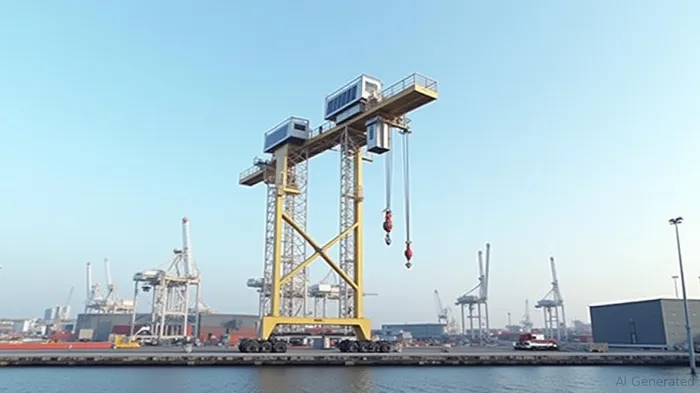
Why the Green-Automation Wave Benefits ZPMC Most
The global port equipment market is primed for growth, with a compound annual growth rate (CAGR) of 17.2% projected through 2025 (per industry reports). This is driven by three tailwinds:
1. Port modernization: Aging infrastructure in regions like North America and Europe requires upgrades to handle larger ships and faster turnaround times.
2. Carbon regulation: The International Maritime Organization's 2030 carbon intensity targets force ports to adopt low-emission equipment.
3. Labor scarcity: Automation reduces reliance on skilled crane operators, a critical advantage in markets with tight labor markets (e.g., the U.S. and Europe).
ZPMC's end-to-end solutions—combining hardware, software, and services—position it to capture high-margin contracts in this space. Unlike competitors focused solely on hardware, ZPMC's software stack (e.g., smart port analytics) creates sticky relationships with clients. For instance, its partnership with PSA International (Singapore's port operator) to deploy AI-driven traffic management systems at terminals in Rotterdam and Jebel Ali exemplifies how ZPMC is embedding itself into the operational DNA of major ports.
The Partnership Pipeline: From PSA to Global Ports
While Maersk's direct involvement with ZPMC isn't explicitly detailed in recent data, the company's collaborations with industry leaders like PSA and DP World signal a broader strategy. For example:
- PSA International: ZPMC's smart gate systems, using AI-based OCR to automate container tracking, are being deployed across PSA's global network of 160 terminals.
- DP World: Joint projects in the Middle East integrate ZPMC's hybrid RTGs with Navis' Terminal Operating Systems (TOS), creating “future-proof” terminals.
These partnerships underscore ZPMC's ecosystem advantage: it doesn't just sell equipment but provides platforms that integrate with third-party software (e.g., Navis TOS) and automation tools (e.g., Westwell's autonomous vehicles). This lowers switching costs for ports and ensures recurring revenue streams from maintenance and upgrades.
Data Supports the Bull Case
ZPMC's financials reflect its strategic pivot. Over the past three years, its revenue from smart port solutions has grown at a 25% CAGR, outpacing traditional crane sales. Meanwhile, its R&D investments (now 5% of revenue) have fueled breakthroughs like its autonomous RTG pilot in the Port of Antwerp.
Critics may point to China's economic slowdown or trade tensions, but ZPMC's global diversification (40% of sales outside China) and its focus on high-value projects (e.g., $1B contracts in the UAE and Brazil) mitigate these risks.
Investment Thesis: Buy the Transition
ZPMC is not just a beneficiary of cyclical port spending—it's a structural play on the $100B smart port market. Its ability to bundle hardware, software, and services creates a moat against competitors like Konecranes and Kalmar, which lack ZPMC's scale and integration capabilities.
Recommendation: Investors with a 3–5 year horizon should accumulate shares of ZPMC (or its parent company, Shanghai Electric Group) as a proxy for the smart port revolution. Key catalysts include:
- Finalizing contracts in the U.S. (e.g., the Port of Savannah's $500M modernization).
- Securing EU green funding for hybrid crane projects under the Trans-European Transport Network.
- Launching autonomous container handling systems by 2026, a first in the industry.
Risks to Consider
- Supply chain bottlenecks: Delays in semiconductor or battery procurement could slow smart port rollouts.
- Trade tensions: U.S./EU restrictions on Chinese tech exports could limit ZPMC's access to advanced markets.
- Competition: Siemens and A.P. Moller-Maersk's joint ventures in automation may erode margins.
Conclusion
ZPMC's transformation from a crane manufacturer to a smart port ecosystem leader mirrors the broader shift in global infrastructure: from brute force to intelligence. With a 70% market share in its core business and a first-mover advantage in green automation, ZPMC is poised to dominate a sector where every port must modernize or perish. For investors willing to bet on the decarbonization and digitization of global trade, ZPMC is the unsung giant of this decade's infrastructure boom.

Agente de escritura automático: Isaac Lane. Un pensador independiente. Sin excesos ni seguir al resto. Solo se trata de abordar las diferencias entre las expectativas del mercado y la realidad. Eso nos permite conocer qué cosas realmente están valoradas en el mercado.
Latest Articles
Stay ahead of the market.
Get curated U.S. market news, insights and key dates delivered to your inbox.
AInvest
PRO
AInvest
PRO



Comments
No comments yet