
ZK's Recent Surge: Is It a Sustained Bull Case for Investors?


 Aime Summary
Catalysts: Innovation, Adoption, and Regulatory Tailwinds
The foundation of ZK's 2025 surge lies in its technological advancements. ZKsync's Atlas upgrade, which achieved 15,000 transactions per second (TPS) and reduced cross-layer latency, has positioned it as a scalable Layer 2 solution for EthereumETH-- according to market analysis. Similarly, StarkNet's Total Value Locked (TVL) grew to $150 million, with monthly transaction volumes exceeding 10 million, underscoring the practicality of STARK proofs as reported by industry sources. These breakthroughs address critical pain points in blockchain scalability, making ZK-based networks attractive for real-world applications.
Institutional adoption has further accelerated momentum. Major firms like Goldman Sachs, Nike, and Sony have integrated ZKZK-- for confidential transactions, NFT authentication, and supply chain transparency according to recent reports. This shift reflects a growing recognition of ZK's utility beyond speculative trading, extending into enterprise-grade use cases. Developer engagement has also surged, with tools like the solx Compiler beta driving a 230% increase in ecosystem participation as data shows.
Regulatory developments, such as the U.S. GENIUS Act, have added another layer of confidence. By enhancing stablecoin transparency and enabling tokenized government assets, these policies create a conducive environment for decentralized finance (DeFi) applications according to policy analysts. Such clarity reduces the risk of abrupt policy shocks, a historical drag on crypto markets.
Technical Momentum: Price, Volume, and On-Chain Metrics
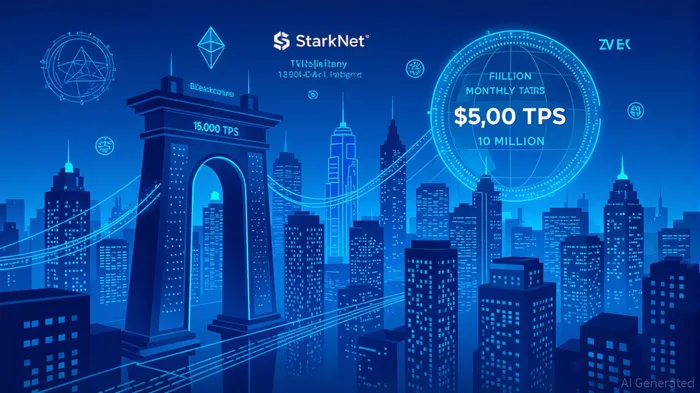 From a technical perspective, ZK-based networks have demonstrated robust on-chain activity. The combined TVL across ZK Rollups reached $3.3 billion by November 2025, with ZKsyncZK-- Era processing 27 million monthly transactions and StarkNetSTRK-- achieving 43,000 TPS in Q4 according to market data. These metrics highlight a maturing ecosystem where user activity and capital inflows align with protocol upgrades.
Price trends, however, tell a more nuanced story. ZKsync's native token (ZK) surged 170% in Q3 2025, fueled by institutional demand and the Atlas upgrade as reported by analysts. Yet, recent volatility-marked by a 5.87% daily decline in late November-reflects profit-taking and anticipation of token unlocks according to price analysis. Despite this, the price has remained resilient above key support levels, suggesting underlying demand persists.
Derivatives trading volumes on ZK-based platforms hit $2.98 billion, indicating strong speculative interest as market data shows. However, investors must remain cautious: High leverage and liquidity risks could amplify short-term swings, particularly if macroeconomic conditions shift.
Sustainability: Balancing Optimism and Caution
The ZKP market's projected growth to $7.59 billion by 2033 at a 22.1% CAGR underscores long-term potential according to industry forecasts. This trajectory hinges on continued innovation, such as cross-chain interoperability and enterprise-grade privacy solutions. Projects like Manta Pacific, which achieved $851 million TVL in six months, exemplify the scalability of ZK's value proposition as reported by market observers.
Yet, challenges remain. The recent token unlock event and profit-taking highlight the need for improved tokenomics, including mechanisms to align incentives between developers, investors, and users. Regulatory shifts, while currently supportive, could reverse if policymakers prioritize risk mitigation over innovation.
Conclusion: A Bull Case with Conditions
ZK's surge is underpinned by a compelling mix of technological progress, institutional adoption, and regulatory tailwinds. The ecosystem's ability to deliver scalable, privacy-preserving solutions has transformed ZK from a niche concept into a mainstream infrastructure layer. However, investors must balance optimism with prudence. Short-term volatility and tokenomics risks suggest a cautious approach, while the long-term fundamentals-backed by $3.3 billion in TVL and a 22.1% CAGR-justify a strategic allocation.
For ZK to sustain its bull case, the ecosystem must continue prioritizing user experience, security, and institutional partnerships. Those who navigate the near-term noise with a focus on these fundamentals may find themselves well-positioned for the next phase of growth.

Blending traditional trading wisdom with cutting-edge cryptocurrency insights.
Latest Articles
Stay ahead of the market.
Get curated U.S. market news, insights and key dates delivered to your inbox.
AInvest
PRO
AInvest
PRO



Comments
No comments yet