
ZK's Recent Price Surge: Is This a Sustainable Bull Run or a Short-Lived Hype?


 Aime Summary
On-Chain Analytics: TVL, Transaction Volume, and Active Addresses
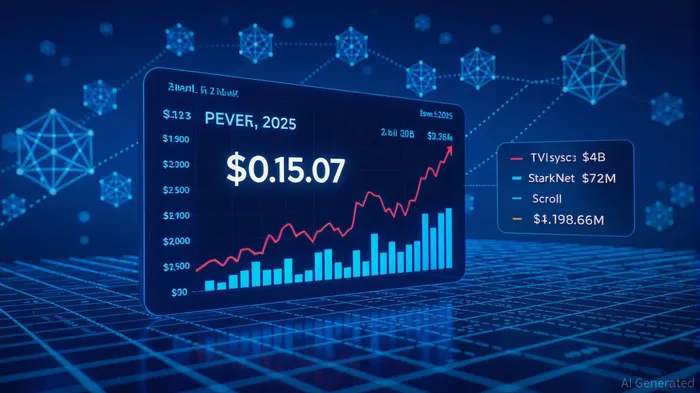
ZK-based ecosystems, particularly ZKsyncZK--, have demonstrated robust on-chain metrics. ZKsync's Total Value Locked (TVL) now exceeds $4 billion, with 700 million transactions processed across its 18-chain network, according to ZKsync's website. This growth is underpinned by institutional adoption, including Deutsche Bank and SonySONY--, which leverage ZK-rollups for compliance-driven blockchain solutions, as Bitget notes. Meanwhile, StarkNet's TVL tripled in Q4 2025, partly due to $72 million in BTCBTC-- bridged into its ecosystem, as Bitget reports.
Transaction volume for the ZK token itself has spiked, with $246 million traded on Kraken in the last 24 hours, according to Kraken's ZKSync price page. However, ZKsync's active addresses tell a mixed story: daily active addresses dropped 63% quarter-over-quarter in Q4 2024, attributed to reduced airdrop incentives, as the Messari Q4 2024 report notes. In contrast, StarkNet's daily transactions surged 300% in 30 days, reaching 900,000, according to Blockchain Reporter, while Scroll's TVL stands at $198.66 million, albeit with volatile active address growth, as DefiLlama notes.
Institutional Adoption and Macroeconomic Drivers
The ZK ecosystem's appeal lies in its ability to address institutional pain points. ZKsync's updated tokenomics model ties the ZK token to network revenue, creating a "value flywheel" that incentivizes long-term adoption, as the Tekedia article explains. This aligns with macroeconomic trends: privacy-focused ZK solutions are increasingly adopted by banks and asset managers seeking to transact on public infrastructure without compromising data confidentiality, as Yellow notes.
Deutsche Bank and Sony's integration of ZK-rollups highlights the technology's scalability and regulatory compliance advantages, as Bitget reports. Meanwhile, ZKsync's Atlas upgrade achieved 43,000 TPS with near-zero fees, outpacing competitors like Polygon's Rio upgrade (5,000 TPS), as Bitget reports. These advancements position ZK as a critical infrastructure layer for both DeFi and enterprise applications.
Ecosystem Competition: ZKsync vs. SolanaSOL--, Base, and Scroll
While ZKsync dominates institutional use cases, other Layer 2 solutions like Solana and Base are gaining traction. Solana processed 66.9 million transactions in a single day in late 2024, with DEX volume hitting $3.8 billion, as Yellow notes. Base, Ethereum's Layer 2, captured 18% of L2 TVL by late 2024, as Yellow notes. However, ZKsync's focus on privacy and real-world asset tokenization gives it an edge in enterprise adoption, according to ZKsync's website.
Scroll, another ZK-rollup, faces challenges despite EVM compatibility. Its TVL of $198.66 million lags behind ZKsync and StarkNetSTRK--, and active address growth remains inconsistent, as DefiLama notes. StarkNet's Cairo VM and zk-STARK technology offer scalability but require developers to learn a less mainstream language, creating a barrier to entry, as the Starknet report notes.
Sustainability: Bull Run or Hype?
The ZK price surge is supported by tangible metrics: rising TVL, institutional partnerships, and technological upgrades like ZKsync's Atlas and StarkNet's SN Stack, as the Tekedia article and Starknet report note. However, risks persist. ZKsync's declining active addresses and Scroll's TVL volatility suggest market saturation or speculative trading, as the Messari report and DefiLama note. Additionally, macroeconomic headwinds-such as regulatory shifts or a broader crypto market correction-could dampen momentumMMT--.
For now, the ZK ecosystem appears to be in a growth phase driven by utility and institutional demand. The key question is whether this will translate into sustained adoption or fade as a short-lived narrative. Investors should monitor TVL trends, active address growth, and institutional partnerships in the coming quarters.
Conclusion
ZK's recent surge reflects a confluence of on-chain strength, macroeconomic tailwinds, and institutional adoption. While risks like market volatility and competition remain, the ecosystem's focus on privacy, scalability, and real-world use cases suggests a foundation for long-term growth. For now, this appears to be more than just hype-it's a bull run with legs, provided the fundamentals hold.

Blending traditional trading wisdom with cutting-edge cryptocurrency insights.
Latest Articles
Stay ahead of the market.
Get curated U.S. market news, insights and key dates delivered to your inbox.
AInvest
PRO
AInvest
PRO



Comments
No comments yet