
ZK Atlas Upgrade: A Catalyst for Institutional Adoption in the Blockchain Era


 Aime Summary
The Scalability Imperative for Institutions
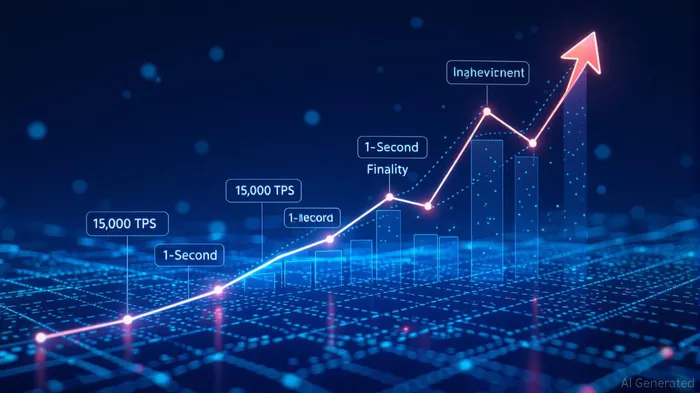
Institutional adoption of blockchain hinges on three pillars: throughput, cost efficiency, and regulatory compatibility. Traditional layer-1 blockchains like BitcoinBTC-- and EthereumETH-- struggle to meet these criteria, with networks often clogged by congestion and high gas fees. ZK-based solutions, however, offer a paradigm shift. Zero-knowledge proofs allow transactions to be validated off-chain and then batched into a single proof, drastically reducing computational load. The ZK Atlas Upgrade, developed by ZKsyncZK--, exemplifies this approach. By optimizing proof aggregation and data compression, it achieves TPS levels comparable to centralized exchanges while maintaining cryptographic security, according to a Coinopolitan article.
This scalability is not merely technical-it's economic. For institutions, faster finality reduces counterparty risk, and lower fees improve profit margins on high-frequency trades. A Coinotag report notes that ZKsync's post-upgrade performance has already attracted institutional interest, with trading volume surging past $300 million in a single day. Such metrics underscore the tangible value of ZK technologies in bridging the gap between decentralized systems and institutional expectations.
Tokenomics as a Value Capture Mechanism
Scalability alone is insufficient to entice institutions; tokenomics must also align with their long-term investment strategies. ZKsync's recent tokenomics redesign, proposed by founder Alex Gluchowski, repositions the ZK tokenZK-- from a governance-only asset to a value-capturing instrument. All network revenue-derived from transaction fees-is now allocated to token buybacks, burns, staking rewards, and ecosystem development, according to a Coinotag report. This creates a deflationary flywheel: increased usage drives higher fees, which in turn reduces the circulating supply of ZK tokens, potentially boosting their value.
This model resonates with institutional investors, who prioritize assets with clear utility and scarcity. By tying token value directly to network activity, ZKsync mirrors successful tokenomic frameworks like Uniswap's fee-sharing model. Moreover, the inclusion of staking rewards provides a yield component, addressing a key concern for capital-efficient institutions. The Coinotag report notes that this redesign has already spurred a 20% increase in ZK token holder activity, signaling confidence in the platform's sustainability.
Vitalik Buterin's Endorsement and Ecosystem Synergy
The ZK Atlas Upgrade's significance extends beyond ZKsync. Ethereum co-founder Vitalik Buterin has publicly endorsed the project, recognizing its role in advancing Ethereum's vision of a scalable, privacy-preserving blockchain ecosystem. This endorsement is critical, as institutions often gravitate toward projects with strong developer backing and interoperability with existing infrastructure. ZKsync's compatibility with Ethereum tooling and smart contracts further lowers adoption barriers, enabling institutions to migrate assets without overhauling their workflows, according to a Coinopolitan article.
Strategic Implications for Investors
For investors, the ZK Atlas Upgrade represents more than a technical milestone-it's a harbinger of broader institutional adoption. The combination of scalability, deflationary tokenomics, and ecosystem support creates a virtuous cycle: improved performance attracts users, which generates revenue, which strengthens the token's value proposition. This dynamic is particularly appealing in a post-2024 regulatory environment, where clarity on digital asset frameworks is emerging.
However, risks remain. ZK technologies are still nascent, and execution gaps could undermine expectations. Additionally, competition from other layer-2 solutions like ArbitrumARB-- and OptimismOP-- means ZKsync must continuously innovate to retain its edge. Investors should monitor metrics such as active addresses, developer activity, and institutional partnerships to gauge long-term viability.
Conclusion
The ZK Atlas Upgrade is a pivotal development in the quest to make blockchain viable for institutional capital. By solving scalability constraints and reengineering tokenomics, ZKsync has positioned itself as a bridge between decentralized innovation and institutional pragmatism. As Vitalik Buterin's endorsement and surging trading volumes suggest, the project is not just technically sound-it's strategically aligned with the next phase of crypto adoption. For investors, this alignment offers a compelling case to consider ZK-based ecosystems as part of a diversified digital asset portfolio.

Blending traditional trading wisdom with cutting-edge cryptocurrency insights.
Latest Articles
Stay ahead of the market.
Get curated U.S. market news, insights and key dates delivered to your inbox.






Comments
No comments yet