
ZK Atlas Upgrade: Blockchain Infrastructure's Next Frontier in DeFi Scalability
 Aime Summary
Technical Innovations Driving Scalability
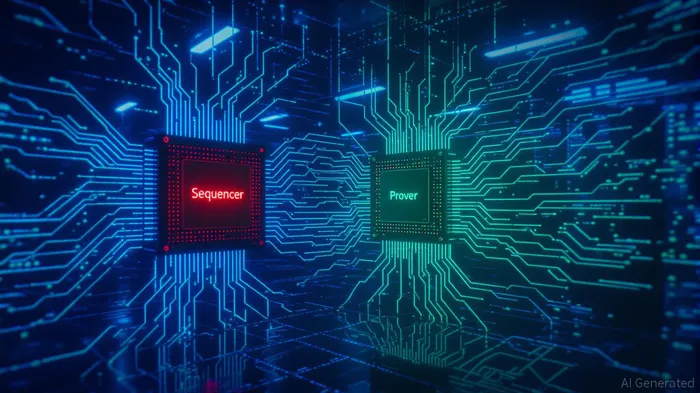
At the heart of the Atlas Upgrade lies the Atlas Sequencer, a high-speed transaction processor capable of handling 15,000–43,000 transactions per second (TPS), with finality achieved in 1–500 milliseconds according to ZKsync's technical documentation. This performance is enabled by a modular design that decouples sequencing from proof generation, allowing the sequencer to focus on transaction ordering while offloading batching and proving to asynchronous modules. This separation of responsibilities minimizes latency and maximizes throughput, a critical advancement for DeFi applications requiring real-time execution.
Complementing the sequencer is the Airbender Prover, an open-source RISC-V-based zkVM that generates zero-knowledge proofs in approximately one second. By eliminating the need to implement the VM twice (once for execution and once for proving), Airbender reduces both development complexity and proving costs. A single transfer now costs as little as $0.0001, and a single GPU can sustain over one million transactions per day. These metrics underscore ZKsync's ability to democratize access to DeFi, enabling micropayments and high-frequency trading at near-zero marginal cost.
 The zkSync OS further solidifies the upgrade's impact. This extensible operating system layer supports multiple execution environments, including EVM compatibility, while allowing future integration with WASM or RISC-V programs according to ZKsync's technical documentation. The "one program, two targets" model ensures consistency between sequencer execution and proving, reducing audit surface and enhancing security. Together, these components form a cohesive infrastructure that bridges the gap between Ethereum's security and the scalability demands of DeFi.
Real-World Impact: DeFi's New Era
The economic ramifications of the Atlas Upgrade are already evident in DeFi's operational metrics. Post-upgrade, ZKsync has facilitated seamless cross-chain interactions through succinctPROVE-- ZKZK-- proofs, eliminating the need for trust-based bridges and reducing latency. This has enabled a unified "networked economy" where liquidity flows freely between L1 and L2 ecosystems, a vision championed by EthereumETH-- co-founder Vitalik Buterin, who has called the upgrade "underrated and valuable" according to a Cointelegraph analysis.
Case studies from 2025–2026 highlight ZKsync's transformative potential. For instance, DeFi platforms leveraging the Atlas Upgrade have reported transaction costs reduced to $0.0001 per transfer, enabling high-frequency trading strategies previously unfeasible on Ethereum. Additionally, the unification of liquidity across chains has spurred the growth of cross-chain yield farming and automated market makers (AMMs), with transaction volumes surging by over 300% in the first quarter post-upgrade. These trends align with Ethereum's broader goal of creating a real-time global financial infrastructure, where ZKsync's role as a Layer 2 solution is indispensable.
Financial Projections and Investment Potential
From an investment perspective, the ZKsync token (ZK) and the broader ZKP market present compelling opportunities. Financial projections from 2025 to 2030 suggest a bullish trajectory for ZK, with the token price expected to reach $0.28 by year-end 2025 and $1.32 by 2030, assuming favorable macroeconomic conditions and technological adoption. These forecasts are underpinned by ZKsync's growing ecosystem, which includes partnerships with DeFi protocols, NFT platforms, and Web3 infrastructure providers.
However, the path to dominance is not without challenges. ZKsync faces competition from other Layer 2 solutions like ArbitrumARB-- (ARB) and OptimismOP-- (OP), which are also vying for Ethereum's scalability market according to Bitget's market analysis. Yet, ZKsync's unique value proposition-combining high throughput, low costs, and interoperability-positions it to capture a significant share of the ZKP market, projected to grow substantially in the coming years. Institutional adoption of zk-rollups, particularly in 2026, could further accelerate ZK's price trajectory, with estimates suggesting a potential peak of $0.70–$1.00 if Ethereum's Layer 2 ecosystem matures as anticipated according to Bitget's forecast.
Conclusion: A Catalyst for DeFi's Future
The ZK Atlas Upgrade is more than a technical milestone; it is a catalyst for DeFi's next phase of growth. By addressing scalability, cost, and interoperability, ZKsync has redefined the boundaries of what blockchain infrastructure can achieve. For investors, the upgrade represents a strategic opportunity to capitalize on the convergence of ZKP innovation and DeFi's expanding use cases. As Vitalik Buterin noted, the Atlas Upgrade's value lies not just in its performance metrics but in its ability to unify Ethereum's fragmented ecosystem into a cohesive, scalable network. In this new era, ZKsync's infrastructure is not merely a Layer 2 solution-it is the backbone of a decentralized financial future.

Blending traditional trading wisdom with cutting-edge cryptocurrency insights.
Latest Articles
Stay ahead of the market.
Get curated U.S. market news, insights and key dates delivered to your inbox.






Comments
No comments yet