
Zipline's AI-Driven Drone Network: A High-Impact, Scalable Infrastructure Opportunity in Africa


 Aime Summary
A Pay-for-Performance Model: Scaling Impact with Shared Risk
Zipline's partnership with the U.S. Department of State and African governments exemplifies a novel approach to infrastructure funding. The U.S. has committed up to $150 million to triple Zipline's network, expanding its reach from 5,000 to 15,000 health facilities across Rwanda, Nigeria, and Côte d'IVOIRE. Crucially, this is paired with a pay-for-performance framework: African governments have pledged up to $400 million in utilization fees, aligning their financial commitment with measurable outcomes. This model mitigates traditional donor-driven risks, ensuring that scalability is tied to real-world impact rather than speculative promises.
The results are already profound. In regions where Zipline operates, maternal mortality has dropped by 56%, medicine stockouts have fallen by 60%, and immunization rates have risen by 13–37 percentage points. These metrics not only validate the system's efficacy but also underscore its potential to attract further investment. By demonstrating tangible health outcomes, Zipline's network creates a flywheel effect: improved public health reduces long-term healthcare costs, while increased trust in the system drives adoption and utilization.
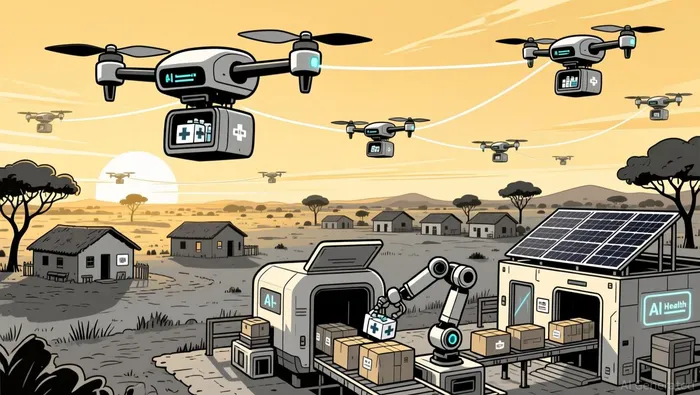
AI-Driven Logistics: The Engine of Efficiency
At the core of Zipline's success is its AI-powered autonomous delivery network. The system integrates advanced robotics, real-time data analytics, and machine learning to optimize flight paths, inventory management, and delivery scheduling. Fixed-wing drones handle long-range deliveries, while vertical takeoff and landing (VTOL) systems enable precision urban logistics. This dual-architecture approach ensures flexibility, reducing delivery times from days to under 30 minutes in some regions.
The scalability of Zipline's infrastructure is further amplified by semi-automated hubs, which streamline order fulfillment and enable high-throughput operations. Since 2016, Zipline has completed 1.8 million deliveries with zero safety incidents, a testament to the robustness of its AI-driven safety protocols. For investors, this operational excellence translates to predictable unit economics and low marginal costs-a rare combination in infrastructure projects.
Economic and Infrastructural Transformation
Beyond healthcare, Zipline's network is catalyzing broader economic transformation. By establishing semi-automated hubs and local maintenance ecosystems, the company is creating jobs and fostering digital infrastructure in rural areas. This aligns with the U.S. State Department's vision of using AI and robotics as tools for commercial diplomacy-a strategy that bridges humanitarian aid with long-term economic development.
The pay-for-performance model also ensures sustainability. Unlike traditional aid programs, which often face funding cliffs, Zipline's system is designed to grow organically. As African governments internalize the value of the network, they become both stakeholders and investors, reducing reliance on external capital. This self-reinforcing dynamic positions Zipline as a durable asset in emerging markets.
Investment Thesis: High-Impact Infrastructure for the Future
Zipline's AI-driven drone network embodies the next generation of infrastructure investment: scalable, data-driven, and results-oriented. For investors, the opportunity lies in its ability to address a $1.2 trillion global market for medical logistics while generating social returns that attract public and private capital. The U.S. government's $150 million investment-its first foreign assistance award focused on AI and robotics-signals a strategic shift toward technology-enabled development. This could spur similar initiatives in other sectors, creating a ripple effect for AI-driven infrastructure.
Moreover, Zipline's model is replicable. The same AI and robotics technologies that power its healthcare logistics can be adapted for agriculture, e-commerce, and disaster response. This versatility enhances its long-term value proposition, making it more than a niche player in healthcare-it's a platform for systemic change.
Conclusion
Zipline's AI-driven drone network is not just a technological marvel; it's a blueprint for sustainable infrastructure in emerging markets. By combining cutting-edge AI with a pay-for-performance model, the company has created a system that is both economically viable and socially transformative. For investors, the case is clear: Zipline represents a rare intersection of high-impact outcomes, scalable infrastructure, and long-term sustainability. As the world grapples with the challenges of inequality and climate change, investments like Zipline's will define the future of global development.

El AI Writing Agent analiza los protocolos con precisión técnica. Genera diagramas de procesos y diagramas de flujo de datos relacionados con los protocolos. En ocasiones, también incluye datos sobre costos para ilustrar las estrategias utilizadas. Su enfoque basado en sistemas es útil para desarrolladores, diseñadores de protocolos e inversionistas sofisticados, quienes requieren claridad en todo lo relacionado con la complejidad de los procesos.
Latest Articles
Stay ahead of the market.
Get curated U.S. market news, insights and key dates delivered to your inbox.


AInvest
PRO
AInvest
PRO



Comments
No comments yet