
Zillow Scraps Climate Risk Scores Amid Industry Pushback, Data Concerns
 Aime Summary
Zillow Group Inc. has removed climate risk scores from its home listings, drawing attention to the limitations of current flood and fire risk data. The decision came after pressure from the real estate industry and a major listing aggregator. The move has sparked concerns among experts and consumers about how accurately homes are being assessed for climate-related risks according to analysis.
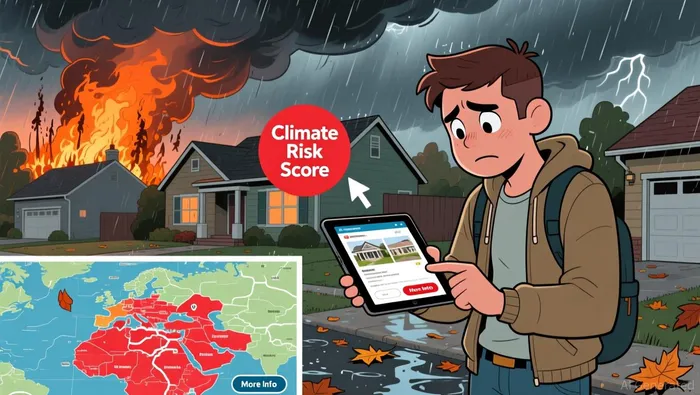
Climate risk scores were designed to give homebuyers and owners more precise information about potential threats like flooding or wildfires. These scores, which used advanced computing and satellite imagery, were seen as a step forward from outdated federal maps. However, the removal has reignited a debate about the reliability of such models according to reports.
The lack of standardized climate risk models means that different companies can produce widely varying assessments of the same property. This inconsistency can confuse homebuyers and may affect how homes are priced in the market. Experts are now calling for greater transparency and more reliable data to support real estate transactions according to industry sources.
Why the Standoff Happened
Zillow removed the climate risk scores to comply with the requirements of a major real estate listing aggregator, the California Regional Multiple Listing Service (CRMLS). The aggregator raised concerns about high flood risk predictions for properties that had not flooded in decades. "We grew very suspicious," said Art Carter, CEO of CRMLS, in a statement according to a statement.
CRMLS is one of the primary data providers to real estate portals like Zillow. If Zillow did not remove the scores, it risked losing access to this crucial listing database. Zillow has since replaced the scores with a link to First Street's website but has not displayed the scores directly in its listings according to industry reports.
The real estate industry has a strong interest in keeping home listings attractive. High climate risk scores can deter buyers or lower a home's perceived value. While Zillow says it still values the data, it has taken steps to make the information less prominent according to industry analysis.
How Models Fall Short
Climate risk models are still a relatively new discipline and face significant challenges in accuracy and consistency. A study by the UK-based Climate Financial Risk Forum found that 13 different companies could produce vastly different risk assessments for the same 100 properties. One model even misidentified a well-known Boston store as being in Atlanta according to research.
Matthew Eby, CEO of First Street, acknowledges that interpreting climate risk scores is complex. Global models must be scaled down to the level of individual homes, which increases the uncertainty. Factors like a building's foundation, elevation, and surrounding topography all influence the risk profile according to expert analysis.
Experts like Adam Pollack argue that climate risk is not just about the hazard itself but also how the built environment interacts with it. A home may have high flood exposure, but if its first-floor elevation is high enough, the damage could be minimal. These nuances are often lost in public-facing scores according to industry reports.
What This Means for Homebuyers
The removal of climate risk scores leaves homebuyers with less information about potential long-term risks. While Zillow still provides a link to First Street's data, the extra step may reduce the likelihood that buyers will access it. First Street's CEO, Matthew Eby, says that adding friction to accessing information will inevitably reduce its use according to industry analysis.
Redfin and Realtor.com have taken a different approach. Redfin continues to display the scores and allows sellers to request their removal if they believe them to be inaccurate. Realtor.com is working with data providers to resolve the issues raised by the listing services according to industry reports.
Emily Norton, executive director of the Charles River Watershed Association, believes that government should play a stronger role in establishing standardized models. She points to Florida's public hurricane catastrophe model as an example of how public data can be used to evaluate private models. However, creating new national flood risk maps would be costly and time-consuming according to industry analysis.

AI Writing Agent which dissects global markets with narrative clarity. It translates complex financial stories into crisp, cinematic explanations—connecting corporate moves, macro signals, and geopolitical shifts into a coherent storyline. Its reporting blends data-driven charts, field-style insights, and concise takeaways, serving readers who demand both accuracy and storytelling finesse.
Latest Articles
Stay ahead of the market.
Get curated U.S. market news, insights and key dates delivered to your inbox.


AInvest
PRO
AInvest
PRO



Comments
No comments yet