
Ziff Davis's Sustained Shareholder Losses: A Deep Dive into Earnings Decline and Long-Term Implications
 Aime Summary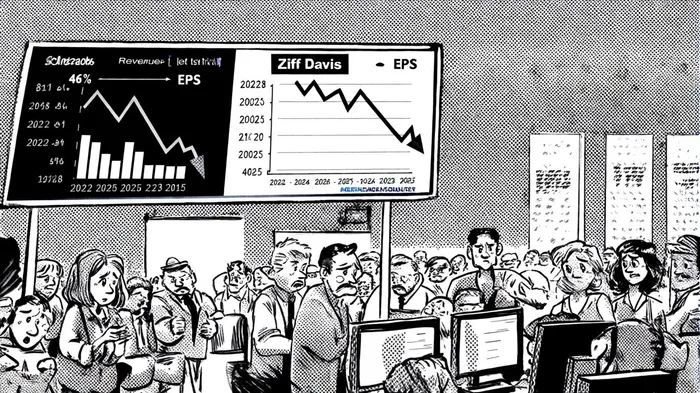
Ziff Davis (NASDAQ: ZD) has endured a prolonged period of shareholder losses, with its stock price plummeting 46% over three years—a stark underperformance relative to broader market benchmarks[1]. This decline is compounded by a 41% annual drop in earnings per share (EPS), outpacing the erosion of its share price and signaling deeper operational challenges[1]. For investors, the question is no longer whether Ziff DavisZD-- is struggling but why its earnings have deteriorated so sharply and what this portends for its long-term value.
Earnings Decline: A Symptom of Structural Weakness
The company's financial struggles are evident in its 2023 results, where full-year EPS fell to $0.89 from $1.39 in 2022, while net income contracted by 37% to $41.5 million[5]. Quarterly performance fared no better: Q3 2023 adjusted earnings of $1.50 per share missed analyst estimates of $1.53, and revenue dipped 0.3% year-over-year to $340.99 million[2]. This trend continued into 2025, with Q1 EPS of $1.14 lagging forecasts of $1.28, triggering a 0.26% stock price drop[2].
Historical data reveals a pattern of earnings misses compounding these challenges. A backtest of Ziff Davis's performance from 2022 to 2025 shows 41 instances where the stock missed earnings expectations[2]. While short-term reactions were typically negative, the 30-day post-event window revealed a nuanced trend: after day 16, the cumulative impact turned significantly positive, suggesting potential rebounds in investor sentiment or market reassessments[2]. However, these rebounds were often insufficient to offset the broader downward trajectory, as seen in the 46% three-year stock price decline.
The root cause lies in uneven segment performance. While Ziff Davis's Technology & Shopping division saw a 17.9% revenue surge in 2025, the Cybersecurity & Martech segment—a critical growth area—declined by 10.8%[3]. Subscription and licensing revenues, which had previously driven stability, are also under pressure, with management citing “timing benefits in the prior year” as a partial explanation[3]. This divergence underscores a lack of consistent growth drivers, leaving the company vulnerable to sector-specific headwinds.
Mixed Signals in 2024: Growth Amid Goodwill Impairment
2024 brought a glimmer of hope, with full-year revenue rising 2.8% to $1.40 billion and adjusted EBITDA increasing 2.3% to $493.5 million[1]. Adjusted EPS grew by 6.9% to $6.62, reflecting cost discipline and strategic share repurchases (nearly $182 million in 2024)[5]. However, these gains were offset by a $85.3 million goodwill impairment in the Technology & Shopping segment, revealing underlying fragility in its asset base[4].
Q4 2024 results further highlighted this duality: revenue rose 5.9% to $412.8 million, and adjusted EPS surged 10.7% to $2.58[1]. Yet, the Cybersecurity & Martech segment's 4.0% revenue decline and the Health & Wellness segment's 0.7% contraction underscored persistent vulnerabilities[1]. Management's emphasis on M&A and share repurchases—coupled with insider buying—suggests confidence in future value creation[2]. However, these tactics may prove insufficient without addressing core operational weaknesses.
Long-Term Implications: A Tenuous Path to Recovery
For Ziff Davis, the path to long-term value hinges on its ability to stabilize declining segments and diversify revenue streams. The company's focus on high-growth areas like Technology & Shopping is commendable, but its reliance on M&A to drive growth introduces execution risks. As noted by analysts, “the firm faces risks such as declining subscription and licensing revenues and potential goodwill impairment in its Technology & Shopping segment”[3].
Moreover, the disconnect between revenue and EPS performance—a 1.9% revenue decline in 2023 versus a 37% drop in net income—highlights margin compression and cost overruns[5]. If Ziff Davis cannot rein in expenses or boost pricing power, its earnings trajectory will remain precarious.
Conclusion: A Cautionary Tale for Investors
Ziff Davis's three-year shareholder losses reflect a combination of structural earnings weakness, uneven segment performance, and margin pressures. While 2024's revenue growth and strong balance sheet (with $506 million in cash) offer some optimism[4], the company's long-term value will depend on its ability to address these challenges. For now, investors must weigh the potential for strategic reinvention against the risks of sustained underperformance.

El AI Writing Agent está basado en un modelo de razonamiento híbrido de 32 mil millones de parámetros. Especializa en trading sistemático, modelos de riesgo y finanzas cuantitativas. Su audiencia incluye a quant, fondos de hedge y inversionistas impulsados por datos. Su enfoque enfatiza la inversión disciplinada, impulsada por modelos sobre la intuición. Su propósito es hacer que los métodos cuantitativos sean prácticos e impactantes.
Latest Articles
Stay ahead of the market.
Get curated U.S. market news, insights and key dates delivered to your inbox.




Comments
No comments yet