
ZEC Resigns Core Developers Over Governance Dispute, Triggers 25% Price Drop
 Aime Summary
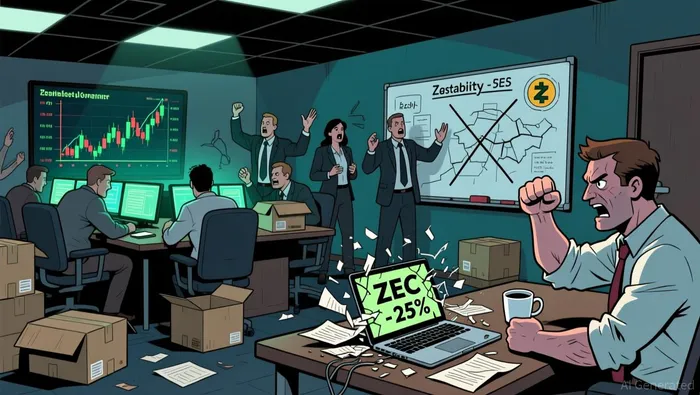
The ZcashZEC-- (ZEC) development team resigned in early 2026, claiming constructive discharge by Bootstrap, the nonprofit overseeing governance, due to misaligned priorities.
The departure led to the formation of a new independent company to continue Zcash development outside Bootstrap's control, but raised concerns about the project's governance structure and future upgrades according to reports.
Zcash's price dropped by up to 25% following the resignation, reflecting investor concerns over governance instability and leadership uncertainty.
The Zcash governance crisis emerged as Electric Coin Company (ECC), the core development team, accused Bootstrap of creating intolerable working conditions and misaligned mission objectives as reported. The ECC team cited constructive discharge, a legal term implying the employer rendered the work environment so objectively hostile that resignation became the only viable option. The dispute centered on disagreements about the privatization of the Zashi wallet and changes to the development fund's governance model according to analysis.
Despite the team's departure, Zcash's protocol remains unaffected and operational, with Zcash founder Zooko Wilcox emphasizing its open-source, secure, and permissionless nature. The incident underscores broader structural weaknesses in how blockchain projects balance decentralization with organized governance as experts note.
The U.S. Securities and Exchange Commission (SEC) concluded a two-year investigation into the Zcash Foundation in late 2025, deciding not to recommend enforcement action. The SEC's favorable outcome affirmed Zcash's compliance with regulatory standards and categorized it as a digital commodity/network token. This regulatory clarity provided a short-term boost to ZEC's price, which had previously seen an 13% rebound in late 2025 according to data.
Why is this governance dispute significant for Zcash investors?
The resignation of the core development team raises concerns about the continuity of Zcash's roadmap and future upgrades as detailed. The formation of a new independent company may help mitigate execution risks, but the lack of a clear governance resolution has created uncertainty about the long-term stability of the project according to reports.
Investors are now weighing the risks of governance instability against the project's foundational strengths, including its privacy-preserving zk-SNARKs technology and fixed supply as noted. The incident serves as a cautionary example of how leadership shifts and governance conflicts can impact market confidence in blockchain projects as analysts observe.
What does the SEC's decision mean for Zcash and other privacy coins?
The SEC's decision to close its investigation without enforcement action represents a significant regulatory victory for the Zcash Foundation according to industry analysis. It highlights the regulator's nuanced understanding of privacy technology and suggests a more measured approach to evaluating such projects as reported.
The outcome may offer regulatory breathing room for other privacy-focused cryptocurrencies by affirming that privacy features alone do not trigger securities law violations according to SEC findings. The Zcash Foundation's non-profit status, transparent engagement with regulators, and established track record since 2016 were key factors in the favorable outcome as stated.
However, Zcash still faces broader regulatory challenges, particularly from U.S. and EU anti-money laundering (AML) rules, which could constrain its growth as a privacy-focused cryptocurrency according to analysis. The SEC's decision does not eliminate the need for ongoing compliance with evolving regulatory standards.
What are the broader implications for blockchain governance models?
The Zcash governance crisis highlights the fragility of decentralized governance models and the potential for internal disputes to disrupt development and erode investor confidence as experts note. The resignation underscores the risks associated with centralized governance structures in blockchain projects, where leadership shifts can introduce execution risks and market volatility according to reports.
The incident has sparked discussions about the importance of strong governance in crypto projects and the need for clear decision-making frameworks that align with the community's long-term goals as noted. The Zcash ecosystem has already seen recent leadership changes and organizational shifts, but the lack of a clear governance resolution continues to pose uncertainty for investors according to analysis.
The broader cryptocurrency industry is watching closely as Zcash navigates these challenges. The project's ability to maintain technical continuity while resolving governance issues will be critical for its long-term success in 2026 and beyond as industry observers state.

Blending traditional trading wisdom with cutting-edge cryptocurrency insights.
Latest Articles
Stay ahead of the market.
Get curated U.S. market news, insights and key dates delivered to your inbox.






Comments
No comments yet