
ZEC Price Surges As Fortitude Mining Expands Zcash Infrastructure
 Aime Summary
- ZEC outperformed BitcoinBTC-- with a 5.44% gain following the successful Ironwood network upgrade and a technical breakout above the 200-day moving average .
- Fortitude Mining, backed by Digital Currency Group, acquired a 12.5 MW facility in Nebraska and ordered 9,000 ASICs to strengthen network security and reduce production costs .
- Approximately 30% of ZEC supply is now shielded, creating a structural supply squeeze as demand expands in a market where nearly all 21 million coins are already in circulation .
- Regulatory uncertainty eased in January 2026 when the SEC concluded its investigation without enforcement action, supporting potential ETF filings and institutional trust .
- Despite bullish momentum, ZEC faces structural constraints from exchange delistings and competition, limiting its price ceiling to a base-case market cap of $11.8–$20.2 billion .
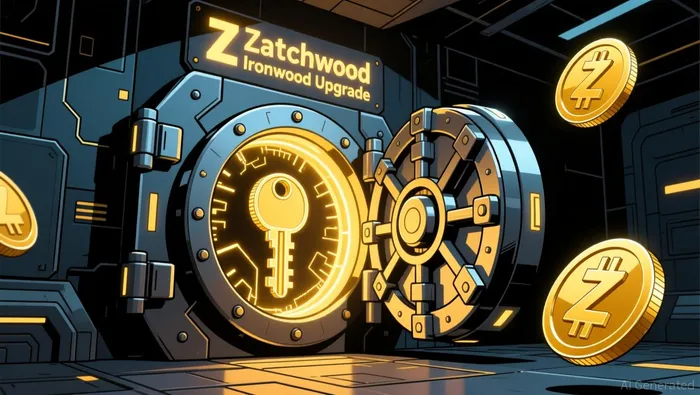
Zcash experienced a notable price surge, outperforming major cryptocurrencies as the market reacted to a confluence of fundamental upgrades and technical breakouts. The primary catalyst was the successful Ironwood (NU6.3) network upgrade on July 28, 2026, which sealed a vulnerable pool and introduced stronger inflation guarantees . This improvement in network security, combined with reports of mining expansion from a major institutional backer, renewed investor confidence and triggered a breakout above the 200-day Simple Moving Average at $385.67 .
The technical momentum was reinforced by significant on-chain data showing record net inflows into shielded pools. Approximately 30% of the supply is now shielded and effectively removed from circulation, creating a structural supply squeeze . This dynamic is critical because nearly all of Zcash's 21 million maximum supply is already issued, with 16.79 million in circulation . Consequently, price appreciation depends entirely on demand expansion, as every $100 increase in price adds roughly $1.68 billion to the market cap .
Institutional investment played a pivotal role in fueling this rally. Fortitude Mining, a subsidiary of Digital Currency Group, finalized a $31.5 million agreement with Bitmain to purchase 9,000 Antminer Z15 Pro ASICs . The company also acquired a 12.5-megawatt mining facility in Prosser, Nebraska, for approximately $4.7 million, increasing its owned power capacity to over 60 MW . This expansion is projected to reduce direct cash mining costs by approximately 43%, lowering the cost per ZEC from around $70 to roughly $40 .
How does Zcash’s supply structure impact its price potential?
Zcash operates with a fixed supply cap of 21 million coins, subject to periodic halvings, and currently trades with a block subsidy of 1.5625 ZEC . Because the token faces no future dilution from unlocks, its valuation ceiling is fundamentally constrained by the size of its addressable market rather than supply scarcity . The total addressable market spans crypto-native privacy demand, broader digital cash markets, and institutional privacy infrastructure .
Valuation scenarios suggest a base-case market capitalization of $11.8–$20.2 billion, implying a price range of $700–$1,200 . An optimistic scenario posits a market cap of $28.6–$53.8 billion, implying prices of $1,700–$3,200, contingent on ZEC becoming a principal privacy-settlement network with sustained institutional adoption . Prices above $3,000 would require exceptional adoption conditions and a market cap exceeding $50 billion .
What regulatory and competitive factors influence ZEC’s trajectory?
Regulatory clarity has improved significantly, with the SEC concluding its investigation into the ZcashZEC-- Foundation in January 2026 without enforcement action . This development has reduced uncertainty and supported the development of institutional exposure through the Grayscale Zcash Trust and potential NYSE Arca ETF filings under the ZCSH ticker . However, privacy coins continue to face severe regulatory headwinds globally, with the EU planning to ban regulated services for anonymizing transactions by July 2027 .
Competition remains a key risk for Zcash. MoneroXMR-- enforces mandatory privacy via ring signatures, creating a robust anonymity set but facing delistings from 73 centralized exchanges . Zcash offers optional privacy via zk-SNARKs, allowing selective disclosure for compliance, but faces scrutiny over anonymity set strength . Exchange delistings continue to pose liquidity risks, and fragmented liquidity across privacy networks limits ZEC's ability to capture broader market share .
The technical outlook remains cautiously bullish provided support levels hold. ZEC has been trading inside a symmetrical triangle pattern, and traders are monitoring the $540 resistance level for a potential breakout toward the $700 region . However, bearish commentary from ARK Invest regarding self-custody risks has introduced narrative headwinds . The price action reflects a cooling-off period where capital rotates between Bitcoin and altcoins, with ZEC's performance dependent on maintaining key technical supports amidst broader market fear .

Blending traditional trading wisdom with cutting-edge cryptocurrency insights.
Latest Articles
Stay ahead of the market.
Get curated U.S. market news, insights and key dates delivered to your inbox.


AInvest
PRO
AInvest
PRO




Comments
No comments yet