
ZEC Outperforms Bitcoin Amid Supply Compression While Pump.fun Revenue Crashes 80%
 Aime Summary
- Zcash (ZEC) has significantly outperformed BitcoinBTC-- over the past ten months, climbing 17-fold in relative terms while Bitcoin declined approximately 44%.
- The primary driver is structural supply compression, with 30-35% of ZECZEC-- locked in shielded pools, reducing speculative sellable supply to just 2.4% of market cap.
- Pump.fun revenue crashed 80% to $24.96 million in July, reflecting a broader collapse in SolanaSOL-- meme coin interest and trading volume.
- ZEC maintains a market cap near $7.7 billion, positioning it competitively with MoneroXMR-- despite facing regulatory friction and exchange delistings.
- The upcoming NU7 governance vote on August 25 is a critical catalyst for ZcashZEC--, potentially influencing protocol sustainability and investor sentiment.
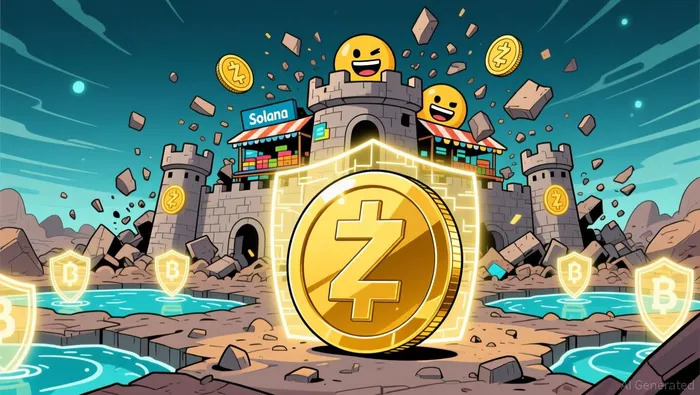
Zcash has demonstrated a remarkable divergence from the broader cryptocurrency market, particularly when measured against Bitcoin. Over the last ten months, the ZEC/BTC ratio has climbed 17-fold, even as Bitcoin itself declined by approximately 44%. This resilience is not attributed to typical speculative hype surrounding privacy coins, but rather to profound structural changes in Zcash's supply dynamics. Approximately 30% to 35% of the total ZEC supply is now effectively locked in shielded pools, including significant holdings by institutional entities like Grayscale and Cypherpunks.
This "float destruction" has dramatically reduced the sellable supply to roughly 2.4% of the total market cap, down from peaks near 22.5%. The reduction in circulating supply indicates decreased speculative churn and suggests a more stable holder base less prone to rapid distribution. Market confidence was tested in June 2026 by a counterfeit scare stemming from a vulnerability in the older Orchard shielded pool, which triggered a 50% price drop. However, ZEC recovered fully within eight weeks, a move analysts describe as evidence of strong holder conviction rather than temporary FOMO.
The recovery coincided with the activation of the Ironwood network upgrade, known as NU6.3, on July 28, 2026. This upgrade introduced a new shielded pool with enhanced accounting features to address the vulnerability, encouraging voluntary migration that further reinforces the locked-supply narrative. Beyond supply mechanics, Zcash’s zero-knowledge proof technology positions it as a differentiated store of value and payment tool amid increasing financial surveillance. The combination of Bitcoin-like scarcity with optional strong privacy creates a compelling hybrid proposition for institutional and privacy-conscious investors.
How Is Meme Coin Revenue Collapsing on Solana?
In stark contrast to Zcash’s structural resilience, the Solana meme coin ecosystem is experiencing a severe downturn. Pump.fun, a dominant Solana-based launchpad, reported its lowest revenue in 2025 for July, totaling $24.96 million. This figure represents an 80% decline from the platform's January peak of over $130 million. The downturn mirrors broader weakness across the meme coin sector, which has experienced fading interest and liquidity contraction over recent months.
Key metrics highlight the severity of the contraction. The total meme coin market cap fell to $65 billion, a 23.5% drop from the $85 billion peak recorded in July. Daily trading volume within the sector plummeted 67% to $5.59 billion, down from the $17.22 billion record seen earlier in the month. On the Solana network specifically, new token minting slowed to 34,040 in a single day, the lowest level in three months.
Platform-specific activity also weakened significantly. Daily traders on Pump.fun dropped 62% to 129,000, while daily trading volume on the platform fell 56% to $150 million. Despite these sector-wide headwinds, competitor platform LetsBonk maintained trader growth, although it still experienced a 10% decline in volume. These trends suggest a structural shift in user behavior and capital allocation within the Solana ecosystem.
What Are Zcash's Price Drivers and Risks?
Zcash's price ceiling is fundamentally constrained by the size of its addressable market and the strength of its adoption narrative, rather than supply scarcity alone. With nearly all of its 21 million maximum supply already issued, ZEC does not face dilution overhang, but valuation growth must come entirely from demand expansion. Historical context shows ZEC's all-time high of approximately $5,941 in 2016 was driven by thin liquidity and launch-phase speculation. A more relevant benchmark is the 2025 peak near $683, implying a market cap of approximately $11.48 billion.
Total Addressable Market analysis identifies three segments: crypto-native privacy demand, broader digital cash usage, and institutional privacy infrastructure. The most defensible near-term ceiling is a return to or modest extension beyond the 2025 peak, consistent with ZEC maintaining leadership in the privacy category. Key growth catalysts include renewed privacy narratives driven by surveillance concerns, exchange accessibility improvements, and the potential approval of a Zcash ETF.
However, structural constraints remain significant. Privacy is a niche demand, and regulatory pressure leads to exchange delistings, with 51 to 73 exchanges delisting privacy coins between 2025 and late 2025. ZEC lacks the ecosystem breadth of smart-contract platforms, and sustained price appreciation requires meaningful capital rotation into privacy assets. The 2028 halving may provide support, but institutional adoption of ZEC's selective-disclosure features is critical for long-term valuation.
Technically, ZEC holds above its key 200-day moving average at $386.86 and the 61.8% Fibonacci retracement level at $503.44, which now acts as immediate support. The next significant resistance is the 23.6% Fibonacci level at $554.64, aligning with the upper Bollinger Band near $548.54. A decisive break above $548.54 is needed to signal stronger momentum, while recent data indicates a pullback phase driven by profit-taking and rising Bitcoin dominance.
The community is preparing for the NU7 governance vote starting August 25, 2026. This vote will address key protocol decisions, including potential adoption of a Network Sustainability Mechanism and adjustments to block times. Successful migration into the new shielded infrastructure and constructive governance outcomes are critical for sustaining Zcash's current trajectory.
Pump.fun has also engaged in significant treasury management, transferring approximately $6.3 million in SOL to Kraken. This transaction, consisting of roughly 26,000 SOL, is part of the platform's broader strategy to monetize fees generated from token creation services. Analysts view this transfer as routine treasury management rather than a bearish indicator, given that the amount is small relative to Solana's daily trading volume.
Cumulatively, Pump.fun has sold an additional 84,789 SOL worth $6.25 million, bringing total cumulative sales to 4.82 million SOL valued at approximately $807 million. The continued liquidation of SOL holdings has drawn attention from traders monitoring large wallet activity and its potential impact on market sentiment. Large-scale token sales can influence liquidity and create additional selling pressure for SOL, though Pump.fun remains a major contributor to on-chain activity within the Solana network.

Blending traditional trading wisdom with cutting-edge cryptocurrency insights.
Latest Articles
Stay ahead of the market.
Get curated U.S. market news, insights and key dates delivered to your inbox.


AInvest
PRO
AInvest
PRO




Comments
No comments yet