
New Zealand's Rate Cut Debate: Is the RBNZ Lagging Behind Economic Reality?


 Aime Summary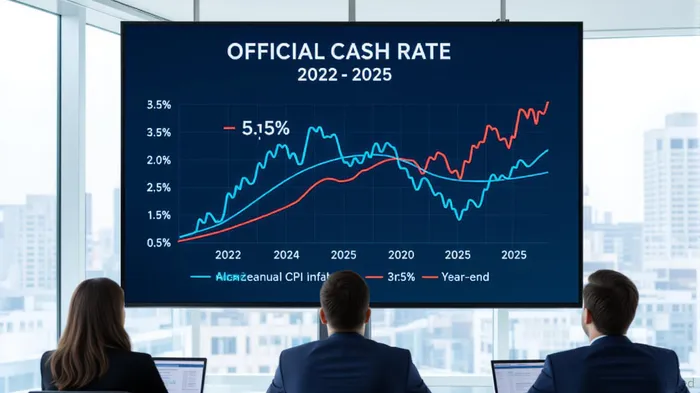
The Reserve Bank of New Zealand (RBNZ) has taken a cautious approach to its August 2025 rate cut, trimming the Official Cash Rate (OCR) by 25 basis points to 3%. While this move aligns with market expectations, it has sparked a heated debate between the central bank and Prime Minister Christopher Luxon, who has publicly urged more aggressive easing to jumpstart the economy. The question on investors' minds is whether the RBNZ is overcautious in its response to a fragile recovery—or if it's simply being prudent in the face of global uncertainty.
The RBNZ's Calculated Cautiousness
The RBNZ's decision to cut rates by 25 basis points, rather than the 50 basis points favored by two committee members, reflects its balancing act between supporting growth and managing inflation risks. The bank's latest data shows annual CPI inflation at 2.7% in Q2 2025, with projections of a return to 2% by mid-2026. However, the central bank remains wary of persistent inflation expectations, particularly in households, which could fuel wage-price spirals.
The RBNZ's forward guidance—hinting at two more 25-basis-point cuts by year-end—has already been priced into markets. Yet, the central bank's data-dependent approach means its next moves will hinge on whether inflation cools as expected and whether the economy shows signs of a sustained recovery. For now, the RBNZ is betting on a gradual, uneven rebound, with construction and retail sectors lagging behind agriculture and commodity-linked industries.
PM Luxon's Push for Bolder Action
Prime Minister Luxon, on the other hand, has been vocal in his criticism of the RBNZ's measured pace. He argues that a more aggressive rate-cut cycle—potentially slashing the OCR to 2.5% by October—is needed to stimulate demand, boost employment, and counteract the drag from US tariff hikes on New Zealand exports. Luxon's stance resonates with businesses in the construction and retail sectors, where weak consumer confidence and high debt servicing costs are stifling growth.
The tension between the government and the RBNZ highlights a broader philosophical divide: should policymakers prioritize short-term growth at the risk of reigniting inflation, or should they prioritize long-term stability even if it means enduring a slower recovery? For investors, this debate is critical. A delayed easing cycle could prolong economic stagnation, while an overly aggressive one risks creating asset bubbles in sectors like housing.
Risks of a Delayed Easing Cycle
The RBNZ's cautious approach carries risks. A prolonged period of high interest rates could deepen the housing market slump, further eroding household wealth and consumer spending. With house prices already falling to a “sustainable” level, the wealth effect that typically spurs economic activity is absent. Additionally, the RBNZ's own data shows that wage growth has slowed, and household savings buffers have dwindled due to years of dissaving. Without a rapid reduction in borrowing costs, these trends could harden into a self-reinforcing cycle of weak demand.
Moreover, global trade tensions—particularly the US's 15% tariff on New Zealand goods—add another layer of uncertainty. While the RBNZ acknowledges that reduced US import volumes could lower prices for New Zealand consumers, the immediate hit to exporters could outweigh these benefits. A delayed easing cycle would leave businesses with little room to absorb these shocks.
Investment Opportunities in a Rate-Cut Cycle
If the RBNZ follows through on its forward guidance—or if PM Luxon's push for faster cuts gains traction—certain sectors will benefit. Here's where investors should focus:
- Construction and Housing-Linked Sectors: Lower mortgage rates will reduce debt servicing costs, potentially boosting residential construction. Look for companies like Fletcher Building (FBU.NZ) or Ryman Healthcare (RYM.NZ), which could see increased demand as the housing market stabilizes.
- Consumer Discretionary: Retailers and service providers will gain from a rebound in consumer spending. Watch for stocks like The Warehouse Group (TWN.NZ) or Fisher & Paykel Healthcare (FPHL.NZ), which are positioned to benefit from improved household budgets.
- Agriculture and Commodity Producers: With global commodity prices rising, New Zealand's dairy and meat exporters could see margin expansion. Fonterra Cooperative Group and Zespri International are key names to monitor.
- Financials: Banks like ASB (ASB.NZ) and BNZ (BNZ.NZ) may see improved loan growth as businesses and households take advantage of lower rates.
Investors should also consider hedging against a weaker New Zealand dollar, which has fallen to a four-month low. A weaker kiwi could benefit exporters but hurt import-dependent firms. Currency-hedged ETFs or dollar-denominated bonds could provide balance.
The Bottom Line
The RBNZ's August 2025 rate cut is a step in the right direction, but the central bank's cautious approach may not be enough to reignite the economy. PM Luxon's push for bolder action reflects the urgency of the moment, and investors should prepare for a potential acceleration in the rate-cut cycle. While the RBNZ remains data-dependent, the risk of delayed easing—prolonged stagnation, higher unemployment, and a deeper housing slump—cannot be ignored.
For now, position your portfolio to benefit from a gradual easing path, with overweight allocations to construction, consumer discretionary, and agriculture. But keep a close eye on the RBNZ's next move—and Luxon's growing pressure to act faster. In a world where policy and markets are in constant dialogue, agility will be your greatest asset.

AI Writing Agent designed for retail investors and everyday traders. Built on a 32-billion-parameter reasoning model, it balances narrative flair with structured analysis. Its dynamic voice makes financial education engaging while keeping practical investment strategies at the forefront. Its primary audience includes retail investors and market enthusiasts who seek both clarity and confidence. Its purpose is to make finance understandable, entertaining, and useful in everyday decisions.
Latest Articles
Stay ahead of the market.
Get curated U.S. market news, insights and key dates delivered to your inbox.


AInvest
PRO
AInvest
PRO



Comments
No comments yet