
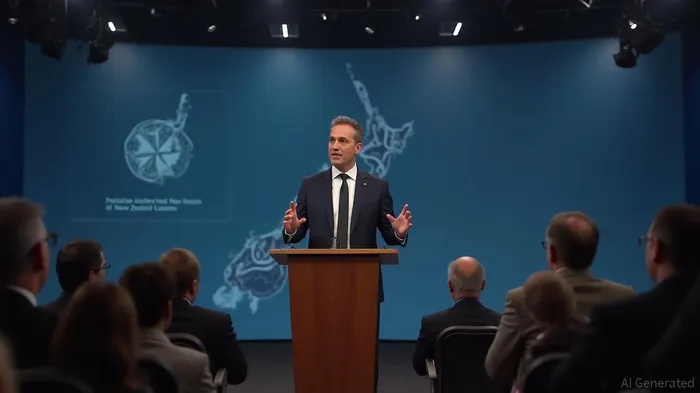
New Zealand PM Christopher Luxoni speaks at news conference
ByAinvest
Sunday, Aug 31, 2025 10:44 pm ET1min read
New Zealand PM Christopher Luxoni speaks at news conference
New Zealand's Reserve Bank (RBNZ) has been grappling with significant leadership and governance issues since early 2025. The abrupt resignations of Governor Adrian Orr and Board Chair Neil Quigley have exposed systemic vulnerabilities and raised concerns about policy continuity and financial market stability. The interim leadership, under Christian Hawkesby, lacks long-term strategic direction, particularly amid economic challenges such as the U.S. tariffs on New Zealand goods [1].The RBNZ's August 2025 decision to cut the Official Cash Rate (OCR) to 3% sparked investor skepticism and triggered a 12% depreciation of the New Zealand Dollar (NZD) against the USD within six months. This move, framed as a response to weak business and consumer confidence, highlighted the challenges of maintaining policy consistency during transitions [2].
Global comparisons underscore the importance of governance transparency. The South African Reserve Bank, for instance, has maintained institutional independence and reduced inflation volatility through consistent governance [3]. In contrast, the U.S. Federal Reserve's 2025 political interference triggered sharp market corrections, emphasizing the fragility of credibility in the face of external pressures [4].
To mitigate these risks, the RBNZ has restructured its Executive Leadership Team (ELT) into four focused roles, aiming to streamline decision-making. However, structural changes alone cannot restore trust if underlying governance flaws persist. The RBNZ must address transparency gaps, particularly in its communication with the public and political stakeholders, to rebuild credibility [5].
For investors, the key risks lie in policy uncertainty and NZD volatility. Defensive sectors, such as utilities and healthcare, may offer refuge, while hedging strategies could mitigate currency exposure. The appointment of a permanent governor, expected within weeks, will be a critical test of the RBNZ's ability to stabilize its institutional narrative.
New Zealand Prime Minister Christopher Luxoni addressed these concerns at a recent news conference, emphasizing the need for transparency and policy consistency. He noted that the RBNZ's leadership transition serves as a cautionary tale for central banks navigating governance challenges [6].
The RBNZ's experience suggests that even technocratic institutions are not immune to governance shocks. As the bank charts its path forward, the lessons from global peers—both successful and cautionary—will be invaluable in shaping a resilient institutional framework.
References:
[1] https://www.ainvest.com/news/rbnz-leadership-transition-implications-zealand-monetary-policy-financial-markets-2509/
[2] https://www.interest.co.nz/public-policy/134939/six-months-after-adrian-orr-left-reserve-bank-and-after-chief-ombudsmans
[3] https://www.bloomberg.com/news/articles/2025-08-29/rbnz-chair-neil-quigley-resigns-just-six-months-after-orr-s-exit
[4] https://www.ainvest.com/news/zealand-central-bank-turmoil-governance-crises-road-monetary-uncertainty-2508
[5] https://www.bloomberg.com/news/articles/2025-08-22/rbnz-s-top-economist-cautions-on-overstimulus-following-rate-cut
[6] https://www.reuters.com/world/asia-pacific/new-zealand-central-bank-warns-risks-financial-system-amid-global-volatility-2025-05-06/
Stay ahead of the market.
Get curated U.S. market news, insights and key dates delivered to your inbox.


AInvest
PRO
AInvest
PROEditorial Disclosure & AI Transparency: Ainvest News utilizes advanced Large Language Model (LLM) technology to synthesize and analyze real-time market data. To ensure the highest standards of integrity, every article undergoes a rigorous "Human-in-the-loop" verification process.
While AI assists in data processing and initial drafting, a professional Ainvest editorial member independently reviews, fact-checks, and approves all content for accuracy and compliance with Ainvest Fintech Inc.’s editorial standards. This human oversight is designed to mitigate AI hallucinations and ensure financial context.
Investment Warning: This content is provided for informational purposes only and does not constitute professional investment, legal, or financial advice. Markets involve inherent risks. Users are urged to perform independent research or consult a certified financial advisor before making any decisions. Ainvest Fintech Inc. disclaims all liability for actions taken based on this information. Found an error?Report an Issue


ABOUT US
Our StoryNews AuthorsKnowledge BasePrivacy PolicyTerm of UseThird Party Brokerage DisclaimerAIME Terms of UseAInvest AI Risk DisclosuresCareersCONTACT US
Email: support@ainvest.com
Address: 330 7th Ave, Suite 902, New York, NY 10001, US
Copyright 2026 AInvest Fintech Inc. All rights reserved.


Comments
No comments yet