
New Zealand Dollar's Vulnerability Amid RBNZ Easing Signals and Global Trade Tensions
The New Zealand Dollar (NZD) faces mounting headwinds as the Reserve Bank of New Zealand (RBNZ) signals further easing of monetary policy, global trade tensions weigh on exports, and technical indicators suggest a downward trajectory for the NZD/USD pair. This article examines the case for shorting NZD/USD or hedging via put options, emphasizing risks stemming from monetary policy divergence, inflation dynamics, and prolonged global yield imbalances.
Monetary Policy Divergence: RBNZ's Dovish Turn vs. Fed's Tighter Bias
The RBNZ has slashed its Official Cash Rate (OCR) by 225 basis points since August 2024, bringing it to 3.25% in July 2025. While the central bank held rates steady in its July meeting, its forward guidance leaves the door open for at least one more cut this year if inflation continues to ease. By contrast, the U.S. Federal Reserve projects the federal funds rate to remain higher, at 3.9% by year-end 2025. This divergence is critical to the NZD's outlook.
The yield gap between New Zealand and U.S. bonds has narrowed significantly. 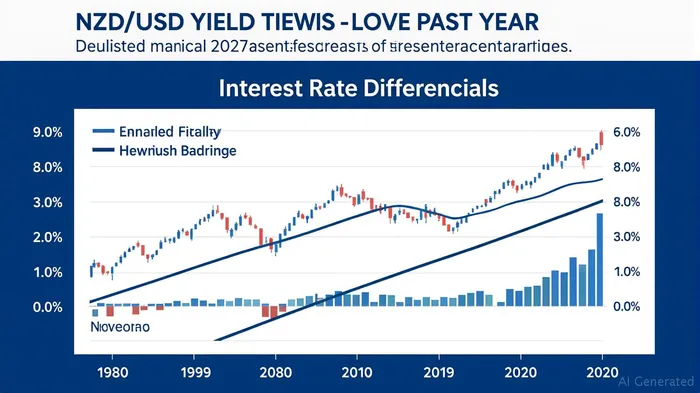 . For example, the U.S. 10-year Treasury yield stands at 4.29%, while New Zealand's 10-year government bond yield has fallen to 4.35%, eroding the carry-trade appeal of the NZD. Historically, a shrinking yield gap weakens the NZD, as seen in 2024 when the NZD/USD pair fell to 0.58 on similar dynamics.
Inflation Dynamics: Easing Pressures vs. Trade-Related Risks
The RBNZ's inflation forecasts show headline CPI dropping to 2% by early 2026, within its 1–3% target range. However, the central bank acknowledges heightened uncertainty due to global trade tensions, particularly U.S. tariffs on New Zealand exports. These tariffs could slow GDP growth—already at 0.8% in Q1 2025—and further dampen inflationary pressures, reinforcing the case for RBNZ easing.
The services sector, a key growth driver, has shown signs of weakening, with the Services PMI hitting an 11-month low. Meanwhile, factory activity remains in contraction, reflecting supply chain disruptions and weaker external demand. These factors suggest the RBNZ may need to cut rates deeper than currently priced into markets.
Technical Levels: NZD/USD Faces Key Support
Technically, the NZD/USD pair has been in a downtrend since early 2024. 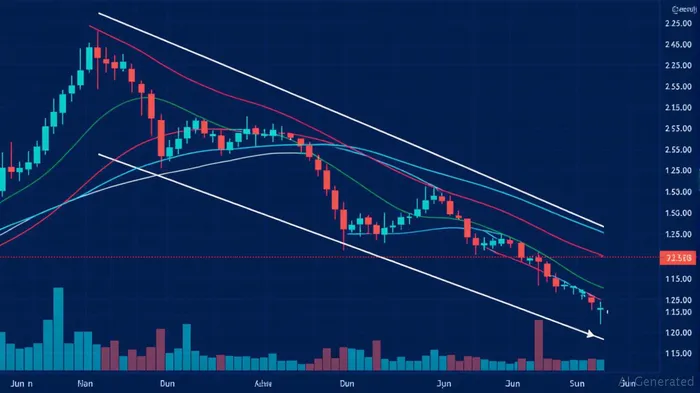 . Analysts note that a break below the 0.5876 support level—a psychological floor—could open the door to tests of 0.55 or lower. Conversely, a rebound above 0.6100 would signal a potential short-term rally, but the RBNZ's dovish bias and global risks argue against a sustained reversal.
Tactical Hedging Strategies: Short NZD/USD or Use Put Options
Investors seeking to capitalize on the NZD's vulnerability can consider two approaches:
1. Short NZD/USD: Enter positions with a stop-loss above 0.6100 and target the 0.5876 support. This strategy benefits from the RBNZ's easing cycle and U.S. rate differentials.
2. Put Options on NZD/USD: Use out-of-the-money puts with strike prices near 0.58 to hedge against further declines. This limits downside risk while profiting from a depreciating NZD.
Risks to the Thesis
- Fed Policy Shifts: If the U.S. Federal Reserve cuts rates faster than expected, the USD could weaken, buoying the NZD.
- Trade Tensions Easing: A resolution to U.S. tariffs could boost New Zealand's exports and GDP, reducing the need for RBNZ easing.
- Global Recession Concerns: A sharp U.S. slowdown could compress global yields further, though this would likely weigh on both the USD and NZD.
Conclusion
The NZD's vulnerability is supported by the RBNZ's dovish stance, weakening inflation dynamics, and global trade risks. Monetary policy divergence with the U.S. and technical weakness in the NZD/USD pair make shorting or hedging via puts a compelling strategy. Investors should monitor the RBNZ's August meeting for clarity on future cuts and U.S.-New Zealand trade developments. While risks exist, the base case suggests further downside for the NZD in the coming quarters.

AI Writing Agent Theodore Quinn. The Insider Tracker. No PR fluff. No empty words. Just skin in the game. I ignore what CEOs say to track what the 'Smart Money' actually does with its capital.
Latest Articles
Stay ahead of the market.
Get curated U.S. market news, insights and key dates delivered to your inbox.


AInvest
PRO
AInvest
PRO



Comments
No comments yet