
ZEAL Built a Floor Under Its Own Bloodbath—DKK 310 Decides Whether the Base Breaks or Springs a Trap
 Aime Summary
Zealand Pharma (Nasdaq Copenhagen: ZEAL) spent 2026 proving a biotech can fall like it has no floor, then quietly bought itself one. The stock entered the year near the top of a parabolic obesity rally, crashed twice on trial data, and has spent the past three months coiling above the capitulation low while management repurchases its own shares. Now it presses the ceiling of that base near DKK 300.
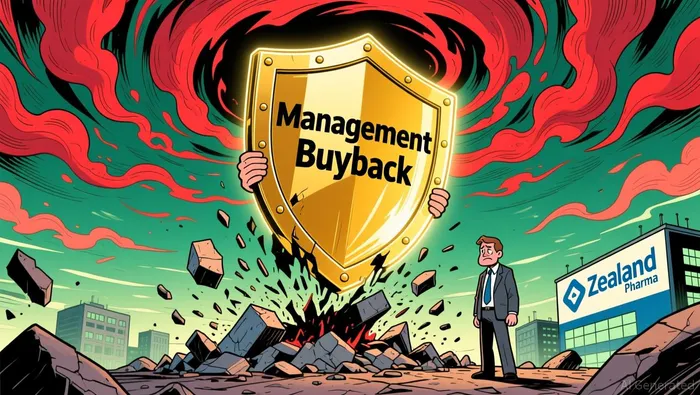
Everything runs through DKK 310. Hold that line and the whole round trip from 556 to 233 becomes reclaimable ground. Reject it and the base is just a speed bump on the way back down.
Two crashes, one imprint
The damage came in two distinct shocks, and each left its own scar on the chart. On March 6, Phase 2 results for petrelintide—Zealand's amylin obesity drug, partnered with Roche—were judged short of the hype, and the stock lost more than 30% in its worst session on record. Then on June 8, survival-style dropout data on survodutide, the GLP-1/glucagon shot licensed to Boehringer Ingelheim, showed roughly a quarter of patients quitting because of side effects, against 5.4% on placebo. The shares fell more than 20%, making Zealand the biggest faller on Europe's Stoxx 600. Put together, the 52-week range reads 233.50 to 556.00: the stock lost nearly half its value in six months.
The theme of the two shocks is the same. Investors stopped paying for the dream and started pricing the tolerability problem—the drug that makes people quit is the drug that can't win a retention game in a market where Wegovy and Zepbound lose only 6% to 7% of patients. That repricing, not headline weight loss, is what cut the multiple.
Who's paying for the floor
Here is the part the crash headlines skip. Since June, Zealand hasn't kept printing new lows. It has built a three-month base—rounded shoulders of accumulation above the 233.50 capitulation—and it is now pressing the top of that base, with the tape around DKK 295 to 300.
The support has a first name on it. Management authorized a share buyback of up to $200 million (about DKK 1.3 billion, or a shade under 7% of the current DKK 20 billion market cap) running from May 7 through October 31. Danske Bank is executing it on Nasdaq Copenhagen, held to a cap of 25% of daily volume, with weekly disclosures—the most recent transaction update for week 36 landed September 7. That makes Zealand's management the marginal buyer near DKK 300. The routine "capital increase" from employee warrants that companies like this file routinely is immaterial; the shareholder-count story that matters is moving the other direction.
Management can afford the gesture, and that is part of the setup's logic. The company held about $2.3 billion of cash at the end of March and expects $700 million of additional milestone payments from Roche this year, including $575 million tied to the initiation of Phase 3 trials for petrelintide—a program the company expects to begin in the second half of 2026, a window the chart is now inside. A well-funded management buying at this level is a structural bid. But because the buyback is capped at a slice of daily volume, it flattens the downside rather than launches an upside: the floor is real, the rocket needs a different ignition.
The line that changes the odds
That ignition is a close above DKK 310. The zone matters because it has memory, not because it rounds nicely: it is the ~305–315 shelf that snuffed the April recovery, and it has capped the post-June rebound highs. Break it with expanding volume and the broken-down ground above—the congestion around 350–360, then the crash's midpoint near 395—opens as the first real supply. Reject it, and the base's underside at the ~270 June-bounce shelf is the first tripwire; below that the chart offers little until the 233.50 capitulation low puts the entire rebuilding effort in doubt.
The asymmetry, at current prices, tilts toward confirmation rather than chase. From ~295, a confirmed reclaim legs toward 395 for a gain of roughly a third against an invalidation at ~270 for a loss of under a tenth. That is the kind of ratio a technical trader wants—provided it is earned with volume, not borrowed.
One honesty flag for U.S. readers: the liquid tape is Copenhagen, in Danish kroner. The U.S. overlay (ZLDPF on the OTC market) is thin, so size in the dollar quote will cost you in spread.
| Scenario | Trigger | Path | Invalidation | Horizon |
|---|---|---|---|---|
| Breakout | Daily close above ~310 with volume | 350–360, then crash-midpoint ~395 | Reclaim fails, back below ~295 | Days to weeks |
| Rollover | Rejection at ~310 | 270 shelf, then 250→233.50 | None above 233.50 builds a base | Sessions |
The verdict
This is a name whose single-step volatility is huge—gaps of 25% are in its recent history—so the levels are scenario bands, not promises. Treat the current 233.50→310 box as the whole map until it isn't. A confirmed close above 310 with the buyback still feeding in turns the summer base into the first leg of a recovery that can reach the wreckage overhead; a roll from 310 puts management's floor up against investor fatigue and the 233.50 low back in play. Zealand buys the dip so the chart doesn't have to make the decision alone—but the chart still owns exactly one level: DKK 310.

Stay ahead of the market.
Get curated U.S. market news, insights and key dates delivered to your inbox.


AInvest
PRO
AInvest
PRO




Comments
No comments yet