
Zcash ZEC Surges Past $1,000 on Grayscale ETF Launch and Privacy Demand
 Aime Summary
- Zcash (ZEC) broke the $1,000 threshold, entering the crypto top 10 with a market cap near $17 billion .
- The rally was primarily driven by Grayscale's launch of the ZCSHZCSH-- spot ETF on NYSE Arca .
- Investors view ZECZEC-- as a hedge against AI-driven blockchain surveillance and financial monitoring .
- Ledger hardware support now allows offline signing of shielded transactions for enhanced security .
- New cryptography tools reduced private transaction construction time from seconds to under 200 milliseconds .
Zcash (ZEC) recently broke the $1,000 threshold, entering the crypto top 10 with a market capitalization near $17 billion . The rally was primarily driven by Grayscale converting its Zcash TrustZCSH-- into a spot ETF (ZCSH) on NYSE Arca . This product allows investors to gain exposure without holding the token directly and charges a 2.5% fee, with revenue reinvested into the ZcashZEC-- ecosystem .
The primary catalyst was Grayscale’s launch of the ZCSH spot ETF, which converted its $304 million Zcash Trust . The fund, listed on NYSE Arca, has attracted steady inflows, reaching roughly $414 million in net assets . Grayscale’s head of research, Zach Pandl, projected a hypothetical scenario where ZEC could reach $8,100 if it captured 10% of Bitcoin’s market value .
Grayscale’s head of index, Steve Vanourny, framed the investment thesis around growing demand for financial privacy as artificial intelligence expands financial monitoring capabilities . Additionally, technical improvements have made Zcash’s shielded transactions significantly faster, addressing previous efficiency concerns . Institutional credibility was bolstered by disclosures from firms such as Multicoin Capital, Cypherpunk Technologies, and a Digital Currency Group subsidiary, all of which hold significant ZEC positions .
Derivatives activity intensified the move. Open interest reached approximately $2.3 billion, and short liquidations totaled roughly $34.5 million in a 24-hour period . This short squeeze forced leveraged traders to buy back tokens, accelerating the price advance . Notable short sellers, including early BitcoinBTC-- adopter Garrett Jin, faced significant unrealized losses on their ZEC positions .
How Does Ledger Integration Improve Zcash Security?
Vizorwallet has enabled the signing of shielded ZEC transactions on Ledger hardware wallets, resolving a long-standing gap in cold storage support for Zcash's privacy features . This integration supports the Orchard and Sapling protocols, allowing users to maintain privacy while securing private keys offline . Historically, Ledger’s Zcash support was limited to transparent transactions, treating ZEC like a public-ledger coin .
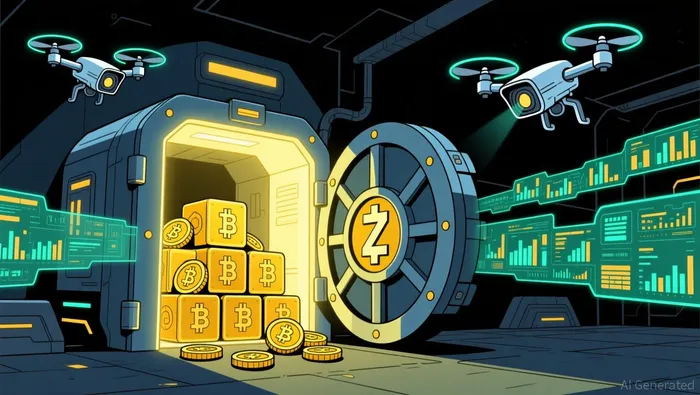
The new dedicated “Zcash Shielded” app, available on select Ledger devices (Nano S Plus, Stax, and Flex), allows users to keep private keys offline while utilizing Zcash’s shielded transaction capabilities . The integration architecture relies on a division of labor: the Ledger device holds private keys and handles signing, while companion wallets like Zkool or Vizor manage shielded accounts and construct transactions .
This setup ensures the Ledger never exposes keys, and the companion wallet never has full custody . The solution supports Zcash’s Orchard and Sapling shielded protocols, which use zero-knowledge proofs to encrypt transaction details while maintaining network validity . Approximately 26% of ZEC’s total supply currently sits in shielded pools, indicating a substantial user base values these privacy features .
The Ironwood update (NU6.3) had previously enhanced the protocols underlying shielded transactions, but hardware wallet compatibility remained limited . This integration provides Vizor users a second hardware wallet option for securing shielded ZEC, alongside existing Keystone support, and offers Zkool users a primary companion app for managing shielded accounts on Ledger devices .
Why Is Zcash Transaction Speed Increasing Now?
Zakura released an open-source cryptography toolkit on August 29 that claims to reduce the time required to construct private Zcash transactions from over three seconds to below 200 milliseconds . The toolkit, called Zakura Common, replaces several cryptographic components used by wallets and full nodes, improving proof generation, verification, and hashing without altering Zcash’s consensus rules .
Benchmarks indicate that mobile proof generation is more than 14 times faster, while desktop performance improved by over five times . Sinsemilla hashing, used within the Orchard shielded protocol, was accelerated more than 21 times, and zk-SNARK verification improved fourfold to eightfold . These gains allow wallets to generate privacy proofs more quickly, reducing delays before transactions are broadcast to the network .
The software is released under dual MIT and Apache 2.0 licenses, allowing wallet and node developers to integrate the libraries without waiting for a coordinated network upgrade or hard fork . Vizor Wallet is among the first projects to adopt the libraries, while other developers must integrate and test the updates according to their schedules .
The release arrives alongside preparations for the proposed NU7 upgrade, which aims to reduce block times to 25 seconds . Despite the rally, analysts cautioned that the move was heavily driven by leverage and derivatives, with short liquidations adding $34.5 million in buying pressure . Risks include regulatory overhangs on privacy coins and the parabolic nature of the 2,000% yearly gain .
For investors, the concrete signals to monitor include ZCSH’s actual net inflow reporting on NYSE Arca, whether ZEC holds current price levels once the launch news ages, and any follow-on filings from the same SEC docket . ZEC remains underowned among liquid fund managers, suggesting potential for continued momentum despite the recent volatility .

Blending traditional trading wisdom with cutting-edge cryptocurrency insights.
Latest Articles
Stay ahead of the market.
Get curated U.S. market news, insights and key dates delivered to your inbox.


AInvest
PRO
AInvest
PRO




Comments
No comments yet