
Zcash (ZEC) and Privacy-Centric Crypto Adoption: Navigating Regulatory Scrutiny and On-Chain Activity Signals
 Aime Summary
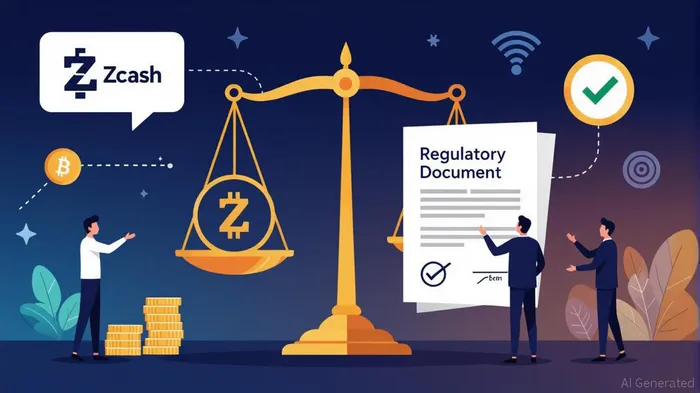
Regulatory Challenges and Zcash's Adaptive Strategy
Privacy coins have faced mounting regulatory pressure since 2023, with frameworks like the European Union's Markets in Crypto Assets (MiCA) and the U.S. Financial Crimes Enforcement Network (FinCEN) mixer rule targeting anonymity-driven assets. The EU's 2024/1624 directive, part of MiCA, mandated enhanced disclosure requirements for privacy coins, leading to delistings on major exchanges like Kraken and Binance in the European Economic Area. Similarly, Japan and South Korea banned institutional trading of privacy coins, reducing liquidity by 11% on Asian exchanges.
Zcash, however, has navigated these challenges more effectively than its peers. Unlike MoneroXMR-- (XMR), which enforces default privacy settings, Zcash offers optional transparency through its dual-transaction model. This flexibility has allowed it to align with regulatory expectations while retaining privacy features. For instance, Zcash's zk-SNARKs technology enables shielded transactions, but users can also opt for transparent transactions that comply with Know-Your-Customer (KYC) requirements. This hybrid approach has attracted institutional interest, with Grayscale filing for a ZEC ETF and Reliance Global Group adopting ZECZEC-- as a primary asset.
On-Chain Activity: A Tale of Institutional Dominance
Zcash's on-chain metrics in Q3 2025 reveal a paradoxical trend: while active addresses hit historic lows, transaction volume surged by over 1000%, signaling a shift toward institutional and whale-driven activity. This decline in active addresses suggests reduced participation from retail users, yet the spike in transaction volume reflects concentrated actions among sophisticated market participants. For example, Cypherpunk, a notable entity, accumulated $18 million in ZEC, increasing its holdings to 1.43% of the circulating supply.
The growth of Zcash's shielded pool-reaching 4.98 million ZEC by November 2025-further underscores genuine demand for privacy features. Despite regulatory headwinds, Zcash's price surged from a two-year low of $100 to over $400, achieving a 300% return for investors. This resilience is attributed to its technological upgrades, such as Halo 2 and NU5/NU6, which enhanced scalability and privacy without compromising compliance.
Institutional Adoption and the Future of Privacy Chains
Institutional adoption of Zcash has been bolstered by its audit-friendly design. Charles Hoskinson, founder of Cardano, has advocated for privacy chains as the fourth generation of blockchain technology, emphasizing the need for solutions that balance anonymity with regulatory compliance. Projects like Midnight, Cardano's privacy sidechain, exemplify this trend. Midnight's Kachina Virtual Machine aligns with GDPR and has drawn institutional interest, reflecting a growing demand for privacy solutions that meet global standards.
Zcash's market projections are equally optimistic. Analysts predict ZEC could reach $563.91 in 2025 and potentially $1,270.96 by 2028, contingent on its ability to adapt to regulatory shifts and maintain institutional support. This trajectory contrasts sharply with Monero's struggles, which face stricter scrutiny due to its default privacy settings.
Conclusion: Balancing Privacy and Compliance
Zcash's journey highlights the broader tension between privacy and regulatory compliance in the crypto space. While privacy coins like Monero (XMR) face existential threats from global crackdowns, Zcash's flexible architecture and institutional backing position it as a model for sustainable adoption. For investors, Zcash represents a unique opportunity: a privacy-centric asset that can navigate regulatory landscapes while catering to both retail and institutional demand. As the crypto ecosystem matures, the ability to reconcile anonymity with transparency will likely determine the success of privacy-focused projects.

Stay ahead of the market.
Get curated U.S. market news, insights and key dates delivered to your inbox.


AInvest
PRO
AInvest
PRO



Comments
No comments yet