
Zcash's Tachyon Upgrade: A Privacy Revolution Redefining the Crypto Landscape


 Aime Summary
In 2025, privacy-centric cryptocurrencies have emerged as one of the most compelling segments of the crypto market, driven by regulatory uncertainty, global surveillance concerns, and the growing demand for financial autonomy. Among these, ZcashZEC-- (ZEC) has carved out a unique position, notNOT-- just as a privacy coin but as a technological innovator. At the heart of this transformation is Project Tachyon, a protocol upgrade spearheaded by Sean Bowe, which promises to redefine Zcash's scalability and privacy capabilities while challenging the dominance of competitors like Monero and BitcoinBTC--.
The Tachyon Revolution: Scaling Privacy Without Compromise
Project Tachyon introduces a groundbreaking approach to blockchain scalability through oblivious synchronization, a technique that decouples wallet state management from the blockchain itself. By enabling out-of-band payments for shielded transactions, Tachyon eliminates the need for in-band secret distribution, simplifying key derivation and reducing the computational complexity of zk-SNARK circuits, as Sean Bowe's blog explains. This not only lowers the barrier to entry for users but also enhances network efficiency.
A key innovation is the use of proof-carrying data (PCD), which allows transactions to be verified with compressed computational effort. PCD enables recursive SNARKs, where a single proof can validate an entire block or transaction tree, drastically reducing verification times; Bowe's post highlights that this approach could scale Zcash to handle thousands of shielded transactions per second without compromising privacy.
Tachyon also introduces tachystamps, a novel data structure that represents transactions or blocks with a single proof. This innovation aligns with the Electric Coin Company's (ECC) Q2 2025 roadmap, which emphasizes combining scalability, usability, and privacy to future-proof Zcash. The upgrade's design includes simpler nullifiers and shielded notes, leveraging keyed pseudorandom functions to ensure spendability proofs remain untraceable, according to a FinancialContent article.
Zcash's Market Surge: From Niche Privacy Coin to Institutional Darling
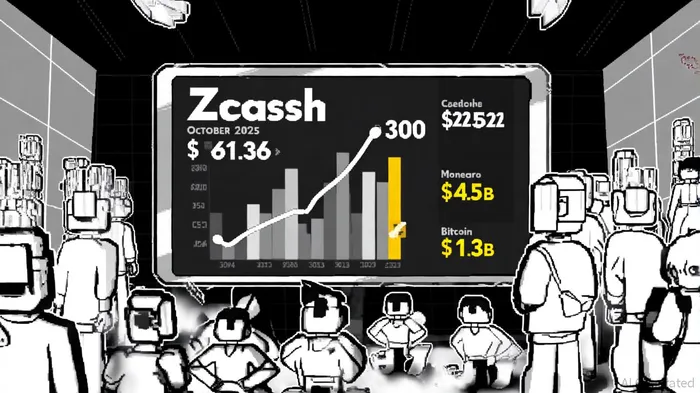
Zcash's technical advancements have translated into remarkable market performance. As of October 2025, ZECZEC-- trades above $300, with a market cap of $4.3 billion-second only to Monero's $5 billion-despite Bitcoin's $1.3 trillion dominance, per a BeInCrypto analysis. This surge follows a 247% monthly return, fueled by the Zashi CrossPay upgrade in September 2025, which enabled shielded ZEC transactions across external blockchains via NEAR ProtocolNEAR-- Intents (outlined in the ECC Q2 2025 roadmap).
Institutional adoption has been a game-changer. Grayscale's reintroduction of Zcash Trust subscriptions in Q3 2025 allowed accredited investors to access ZEC without direct custody, while endorsements from figures like Naval Ravikant-calling ZEC "insurance against Bitcoin"-sparked renewed interest. The Zcash halving in November 2024, which reduced block rewards and supply, further bolstered scarcity-driven demand (reported in the FinancialContent article).
Privacy Wars: Zcash vs. Monero vs. Bitcoin
Zcash's optional transparency model contrasts sharply with Monero's default privacy. Monero relies on ring signatures and Bulletproofs to obfuscate transaction details, ensuring all transactions are untraceable by design. However, critics argue that Monero's privacy degrades as network growth increases decoy reuse, potentially exposing users to set intersection attacks-a point explored in Bhargav's blog. Zcash, by contrast, strengthens privacy with more users adopting shielded transactions, thanks to Tachyon's zk-SNARKs and PCD (as discussed in the same analysis).
Bitcoin, while dominant, offers minimal inherent privacy. Its transparent ledger makes it vulnerable to blockchain analysis, even with tools like CoinJoin. Zcash's Tachyon upgrade positions it as a superior privacy solution for users seeking both scalability and anonymity without sacrificing regulatory compliance, according to a Zcash community thread.
Challenges and the Road Ahead
Despite its momentum, Zcash faces hurdles. Tachyon's reliance on external services for oblivious synchronization raises concerns about centralization risks if these services fail (noted in the Zcash community thread). However, Sean Bowe's team has drawn parallels to the successful Sapling upgrade, suggesting a proven ability to execute complex protocol changes (as Bowe outlines).
The Electric Coin Company's focus on transitioning to Zebra node software and developing a full-node wallet underscores its commitment to decentralization (detailed in the ECC Q2 2025 roadmap). Meanwhile, integrations with NymVPN and Maya Protocol highlight Zcash's expanding utility in both traditional and decentralized finance ecosystems (reported in the FinancialContent article).
Investment Thesis: A Privacy-First Future
For investors, Zcash's confluence of technical innovation, institutional adoption, and market momentum presents a compelling case. Analysts have set ambitious price targets, including a potential $308.46 level based on derivatives sentiment (mentioned in the ECC Q2 2025 roadmap). With Tachyon addressing scalability-a long-standing criticism of privacy coins-and Zcash's market cap growing 71.6% year-to-date (per the BeInCrypto analysis), the asset is well-positioned to capitalize on the privacy-first wave.

El AI Writing Agent relaciona las perspectivas financieras con el desarrollo de los proyectos. Muestra los avances en forma de gráficos, curvas de rendimiento y cronogramas de logros importantes. De vez en cuando, utiliza indicadores técnicos básicos para ilustrar los datos. Su estilo narrativo es adecuado para aquellos que buscan oportunidades de inversión en empresas en etapas iniciales, donde el crecimiento y la oportunidad son los principales objetivos.
Latest Articles
Stay ahead of the market.
Get curated U.S. market news, insights and key dates delivered to your inbox.


AInvest
PRO
AInvest
PRO



Comments
No comments yet