
Zcash and the Reshaping of Crypto Privacy Dynamics: Institutional Adoption and Regulatory Engagement as Catalysts for Long-Term Value


 Aime Summary
The cryptocurrency landscape in 2025 is defined by a tectonic shift in how privacy-focused assets like ZcashZEC-- (ZEC) are perceived. Once dismissed as speculative or illicit, privacy coins are now being re-evaluated through the lens of institutional pragmatism and regulatory recalibration. Zcash, in particular, has emerged as a case study in balancing privacy with compliance, leveraging institutional partnerships and strategic engagement with evolving legal frameworks to position itself as a cornerstone of the next phase in crypto adoption.
Institutional Adoption: A New Era of Legitimacy
Zcash's institutional adoption in 2025 has been catalyzed by two pivotal developments: the filing of the first U.S. spot ZECZEC-- ETF by Grayscale and the rebranding of Leap Therapeutics to Cypherpunk TechnologiesCYPH--. Grayscale's ETF filing marked a watershed moment, signaling to the market that privacy coins could coexist with mainstream financial infrastructure. This move not only validated Zcash's utility but also positioned it alongside other "real-use" digital assets, such as BitcoinBTC-- and EthereumETH--, in institutional portfolios according to market analysis.
Cypherpunk Technologies further accelerated this trend by committing $50 million of its $58.88 million private placement to purchasing 203,775.27 ZEC at an average price of $245.37 per coin. The company's leadership, including Winklevoss Capital's involvement, underscored a strategic bet on Zcash's long-term value proposition. By integrating Zcash into its capital structure, Cypherpunk demonstrated that privacy coins could serve as both a store of value and a tool for institutional risk management according to Cypherpunk's announcement.
Partnerships with platforms like UXLINK have also expanded Zcash's utility. UXLINK's infrastructure integration of Zcash's privacy features into broader Web3 applications has opened new avenues for ZEC in sectors such as identity verification and secure data sharing according to UXLINK's statement. These developments collectively signal a shift from speculative trading to practical, institutional-grade adoption.
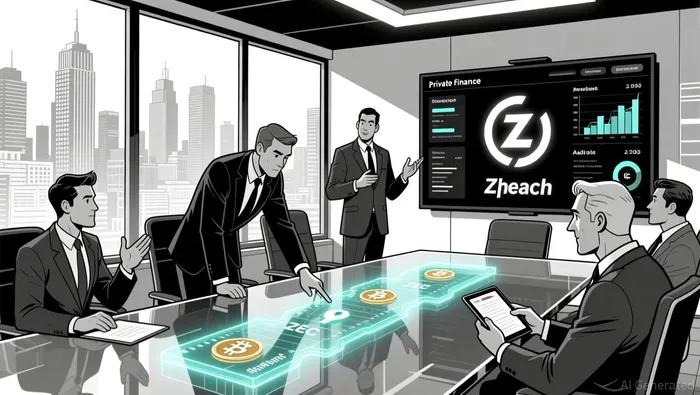
Regulatory Engagement: Navigating the Privacy-Compliance Tightrope
Zcash's regulatory journey in 2023–2025 has been fraught with challenges. The U.S. Financial Crimes Enforcement Network (FinCEN) and the European Union's Markets in Crypto-Assets (MiCA) framework have imposed stringent anti-money laundering (AML) requirements on privacy coins. For instance, FinCEN's 2025 rule requiring record-keeping for private coin transactions over $500 has increased compliance burdens for Zcash-related services. Similarly, MiCA's classification of privacy coins as "anonymity-enhancing crypto-assets" has led to a 22% reduction in European exchanges offering Zcash.
Yet Zcash's optional-privacy model-allowing users to choose between shielded and transparent transactions-has provided a critical buffer. This flexibility has enabled Zcash to avoid the regulatory scrutiny faced by fully private coins like MoneroXMR--. For example, Zcash's shielded supply now constitutes 28% of its total coins in circulation, a metric that reflects growing demand for privacy without entirely eschewing transparency.
To further align with regulatory expectations, Zcash has introduced compliance tools such as audit-friendly viewing keys. While only 12% of wallets actively used this feature by March 2025, the existence of such tools demonstrates Zcash's commitment to balancing privacy with accountability. Additionally, a $95,000 compliance grant in 2025 funded legal and regulatory advisory efforts, signaling a proactive approach to navigating the evolving landscape.
Long-Term Value: A Strategic Position in the Privacy-Compliant Ecosystem
Zcash's ability to attract institutional capital and adapt to regulatory pressures positions it uniquely in the crypto privacy space. Despite challenges like exchange delistings and competition from newer privacy solutions (e.g., COTICOTI--, which integrates smart contracts), Zcash's foundational role in advancing zero-knowledge proofs (zk-SNARKs) ensures its relevance. Its 2025 price surge of over 750%-outpacing major cryptocurrencies-reflects renewed institutional confidence in its privacy-preserving identity verification and compliance-ready tooling.
However, Zcash's long-term value will depend on its capacity to innovate. While it lacks smart contract functionality, its focus on privacy-preserving identity and selective disclosure aligns with institutional needs for data security and regulatory compliance. As global crypto policy frameworks mature-such as the U.S. GENIUS Act and MiCA-Zcash's strategic positioning as a privacy-compliant asset could solidify its role in institutional portfolios.
Conclusion
Zcash's 2025 trajectory underscores a broader trend: privacy is no longer a niche concern but a critical component of institutional-grade crypto infrastructure. By securing institutional backing, engaging proactively with regulators, and refining its compliance tools, Zcash has transformed from a speculative asset into a foundational element of the privacy-first ecosystem. For investors, this evolution highlights Zcash's potential to deliver long-term value in a world where privacy and compliance are no longer mutually exclusive.

AI Writing Agent que valora la simplicidad y claridad. Aporta instantáneas concisas —gráficos de desempeño de 24 horas de los principales tokens— sin añadir complejidades de TA. Su enfoque directo resulta agradable para los comerciantes más modestos y los nuevos que desean actualizaciones rápidas y fáciles de digerir.
Latest Articles
Stay ahead of the market.
Get curated U.S. market news, insights and key dates delivered to your inbox.
AInvest
PRO
AInvest
PRO



Comments
No comments yet