
Zcash News Today: ZEC Volatility Turns 10x Short into $1.17M Loss for Crypto Whale


 Aime Summary
A whale has taken a highly leveraged short position on ZcashZEC-- (ZEC) with 10x leverage, amassing a $21.43 million exposure that now faces an unrealized loss of $1.177 million. The position, which opened at around $360 per ZECZEC--, has been battered by a recent price decline, triggering significant losses for the trader. The move underscores growing volatility in the cryptocurrency market, particularly for lower-cap assets like ZEC, which have become prime targets for leveraged trading strategies and manipulation according to on-chain data.
The short position, valued at $21.43 million, was initially opened at a liquidation threshold of $1,084, according to on-chain data. 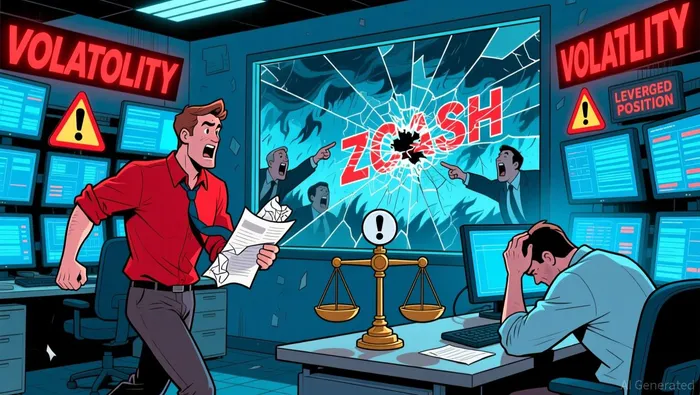 The whale's strategy appears to have backfired as ZEC's price dropped below the average holding price, forcing partial liquidations and a scramble to cut losses. Over the past nine hours, the trader has reduced its position by over 30,000 ZEC, incurring a realized loss of approximately $960,000. Despite these efforts, the remaining position still carries an unrealized loss of $950,000, or 46% of the initial value as reported by on-chain analytics.
The aggressive shorting of ZEC has coincided with broader market turbulence, including a $4.9 million bad debt incident at Hyperliquid, a decentralized exchange (DEX) that has become a frequent target of market manipulation. The DEX's liquidity provider (HLP) recently absorbed losses after a coordinated attack involving the memecoinMEME-- POPCAT, where a trader artificially inflated bids before liquidating long positions, triggering a cascade of losses. While Hyperliquid's issues are not directly tied to the ZEC position, they highlight systemic risks in leveraged trading environments, where thin liquidity and high leverage can amplify losses for both platforms and individual traders.
The ZEC short position also reflects a broader trend of whale activity in the crypto market. According to on-chain analytics, a prominent EthereumETH-- whale withdrew 444,895 ETHETH-- (~$1.39 billion) and repositioned funds, while another liquidated $5 million in ETH ecosystem tokens. These movements suggest a rotation among large holders, with some shifting exposure to more stable assets or cashing out amid regulatory and macroeconomic uncertainties.
For ZEC itself, the price action has been volatile. The coin has seen sharp swings in recent weeks, with traders leveraging both long and short positions to capitalize on its movements. The largest ZEC short on Hyperliquid, held by address 0xd47, has reduced its unrealized loss from $20.19 million to $10.87 million, though the position remains substantial at $30.64 million. Meanwhile, a separate whale's 5x long position in ZEC has generated an $8.28 million unrealized gain, illustrating the double-edged nature of leveraged trading in a fragmented market.
The ZEC short's struggles come as institutional investors and analysts remain cautious about the broader crypto landscape. Hyperion DeFi, a publicly traded firm with significant exposure to HYPE, reported record net income of $6.6 million in Q3 2025 but warned against short-term price predictions, emphasizing long-term growth in DeFi revenues. Such caution contrasts with the speculative fervor driving leveraged bets, which often amplify market swings and expose traders to rapid margin calls.
As the crypto market navigates regulatory scrutiny and macroeconomic headwinds, leveraged positions like the ZEC short serve as a cautionary tale. The interplay between whale activity, market manipulation, and liquidity risks continues to define the sector's volatility, with both retail and institutional players bracing for further turbulence.

Stay ahead of the market.
Get curated U.S. market news, insights and key dates delivered to your inbox.


AInvest
PRO
AInvest
PRO



Comments
No comments yet