
Zcash News Today: Privacy Coins Struggle as Regulators Crack Down and Investors Seek Yield


 Aime Summary
Arthur Hayes, co-founder of BitMEX, has issued a stark warning about Monad, a privacy-focused cryptocurrency, suggesting it could plummet by 99% due to its high-risk profile as a "VC coin." This assessment aligns with broader concerns in the crypto market about speculative projects lacking robust fundamentals or regulatory clarity. While Hayes did not directly reference ZcashZEC-- (ZEC) in his remarks, the broader context of privacy coin volatility and regulatory scrutiny mirrors recent analyses of Zcash's price trajectory. The Zcash Foundation's own price forecasts, detailed in a comprehensive 2025-2040 report, highlight similar risks, particularly under a bear case scenario where ZEC could drop below $100 amid harsh regulatory crackdowns and liquidity constraints.
The Zcash report outlines three potential price paths for the privacy coin, with the bear case emphasizing the growing regulatory hostility toward privacy-focused assets. Governments, including the U.S. and EU, have increasingly targeted such coins for their perceived ties to illicit activity, leading to exchange delistings and stricter compliance measures. For instance, the U.S. Senate's pending CLARITY Act, while not explicitly targeting privacy coins, could indirectly suppress demand by tightening anti-money laundering (AML) rules. This regulatory environment, combined with competition from newer zero-knowledge (ZK) ecosystems, poses a significant threat to Zcash's long-term adoption.
Market dynamics further amplify these risks. Zcash's price has historically been volatile, with a recent surge to a nine-year high of $740 in November 2025 driven by speculative hype rather than structural improvements. Analysts at 99Bitcoins note that without tangible regulatory support or technological differentiation, Zcash could remain rangebound or face sharp declines if macroeconomic conditions deteriorate. The Federal Reserve's potential rate cuts, for example, could shift capital flows away from speculative assets like privacy coins, exacerbating downward pressure.
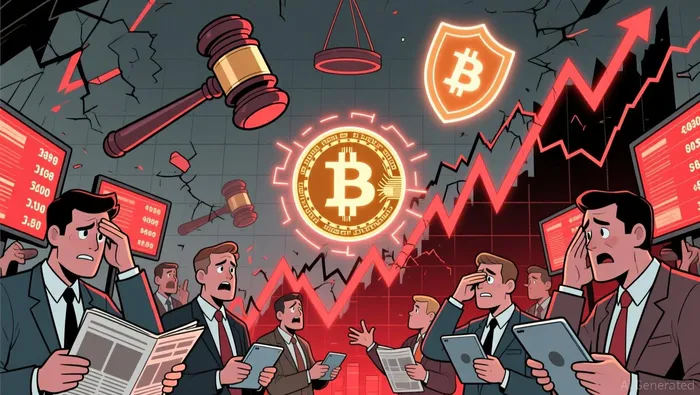 The bear case scenario for Zcash-projecting a price drop below $100-mirrors Hayes' warning about Monad, underscoring the fragility of projects that rely heavily on niche demand for financial privacy. While Zcash has a fixed supply of 21 million tokens and optional privacy features, these advantages may not suffice to counter regulatory headwinds or competition from more scalable privacy solutions. The report also highlights the risk of quantum computing advancements, which could undermine Zcash's cryptographic security over time.
In contrast, projects like BitcoinBTC-- Munari, a new fixed-supply asset launching on SolanaSOL--, emphasize structured development and macroeconomic resilience. Bitcoin Munari's phased rollout, with a fixed 21 million supply and presale rounds unaffected by market volatility, contrasts with the speculative nature of privacy coins like Zcash. Such models aim to attract institutional and retail investors seeking stability amid crypto's inherent volatility.
The broader market's shift toward yield-generating assets also challenges privacy coins. Solana ETFs, for instance, attracted $369 million in November as investors prioritized staking rewards over speculative bets. This trend reflects a growing preference for projects that offer utility beyond privacy, such as DeFi integration or cross-chain interoperability. Zcash's focus on anonymity, while still relevant to a niche audience, may struggle to compete in this evolving landscape.
As the crypto market navigates regulatory uncertainty and shifting investor priorities, the fate of privacy coins like Zcash-and speculative projects like Monad-remains precarious. Hayes' warning serves as a cautionary note for investors, emphasizing the need to scrutinize fundamentals, regulatory exposure, and long-term viability. For Zcash, the coming years will test its ability to adapt to a landscape where privacy is increasingly at odds with compliance.

Conoce rápidamente la historia y el antecedente de diferentes monedas conocidas
Latest Articles
Stay ahead of the market.
Get curated U.S. market news, insights and key dates delivered to your inbox.


AInvest
PRO
AInvest
PRO



Comments
No comments yet