
Zcash News Today: Institutions Bet on Zcash's Quantum Resilience as Bitcoin Lags


 Aime Summary
Zcash Developers Outpace BitcoinBTC-- in Quantum Threat Preparedness
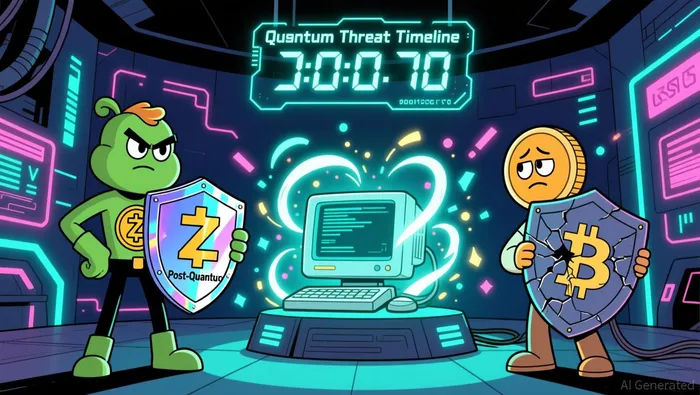 Zcash (ZEC) is positioning itself as a quantum-resistant pioneer in the cryptocurrency space, with developers implementing proactive measures to safeguard against future quantum computing threats-a stark contrast to Bitcoin's slower, more cautious approach. As quantum computing advances, the vulnerability of elliptic-curve cryptography, used by both ZcashZEC-- and Bitcoin, has intensified urgency for upgrades. Zcash's modular network design and governance model enable rapid deployment of post-quantum cryptographic solutions, while Bitcoin's decentralized consensus process complicates swift action.
Zcash's readiness stems from its repeatable network upgrade framework, exemplified by the 2022 NU5 upgrade, which introduced Halo 2 and the Orchard shielded pool. This process allows the chain to adapt its cryptography via on-chain consensus, a flexibility absent in Bitcoin's rigid upgrade mechanisms. The Electric Coin Company and Zcash Foundation are leveraging this agility to integrate post-quantum algorithms, such as NIST's standardized lattice-based CRYSTALS-Dilithium and hash-based SPHINCS+ signatures. These tools, though not yet deployed, are candidates for future upgrades once performance optimizations are validated.
A key innovation is Zcash's "quantum recoverability" strategy, a contingency plan designed to buy time during a quantum attack. Engineer Sean Bowe explains that this approach structures the protocol to pause, upgrade, and restore user access if quantum computers break current cryptography. Unlike Bitcoin, where a quantum attacker could immediately drain accounts, Zcash's system ensures users retain control during transitions. Bowe notes that most protocol work for quantum recoverability is complete, with wallet software updates expected in 2025.
Institutional interest in Zcash's quantum resilience is fueling market momentum. Cypherpunk Technologies, a privacy-focused firm, recently purchased $18 million in ZEC, raising its holdings to 1.43% of the total supply. This follows a 125% price surge in 30 days, outpacing Bitcoin's decline, as shielded pool activity hit multi-year highs. Analysts attribute this to Zcash's zero-knowledge proofs and quantum-safe cryptography, which align with growing concerns over blockchain surveillance.
Bitcoin, by contrast, lacks a concrete post-quantum roadmap. While developers have discussed options on the bitcoin-dev mailing list, no mainnet upgrades have materialized. Vitalik Buterin's recent warnings -citing potential quantum breaks in Bitcoin and Ethereum's cryptography by 2028- have amplified concerns. However, Bitcoin's upgrade process, requiring broad consensus, poses challenges for rapid responses.
Traders are advised to monitor Zcash's ZIP proposals, testnet deployments, and engineering updates as leading indicators of quantum readiness. For example, a ZIP proposing post-quantum key rotation or a timeline mirroring prior upgrades could trigger market optimism. Meanwhile, Bitcoin's lack of progress may drive investors toward privacy coins like ZECZEC--, particularly as institutional allocations to quantum-resistant assets grow.
The broader crypto market is also recalibrating. Ethereum faces dual pressures from institutional ETH concentration and quantum risks, with Buterin advocating for "layered ossification" to balance adaptability and stability. Yet Zcash's focused approach on quantum threats highlights a niche where privacy coins can differentiate themselves in a post-quantum era.
As quantum computing timelines remain uncertain, Zcash's proactive stance-coupled with institutional validation-positions it as a bellwether for the next phase of crypto innovation. For now, the race to quantum resilience is not just technical but financial, with ZEC's trajectory underscoring the growing premium on forward-looking security.

Stay ahead of the market.
Get curated U.S. market news, insights and key dates delivered to your inbox.


AInvest
PRO
AInvest
PRO



Comments
No comments yet