
Zcash Halving and Its Implications for Cryptocurrency Valuation
 Aime Summary
Zcash's Halving Mechanism: A Scarcity-Driven Framework
Zcash's halving occurs every 1,680,000 blocks, approximately every four years, with the next event expected at block height 4,406,400 in late 2028 according to CoinCodex. This systematic reduction in block rewards-first implemented in 2020 and again in 2024-lowers the annual inflation rate, creating a deflationary supply curve. Unlike BitcoinBTC--, Zcash's design includes the ZIP 1015 lockbox mechanism, which withholds 12% of block rewards to reduce daily liquidity by roughly $337,000. This dual-layer scarcity model-combining halving with liquidity constraints-positions Zcash as a hybrid between Bitcoin's supply constraints and tailored monetary policy.
Historical Price Performance: Scarcity and Sentiment in Action
Historical data reveals Zcash's price responsiveness to halving events. The 2024 halving, which cut block rewards to 1.5625 ZEC, coincided with a 1,172% surge in 2025, driven by institutional adoption (e.g., Grayscale's Zcash Trust acquiring 5% of the total supply) and regulatory clarity. Similarly, the 2020 halving saw a 950% price increase by year-end, fueled by speculative demand and reduced supply according to market analysis. These trends align with Bitcoin's historical pattern, where halvings have historically preceded multi-year bull markets as reported in community discussions. However, Zcash's volatility underscores the role of liquidity and sentiment, with social media and behavioral economics amplifying short-term swings as noted in community forums.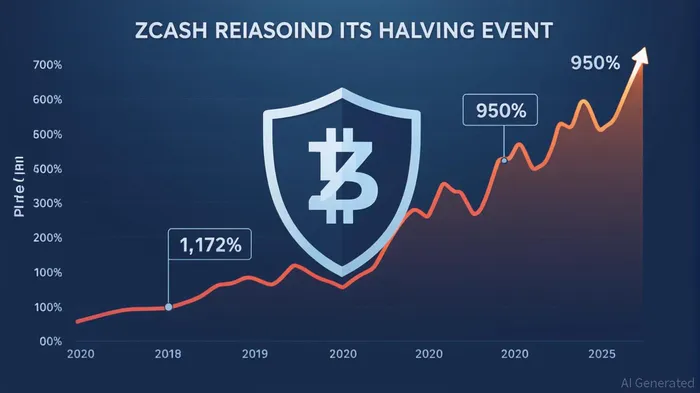 ### Investor Psychology: Scarcity Narratives and Behavioral Biases
The psychological impact of halving events is profound. Scarcity economics, a well-documented driver of value, triggers fear of missing out (FOMO) among retail and institutional investors. Zcash's privacy features further differentiate it, appealing to investors seeking anonymity in an era of heightened regulatory scrutiny according to market analysis. For example, post-2024, Zcash's price surge coincided with growing institutional interest in privacy coins, despite broader regulatory skepticism as reported in financial news. This duality-scarcity and privacy-creates a unique value proposition, though it also exposes Zcash to regulatory risks that could dampen demand.
Comparative Analysis: Zcash vs. Bitcoin and Other PoW Cryptocurrencies
While Bitcoin remains the gold standard for scarcity economics, Zcash's hybrid proof-of-work (PoW) and privacy-driven model introduces distinct advantages. Litecoin's 2023 halving, for instance, failed to generate comparable price momentum, highlighting the importance of institutional adoption and narrative strength according to market reports. Zcash's post-2024 performance, marked by a 950% increase, mirrors Bitcoin's post-halving trajectories but is amplified by its lockbox mechanism and privacy appeal as observed in financial analysis. However, Bitcoin's entrenched dominance and broader market recognition mean its halving events still command greater psychological weight as discussed in community forums.
Strategic Investment Considerations
For long-term investors, Zcash's 2028 halving presents a strategic opportunity, contingent on three factors:
1. Regulatory Resilience: Zcash must navigate privacy coin scrutiny while maintaining utility.
2. Institutional Adoption: Continued trust from entities like Grayscale could mirror Bitcoin's post-halving institutional inflows according to market analysis.
3. Price Elasticity: The 2028 halving is projected to reduce Zcash's inflation rate to 1%, potentially driving demand if mining costs and network security remain stable as estimated by analysts.
However, risks persist. Privacy coins face regulatory headwinds, and Zcash's price volatility-exacerbated by liquidity constraints-could deter risk-averse investors.
Conclusion: A Scarcity-Driven Buy?
Zcash's halving schedule, coupled with its deflationary and privacy-centric design, creates a compelling case for long-term investment. While Bitcoin's scarcity narrative remains unmatched, Zcash's unique features-liquidity-reducing lockboxes, institutional adoption, and privacy-offer a differentiated value proposition. For investors willing to navigate regulatory uncertainties and short-term volatility, Zcash's 2028 halving could catalyze a new bull cycle, particularly if institutional demand mirrors Bitcoin's post-halving trends. As with any speculative asset, due diligence on regulatory and market dynamics is essential.

Blending traditional trading wisdom with cutting-edge cryptocurrency insights.
Latest Articles
Stay ahead of the market.
Get curated U.S. market news, insights and key dates delivered to your inbox.






Comments
No comments yet