
Zcash Halving and Its Implications for Cryptocurrency Markets
 Aime Summary
Bitcoin's Halving Legacy: A Blueprint for Scarcity-Driven Value
Bitcoin's halving events, occurring roughly every four years, have historically reinforced its narrative as "digital gold." The 2012, 2016, and 2020 halvings reduced block rewards from 50 to 25, then 12.5, and finally 6.25 BTC, respectively. These events have often coincided with price surges, driven by reduced supply and speculative demand. For instance, Bitcoin's 2020 halving preceded a 150% rally in 2021, as institutional adoption and macroeconomic tailwinds amplified scarcity-driven narratives. This pattern underscores the importance of supply-side mechanics in shaping investor behavior.
Zcash's Halving Trajectory: Privacy, Upgrades, and Market Volatility
Zcash, launched in 2016, mirrors Bitcoin's emission schedule but introduces a critical distinction: optional shielded transactions that encrypt sender, receiver, and transaction amounts. 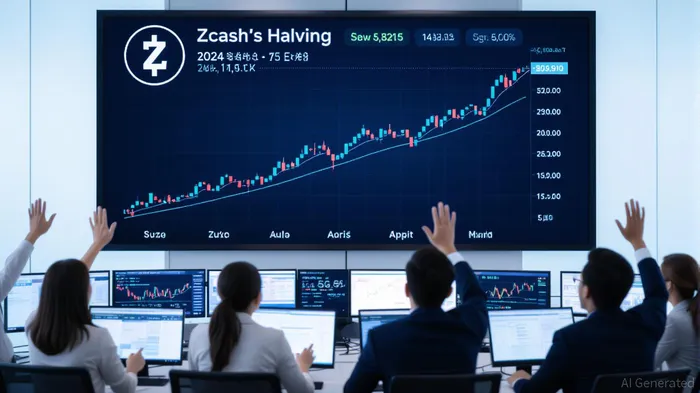 . Its first halving in November 2020 reduced block rewards from 12.5 to 6.25 ZECZEC--, but the market response was muted, with ZEC trading at around $100 by year-end. However, the second halving in late 2024-cutting rewards to 3.125 ZEC-coincided with the NU5 (Halo) network upgrade, which enhanced scalability and privacy features. This upgrade, coupled with institutional adoption via the Grayscale Zcash Trust, catalyzed a 1,172% year-to-date price surge, pushing ZEC to $589.
This divergence highlights how technological upgrades and adoption metrics can amplify or dampen the impact of halving events. Unlike Bitcoin, where price reactions are often supply-driven, Zcash's market dynamics are influenced by privacy demand, regulatory sentiment, and ecosystem development. For example, Zcash's Canopy upgrade in 2020 allocated a portion of block rewards to fund development, fostering innovation while maintaining scarcity.
Comparative Analysis: Scarcity vs. Privacy as Value Drivers
While both Bitcoin and Zcash rely on halving to reduce supply inflation, their value propositions diverge. Bitcoin's appeal lies in its transparent ledger and store-of-value narrative, whereas Zcash's privacy features cater to a niche but growing segment of investors prioritizing financial confidentiality. This distinction is reflected in market behavior: Bitcoin's halving events tend to attract macro-driven speculation, while Zcash's price movements are more closely tied to upgrades and adoption of shielded transactions.
However, Zcash's privacy-centric model also introduces risks. Regulatory scrutiny of shielded transactions-particularly in jurisdictions like the U.S.-could dampen demand, as seen with MoneroXMR-- (XMR) in 2023. Investors must weigh these risks against Zcash's potential to benefit from a broader privacy narrative, especially as concerns over data privacy intensify as highlighted in recent analyses.
Investment Strategies: Speculative Timing vs. Long-Term Positioning
For speculative investors, Zcash's halving events present opportunities to capitalize on short-term volatility. The 2024 halving, for instance, was preceded by a 30% price rally in the six months leading up to the event, driven by anticipation of the NU5 upgrade. However, timing such moves requires careful analysis of on-chain metrics and ecosystem developments, as halvings alone do not guarantee price surges.
Long-term investors, meanwhile, may focus on Zcash's structural advantages. Its capped supply of 21 million coins aligns with Bitcoin's scarcity model, while its privacy features position it as a hedge against surveillance in an increasingly data-centric world. Institutional adoption, such as the Grayscale Zcash Trust, further signals confidence in its utility as a privacy asset. Investors seeking diversification beyond transparent blockchains might view Zcash as a strategic addition to a crypto portfolio, particularly if privacy becomes a dominant theme in the next bull market.
Conclusion: Navigating the Future of Privacy-Driven Assets
Zcash's halving events illustrate the complex interplay of supply-side mechanics, technological innovation, and market sentiment in privacy-focused digital assets. While Bitcoin's halving legacy provides a blueprint for scarcity-driven value, Zcash's unique position as a privacy coin introduces variables that require nuanced analysis. For investors, the key lies in balancing short-term speculation with long-term conviction in Zcash's ability to address evolving demand for financial privacy. As the cryptocurrency market matures, assets like Zcash may play a pivotal role in shaping the next phase of digital finance-where privacy and scarcity converge.

Blend tradicional sabiduría comercial con conocimiento de criptomoneda de vanguardia.
Latest Articles
Stay ahead of the market.
Get curated U.S. market news, insights and key dates delivered to your inbox.






Comments
No comments yet