
Zcash Halving 2025 and Its Implications for Privacy-Centric Crypto Adoption


 Aime Summary
The Mechanics of Deflation and Scarcity
Zcash's halving cycle, occurring every 1,680,000 blocks (roughly four years), is engineered to mimic Bitcoin's scarcity model while enhancing privacy. The 2025 halving slashed annual inflation to 2%, a critical threshold for asset classes competing with Bitcoin's 1.8% inflation rate. By locking 12% of block rewards in a community wallet, ZIP 1015 further tightens liquidity, creating a deflationary flywheel that could theoretically drive demand higher as supply dwindles. For context, Bitcoin's halvings have historically correlated with price surges, but Zcash's unique blend of privacy and controlled supply may offer a more nuanced narrative.
Historical Volatility: A Double-Edged Sword
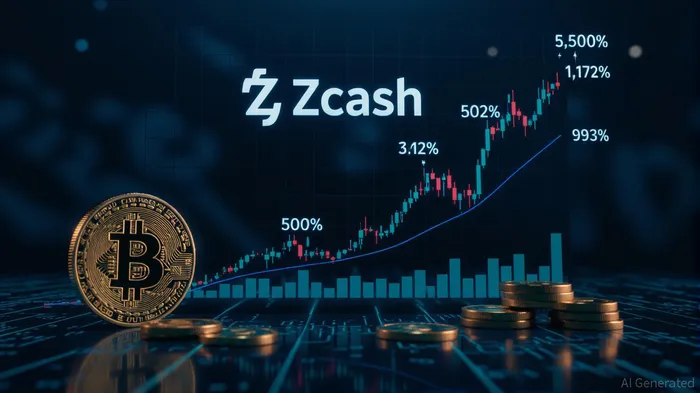 History shows Zcash's halvings are catalysts for explosive gains-and brutal corrections. The 2020 halving triggered a 500% price surge, while the 2024 event saw a staggering 1,172% rally, pushing ZEC to $750. Yet these gains were short-lived. Within weeks, the price collapsed to $25.96, a 97% drop, as traders cashed in profits amid broader market jitters. This volatility is partly attributable to Zcash's $10.3 billion market cap, which makes it susceptible to liquidity shocks and concentrated ownership.
The 2025 halving followed a similar pattern. ZEC surged 942% year-over-year to $526.48 by late November 2025, only to face a 4.2% dip to $421 in early December 2025 as traders took profits. Such whipsaws highlight the risks of investing in a nascent asset class where sentiment and macroeconomic factors (e.g., Bitcoin's performance) often override fundamentals.
Institutional Adoption: A Ray of Hope?
Despite the volatility, institutional interest in Zcash has grown. The Grayscale Zcash Trust injected $137 million into the ecosystem, signaling confidence in its privacy-centric model. Meanwhile, ZIP 1015's lockbox mechanism has attracted attention from investors seeking assets with built-in scarcity, particularly as privacy coins face regulatory scrutiny under frameworks like the EU's MiCA.
However, institutional adoption is a double-edged sword. While it can stabilize prices by injecting liquidity, it also raises concerns about centralization. For Zcash to thrive long-term, it must balance privacy with regulatory compliance-a tightrope walk that could determine its fate in 2028 and beyond.
The Road to 2028: A New Halving Horizon
With the next halving scheduled for late 2028 at block height 4,406,400, Zcash's annual inflation will drop to 1%, matching Bitcoin's projected rate. If historical patterns repeat, this could trigger another price rally, especially if institutional adoption accelerates. Yet the path is fraught with challenges.
Regulatory headwinds remain a wildcard. Privacy coins like Zcash are under the microscope for their potential misuse in illicit activities, and stricter compliance measures could dampen demand. Conversely, if Zcash successfully navigates these hurdles-perhaps by integrating selective transparency features-it could carve out a niche in a post-MiCA world where privacy and regulation coexist.
Final Verdict: A High-Risk, High-Reward Proposition
Zcash's 2025 halving underscores its potential as a privacy-centric alternative to BitcoinBTC--, but investors must tread carefully. The asset's volatility, while enticing for traders, poses significant risks for long-term holders. For those willing to stomach the ride, Zcash's deflationary mechanics and growing institutional interest offer a compelling case for future value creation. However, success hinges on its ability to adapt to regulatory realities and maintain its edge in a crowded crypto market.
As the clock ticks toward the 2028 halving, one thing is clear: Zcash's journey is far from over. Whether it becomes a cornerstone of the privacy-first crypto ecosystem or fades into obscurity will depend on how well it balances innovation with pragmatism..

Blending traditional trading wisdom with cutting-edge cryptocurrency insights.
Latest Articles
Stay ahead of the market.
Get curated U.S. market news, insights and key dates delivered to your inbox.






Comments
No comments yet