
Zcash Halving 2025: Implications for Crypto Markets and Investor Strategy


 Aime Summary
Blockchain Economics: Supply Constraints and Miner Incentives
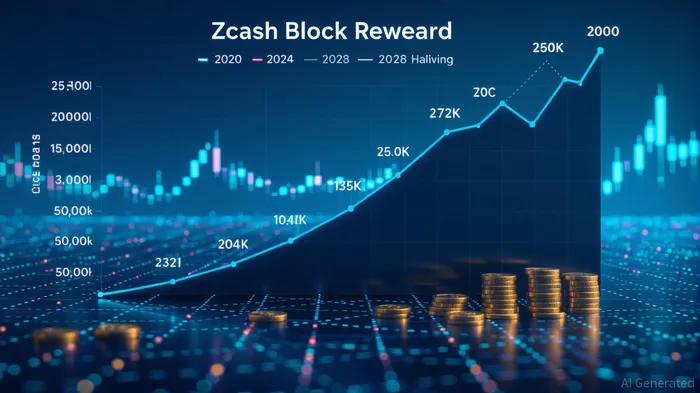
Zcash's halving mechanism operates on a four-year cycle, reducing block rewards by 50% after every 1,680,000 blocks mined CoincideX. The most recent halving, in November 2024, cut block rewards from 3.125 ZECZEC-- to 1.5625 ZEC CoincideX, aligning with its trajectory toward a maximum supply cap of 21 million ZEC. The next halving, expected at block height 4,406,400, will further reduce rewards to 0.78125 ZEC CoincideX.
This deflationary model mirrors Bitcoin's supply schedule but introduces unique dynamics. By tightening the issuance rate, Zcash reduces annual inflation from 6.25% post-2024 to 4% by late 2025 Coinpedia. Such supply constraints inherently create scarcity, a key driver of speculative demand in proof-of-work (PoW) cryptocurrencies. However, miners face reduced revenue, potentially leading to short-term selling pressure unless offset by rising ZEC prices Coinpedia.
Speculative Demand: Historical Patterns and Institutional Shifts
Historical data reveals a strong correlation between Zcash halvings and price surges. The 2020 halving catalyzed a 500% price increase, while the 2024 event spurred a 92% rally by Q4 2025 Coinpedia. These trends align with the broader thesis that supply reductions amplify demand, particularly in markets where Zcash's privacy features-such as shielded transactions-gain traction Coinpedia.
Institutional adoption has further bolstered speculative momentum. The launch of the $137 million Grayscale Zcash Trust in 2025 Coinpedia marked a pivotal shift, signaling growing institutional confidence in Zcash's utility. Meanwhile, network upgrades like the Zashi wallet and CrossPay have expanded Zcash's real-world applications, enhancing its appeal beyond speculative trading Coinpedia.
Market Behavior: Counter-Cyclical Trends and Regulatory Risks
Zcash's price dynamics often diverge from Bitcoin's, particularly during market downturns. In late 2025, ZEC surged 750% as investors flocked to privacy coins amid Bitcoin's volatility Coinpedia. This inverse correlation underscores Zcash's role as a hedge against regulatory and macroeconomic uncertainties. However, such counter-cyclical behavior is not without risks.
Regulatory scrutiny of privacy coins remains a wildcard. While the SEC's 2025 exemption of PoW mining from securities laws Coinpedia provided a temporary boost, stricter rules on shielded transactions could dampen adoption. Additionally, the Electric Coin Company's roadmap lacks clarity on post-halving supply adjustments, raising concerns about miner sell-offs and short-term price instability Coinpedia.
Strategic Considerations for Investors
For investors, the interplay of supply constraints, speculative demand, and regulatory risks demands a nuanced approach. Key strategies include:
1. Long-Term Positioning: Given Zcash's deflationary trajectory, holding ZEC through halving cycles may yield compounding benefits as supply dwindles.
2. Diversification: Balancing Zcash exposure with other privacy-focused assets or BitcoinBTC-- can mitigate risks from regulatory shifts.
3. Monitoring Network Upgrades: Projects like Zashi and CrossPay could drive utility-based demand, independent of speculative cycles Coinpedia.
Conclusion
The Zcash halving cycle remains a powerful lens for understanding blockchain economics and speculative behavior. While the next halving is not until 2028, the 2024 event's aftermath-marked by institutional adoption and price resilience-highlights Zcash's potential as both a store of value and a privacy-centric utility asset. Investors must weigh these opportunities against regulatory and market volatility risks, ensuring their strategies align with both macroeconomic trends and Zcash's evolving ecosystem.

Blending traditional trading wisdom with cutting-edge cryptocurrency insights.
Latest Articles
Stay ahead of the market.
Get curated U.S. market news, insights and key dates delivered to your inbox.


AInvest
PRO
AInvest
PRO



Comments
No comments yet