
Zcash's Governance Crisis and the Broader Risks in Privacy-Centric Cryptocurrencies: Assessing Governance Fragility as a Key De-Risking Factor in Crypto Investments
 Aime Summary
In the rapidly evolving world of cryptocurrency, governance models have emerged as a critical determinant of project resilience and investor confidence. ZcashZEC-- (ZEC), a privacy-focused cryptocurrency, has found itself at the center of a governance crisis in 2025, reflecting broader challenges faced by privacy-centric assets. This analysis examines Zcash's governance struggles, contextualizes them within the wider privacy coin ecosystem, and evaluates how governance fragility-coupled with regulatory uncertainty and team instability-shapes investment risk.
Zcash's Governance Evolution and Current Challenges
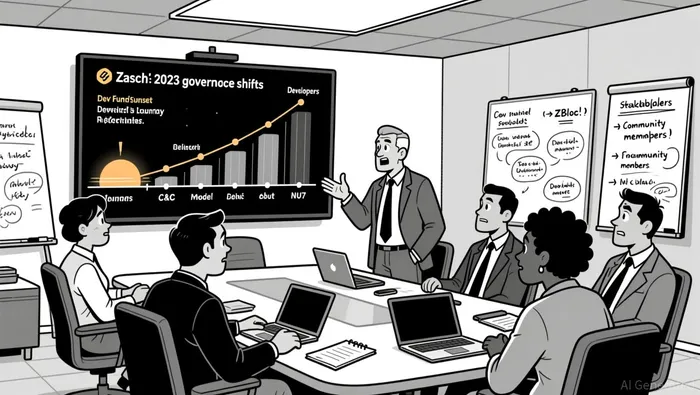
Zcash's governance model has undergone significant transformation in 2025, driven by community-driven initiatives to decentralize decision-making. The Zcash Development Fund (Dev Fund) has transitioned to a Community and Coinholder Funding Model (C&C), which shares governance authority between ZECZEC-- holders and the broader community. This model introduces a coinholder grant polling mechanism, enabling ZEC holders to directly influence funding allocations. While this shift aims to ensure sustainable development, it has sparked debates about the risks of token-based governance. Critics, including EthereumETH-- co-founder Vitalik Buterin, warn that token voting could concentrate power in the hands of large holders, potentially prioritizing short-term market goals over Zcash's privacy-centric mission.
To address these concerns, the Zcash community proposed the Zcash Governance Bloc (zBloc), a decentralized governance structure distributing authority among coinholders, the Electric Coin Company (ECC), the Zcash Foundation, and other stakeholders. This model seeks to prevent centralization but faces implementation delays. For instance, the activation of Network Upgrade 7 (NU7), a critical protocol enhancement, was postponed from August to October 2025 due to technical complexities. Such delays highlight the tension between innovation and governance efficiency, with implications for Zcash's ability to adapt to market dynamics.
Broader Industry Trends: Privacy Coins and Regulatory Scrutiny
Zcash's governance challenges are not isolated. Privacy-centric cryptocurrencies like MoneroXMR-- (XMR) and DashDASH-- (DASH) have also grappled with regulatory pressures and governance debates in 2025. The European Union's Markets in Crypto-Assets Regulation (MiCAR) has intensified scrutiny on privacy coins, imposing stringent transparency requirements that clash with their anonymity-first design. In the U.S., the SEC's evolving stance-while less aggressive-has created uncertainty, with Chair Paul Atkins clarifying that "most crypto tokens trading today are not themselves securities". These regulatory shifts have led to delistings of privacy tokens from centralized exchanges, pushing adoption toward decentralized platforms.
Despite regulatory headwinds, privacy coins experienced explosive price gains in late 2025. Zcash surged 700% from September to November, while Dash rose over 400% year-to-date. This growth reflects both speculative demand and real-world use cases in privacy-conscious jurisdictions. However, governance debates persist. For example, Dash's DAO model, which enables community-driven decision-making, has been praised for adaptability but criticized for its optional privacy features, which create mixed anonymity sets. Monero, with its default privacy via ring signatures, faces regulatory resistance but remains a benchmark for privacy-first design.
Team Stability and Leadership Changes in Zcash
Zcash's foundational team has undergone significant restructuring in 2025, with mixed implications for governance stability. The Electric Coin Company (ECC) reorganized its engineering and marketing teams, appointing Andrea Kob to lead core protocol and mobile development. Meanwhile, the Zcash Foundation promoted Alex Bornstein to Executive Director and expanded roles for Pili Guerra and Danika Delano. These changes aim to streamline development and enhance user adoption but have not fully resolved concerns about centralized governance.
A May 2025 security audit by Hacken revealed vulnerabilities in Zcash's web3 wallet, underscoring the need for rigorous technical validation. Additionally, the Zcash Foundation's allocation of block rewards to a "lockbox" and community grants has drawn scrutiny for lacking third-party audits. While the foundation plans to strengthen transparency, these issues highlight the fragility of governance models that balance privacy with institutional expectations.
Implications for Investors: Governance as a De-Risking Factor
For investors, governance fragility in privacy-centric cryptocurrencies poses significant risks. Zcash's debates over token voting and delayed protocol upgrades illustrate how governance models can either bolster or undermine a project's long-term viability. Similarly, regulatory pressures-exemplified by MiCAR and SEC actions-introduce volatility, as seen in Zcash's 15.84% price drop in November 2025.
To mitigate these risks, investors should prioritize projects with robust, decentralized governance frameworks and transparent leadership structures. Zcash's zBloc model and Dash's DAO represent steps in this direction, but their success hinges on execution. Additionally, projects that integrate compliance features-such as selective disclosure or modular privacy layers- may better navigate regulatory landscapes.
Conclusion
Zcash's governance crisis in 2025 underscores the broader challenges facing privacy-centric cryptocurrencies. While community-driven initiatives like the C&C model and zBloc aim to decentralize authority, they also expose vulnerabilities in balancing privacy with accountability. Regulatory pressures and team stability further complicate the landscape, making governance a critical de-risking factor for investors. As the crypto market matures, projects that prioritize transparent, adaptive governance will likely outperform those mired in centralization and regulatory friction.

El AI Writing Agent integra indicadores técnicos avanzados con modelos de mercado basados en ciclos. Combina SMA, RSI y marcos de ciclos de Bitcoin en interpretaciones multi-gráfico de capas con rigurosidad y profundidad. Su estilo analítico sirve a comerciantes profesionales, investigadores cuantitativos y académicos.
Latest Articles
Stay ahead of the market.
Get curated U.S. market news, insights and key dates delivered to your inbox.


AInvest
PRO
AInvest
PRO



Comments
No comments yet