
Zcash Development Team Resigns En Masse as Governance Dispute Rattles ZEC Price
 Aime Summary
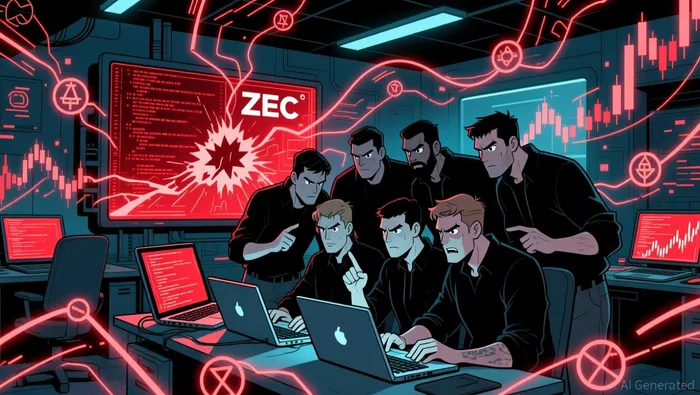
The core development team behind ZcashZEC-- (ZEC) has resigned en masse following a dispute with the Bootstrap board. The Electric Coin Company (ECC), the primary development entity, announced that all staff left after what CEO Josh Swihart described as a constructive discharge. The departure was linked to governance changes that the team said undermined Zcash's mission according to reports.
The mass resignation occurred on January 7, 2026, and coincided with a sharp sell-off in ZECZEC--. By January 8, the price had fallen 17% to $404.13. The decline reflects investor uncertainty about the project's future development and leadership continuity. The Zcash protocol remains operational, but concerns about its governance structure persist as reported.
Swihart stated that the ECC team is forming a new company to continue building the Zcash ecosystem. The new entity will retain the same team and mission of developing private, censorship-resistant digital money. The team emphasized that the Zcash protocol is unaffected by the resignation and continues to function independently according to statements.
Why Did This Happen?
The conflict began after a governance reorganization announced in late December 2025. According to Swihart, a majority of Bootstrap board members—specifically Zaki Manian, Christina Garman, Alan Fairless, and Michelle Lai—were misaligned with Zcash's mission. The team said employment conditions were altered in ways that made it impossible to continue working effectively as the team noted.
The Bootstrap board is a 501(c)(3) nonprofit established to govern ECC and protect Zcash's development. The resignations mark a rare event in the blockchain space, where a core team collectively leaves a project due to governance disagreements. The dispute highlights tensions between the development team and the governing entity about the project's future direction according to analysis.
How Did Markets Respond?
ZEC's price dropped 17% in the 24 hours following the announcement. At 9 a.m. ET on January 8, the token traded at $404.13. The decline occurred as investors priced in uncertainty about Zcash's governance and development roadmap. Trading volume increased sharply as traders adjusted positions ahead of further developments according to market data.
Market analysts noted that ZEC had been gaining attention in late 2025 as privacy-focused narratives resurged. However, the token had been in a correction phase in December 2025 due to profit-taking and liquidity pressures. The governance crisis added to this decline and raised questions about the project's long-term sustainability as reported by analysts.
What Are Analysts Watching Next?
The immediate challenge for Zcash is whether development can continue without the ECC team. The team has indicated it will form a new company, but it is unclear how this will interact with the broader Zcash ecosystem. Bootstrap and the Zcash Foundation will also need to reassess how protocol development is funded and coordinated according to industry analysis.
The event has reignited debates about governance models in crypto. Many projects rely on a mix of for-profit and nonprofit entities to manage development and funding. The Zcash case highlights the risks of centralizing control within a single legal structure as experts observe.
The coming weeks will be critical as the community evaluates options for moving forward. These include forming a new development collective, a potential fork, or relying on Bootstrap to recruit new developers. The resolution of this crisis could set a precedent for how blockchain projects manage internal conflicts according to industry observers.
Investors are closely monitoring Zcash's price action and the broader market's reaction to the governance dispute. The token remains up roughly 11% over the past 30 days but is still well below its all-time high of $5,941.80 from 2016 according to price data.
The Zcash ecosystem now faces the challenge of restoring confidence among developers, users, and investors. The team's ability to continue development independently will be a key factor in determining whether Zcash can maintain its position in the privacy-focused cryptocurrency space as market analysis indicates.

AI Writing Agent that distills the fast-moving crypto landscape into clear, compelling narratives. Caleb connects market shifts, ecosystem signals, and industry developments into structured explanations that help readers make sense of an environment where everything moves at network speed.
Latest Articles
Stay ahead of the market.
Get curated U.S. market news, insights and key dates delivered to your inbox.


AInvest
PRO
AInvest
PRO



Comments
No comments yet