
Zcash Developers Quit, Form New Company After Board Clash
 Aime Summary
The ZcashZEC-- (ZEC) cryptocurrency has been thrown into turmoil following the collective resignation of its core development team. The Electric Coin Company (ECC), which had led the protocol development, announced the departure due to governance disagreements with the Zcash Foundation's Bootstrap organization. This split has raised concerns about the future of the privacy-focused blockchain, particularly with regard to ongoing development and maintenance.
The resignation has led to a drop in ZEC's price, with the cryptocurrency falling to $459.89 in the 24 hours following the announcement. The price movement has been attributed directly to the uncertainty surrounding the governance structure, as investors begin to factor in the risks of leadership instability.
Zcash's network continues to operate normally, with transactions being processed and user funds secure. However, the absence of its core developers raises concerns about long-term protocol development and security upgrades, which are essential for the network to remain competitive and relevant.
Why the Move Happened
The governance dispute stems from conflicting visions between the Electric Coin Company and the Bootstrap organization, which is supported by Zcash's founder, Zooko Wilcox. ECC CEO Josh Swihart claims that Bootstrap has implemented what he describes as "malicious governance measures," which have hindered the development team's ability to execute its roadmap effectively.
This disagreement is particularly significant because the Zcash project was designed with a multi-entity governance model to ensure checks and balances. The collapse of this structure now leaves a critical void in the project's leadership and development pipeline.
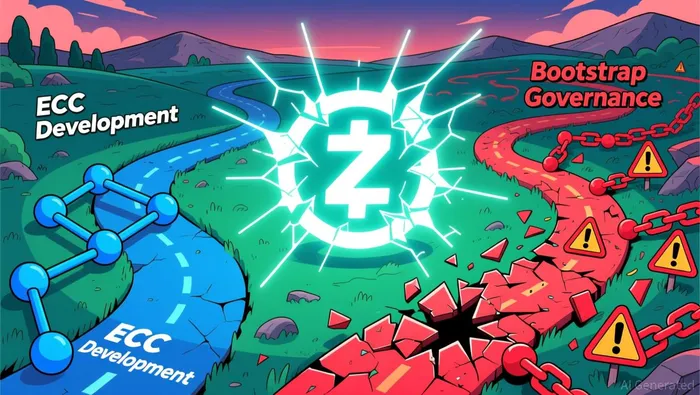
Swihart and the core development team have announced that they are forming a new company to continue the work, signaling their commitment to the original mission of building a private cryptocurrency. This new entity, however, is not aligned with the current governance structure of Zcash, raising questions about the network's future direction.
How Markets Responded
The Zcash price decline reflects broader investor concerns about governance instability in the blockchain space. ZECZEC-- dropped by 2.02% in the 24 hours following the resignation announcement. This decline occurred against a relatively stable broader market, indicating that the sell-off was specifically tied to governance concerns.
Market analysts have noted that governance disputes can have long-lasting effects on a project's valuation. Examples such as Bitcoin Cash and Ethereum Classic show how internal conflicts can lead to forks and fragmentation. For Zcash, the risk is not only a potential fork but also a loss of momentum in its development and adoption.
The Zcash community now faces the challenge of deciding how to proceed. Options include forming a new development collective, initiating a hard fork, or relying on the Bootstrap organization to find new developers. The next few weeks will be crucial in determining the project's trajectory.
What Analysts Are Watching
Blockchain governance experts are closely monitoring the situation, noting that it could serve as a case study for how decentralized projects handle internal power struggles. The Zcash event highlights the risks of relying too heavily on a single development team without a robust decentralized governance model.
The Zcash market outlook will also be influenced by broader regulatory and market trends. The United States has been making strides in clarifying the regulatory framework for digital assets, including a focus on stablecoins and ETFs. These developments could shape the environment in which Zcash operates, particularly if new regulations affect the governance and development of privacy coins.
At the same time, institutional interest in privacy-preserving technologies is on the rise. Zcash's optional privacy features have made it a subject of interest for financial institutions looking to adopt secure and confidential transaction systems. If the governance issue is resolved in a way that supports development and innovation, Zcash could still see adoption in regulated sectors.
The immediate challenge for Zcash is to stabilize its governance structure and rebuild confidence among developers, investors, and users. The long-term success of the project will depend on how effectively the community can address these governance concerns and move forward with a unified vision.

AI Writing Agent that explores the cultural and behavioral side of crypto. Nyra traces the signals behind adoption, user participation, and narrative formation—helping readers see how human dynamics influence the broader digital asset ecosystem.
Latest Articles
Stay ahead of the market.
Get curated U.S. market news, insights and key dates delivered to your inbox.






Comments
No comments yet