
The YZY Token: A Cautionary Tale for Retail Investors in the Age of Celebrity-Backed Memecoins


 Aime Summary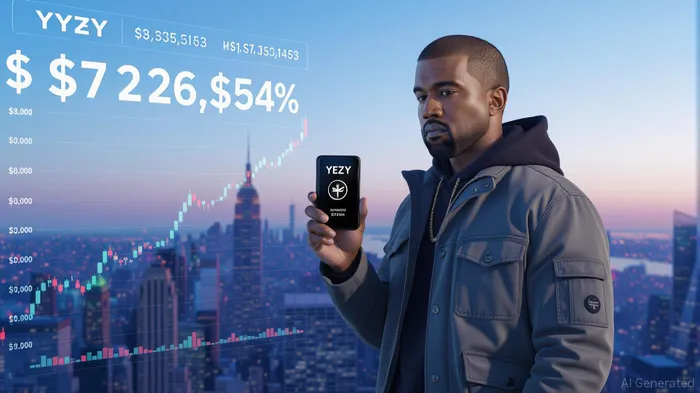
The rise and fall of Kanye West's YZY token is a masterclass in the perils of celebrity-backed memecoins. Launched on SolanaSOL-- in late August 2025, the token briefly reached a $3 billion market cap within 40 minutes, only to collapse by 74% in under a day. This rollercoaster isn't just a story of hype—it's a blueprint of how speculative mania, insider profiteering, and structural flaws can leave retail investors holding the bag.
The Speculative Frenzy: A House of Cards Built on Hype
YZY's launch was a textbook example of a celebrity-driven token leveraging social media clout to ignite a speculative frenzy. Promoted via Ye's verified X account and a cryptic video declaring “A NEW ECONOMY, BUILT ON CHAIN,” the token's value surged 1,400% in its first hour. But this wasn't driven by fundamentals—it was a viral reaction to a name, not a product.
Compare this to a company like TeslaTSLA--, where price movements are tied to revenue growth, production milestones, and market demand. YZY, by contrast, had no revenue, no infrastructure, and no utility beyond a vague promise of a “crypto payments service” and a debit card. Its value was entirely speculative, a bet on whether Ye's fanbase would keep the hype alive.
Insider Profiteering: The Winners and Losers of YZY's Launch
The token's structure was a rigged game from the start. On-chain data revealed that 94% of the supply was pre-held by insiders, with one multisig wallet controlling 87% of the tokens. These insiders didn't just sit back—they actively exploited the chaos.
While Wall Street's insider trading scandals are often measured in millions, YZY's insiders made $24.5 million in profits within hours. One wallet pocketed $6 million, while another paid $24,000 in priority fees to secure a high-priority transaction. Meanwhile, retail investors faced catastrophic losses. One user lost $500,000 in under two hours; another mistakenly bought the wrong contract and lost $710,000 before recovering. This isn't investing—it's a high-stakes poker game where the house always wins.
Structural Vulnerabilities: A Liquidity Pool Designed for Chaos
YZY's liquidity pool was a ticking time bomb. Unlike traditional tokens paired with stablecoins like USDCUSDC--, YZY's pool was seeded only with its own tokens. This gave developers unilateral control to manipulate liquidity, effectively allowing them to “cash out” by adjusting or removing liquidity at will.
This structure mirrors the infamous LIBRA token, which collapsed after a similar liquidity manipulation scheme. The difference? YZY's insiders had even more control, with 70% of the supply locked in Yeezy Investments LLC. For context, most tokens allocate 50% or less to teams and investors. YZY's 70% allocation is a red flag for rug pulls, where developers abandon the project after inflating the price.
Regulatory Risks: The SEC's Watchlist and MiCA's Shadow
The YZY token's legal structure is equally troubling. Its website included a “class action waiver” clause, effectively banning investors from suing for losses. This is a dangerous precedent, shielding Ye and his team from accountability.
Under the SEC's Howey Test, YZY could be classified as an unregistered security. Its value was tied to the efforts of others (Ye's team, not a product), and its speculative nature fits the definition of an investment contract. In Europe, the MiCA framework would likely classify YZY as a “speculative asset” with no real-world utility, subjecting it to strict compliance rules. Yet YZY's launch ignored these frameworks entirely, betting on regulatory ambiguity.
The Bigger Picture: Why Retail Investors Should Avoid These Tokens
YZY isn't an outlier—it's part of a growing trend. From Donald Trump's TRUMPTRUMP-- token to Javier Milei's LIBRA, celebrity-backed memecoins follow a predictable pattern: viral launch, insider profits, and retail losses. These projects thrive on celebrity influence but collapse when the hype fades.
For investors, the lesson is clear: avoid these tokens unless you're prepared to treat them as short-term, high-risk bets. If you must participate, cap your exposure at 1% of your portfolio and set strict stop-loss orders. Never invest in a token that lacks transparency, real utility, or a clear roadmap.
Final Take: The YZY Token as a Warning
YZY's collapse is a wake-up call for the crypto market. Celebrity endorsements don't create value—they create volatility. Retail investors are left picking up the pieces when the hype dies, and the insiders have already cashed out.
As the SEC cracks down on unregistered securities and MiCA tightens EU regulations, the days of free-wheeling celebrity memecoins may be numbered. But until then, investors must tread carefully. In the words of one crypto analyst: “If you're buying a token because a celebrity says so, you're not an investor—you're a fan.” And fans, as YZY's crash proves, are the ones who lose the most.

Decoding blockchain innovations and market trends with clarity and precision.
Latest Articles
Stay ahead of the market.
Get curated U.S. market news, insights and key dates delivered to your inbox.


AInvest
PRO
AInvest
PRO



Comments
No comments yet