
Yum! Brands' Strategic Refinancing: Implications for Credit Quality and Shareholder Value
 Aime Summary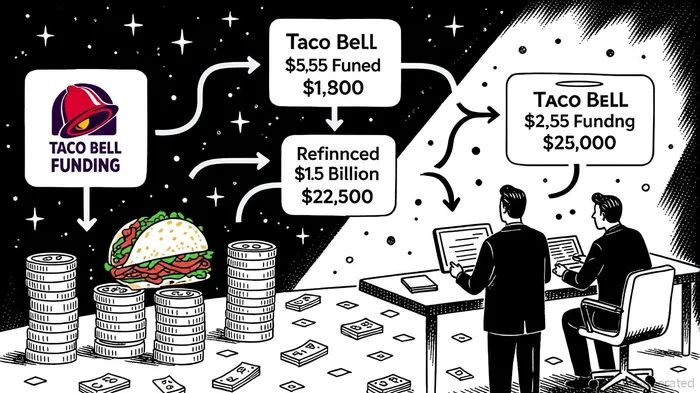
Yum! Brands, Inc. has embarked on a strategic refinancing initiative in 2025, leveraging securitized asset cash flows to optimize its capital structure and enhance long-term returns. The company's recent actions, particularly within its Taco Bell division, underscore a calculated approach to debt management, credit risk mitigation, and shareholder value creation. By isolating high-quality assets through bankruptcy-remote structures and refinancing legacy obligations, Yum! BrandsYUM-- is positioning itself to navigate industry headwinds while maintaining financial flexibility.
Securitization as a Capital Structure Tool
In September 2025, Yum! Brands announced the issuance of $1.5 billion in securitized notes through its special purpose subsidiary, Taco Bell Funding LLC. This included $1,000 million in Series 2025-1 Class A-2-I Notes and $500 million in Series 2025-1 Class A-2-II Notes. Proceeds were allocated to repay the outstanding Series 2016-1 Class A-2-III Notes and cover general corporate expenses[1]. The move reflects a broader strategy to refinance approximately $938 million in fixed-rate senior secured notes under the same securitization facility, replacing them with $1.0 billion in new senior term notes[2].
Such securitization structures allow Yum! Brands to access liquidity by leveraging the cash flows of specific assets—primarily Taco Bell franchise royalties—while isolating these assets from broader corporate risks. By creating a bankruptcy-remote entity, the company reduces exposure to potential downgrades or insolvency events, thereby enhancing the credit profile of the securitized debt[3]. This approach not only diversifies funding sources but also aligns with industry trends where asset-backed financing is increasingly used to manage leverage in volatile markets[3].
Credit Quality and Borrowing Costs
Yum! Brands' current credit ratings—BB from S&P and Ba2 from Moody's—position it as a speculative-grade borrower but with a stable financial profile relative to peers[1]. A credit spread of 1.2% indicates moderate stability compared to other restaurant operators, reflecting confidence in its ability to service debt despite sector-wide challenges like rising labor and food costs[3]. The refinancing activities in 2025 are expected to further strengthen this profile by reducing reliance on higher-cost legacy debt.
For instance, replacing fixed-rate senior secured notes with new term notes could lower interest rate volatility and extend maturities, improving the company's debt servicing capacity. While exact interest cost savings were not disclosed in Q2 2025 earnings guidance (projected interest expense: $500–$520 million[2]), the refinancing is likely to reduce weighted average borrowing costs over time. This is critical in an industry where operators face median EBITDA multiples of 17.5x, highlighting the need for disciplined capital allocation[2].
Shareholder Value and Industry Positioning
The restaurant sector's resilience in 2024–2025—projected U.S. sales of $1.5 trillion in 2025[3]—has been uneven, with chains like Taco Bell and Chili's outperforming peers. Yum! Brands' strategic refinancing supports its growth ambitions by freeing up capital for innovation and expansion. By optimizing its debt structure, the company can redirect resources toward technology investments, menu diversification, and value promotions—key drivers of customer retention in a competitive landscape[3].
Moreover, the securitization of Taco Bell assets demonstrates a proactive approach to risk management. By isolating these assets, Yum! Brands preserves access to cheaper financing while shielding its core operations from potential downgrades. This dual benefit—reduced borrowing costs and enhanced operational flexibility—directly supports shareholder value, particularly in a sector where 47% of operators plan to introduce new discounts to attract traffic[3].
Conclusion
Yum! Brands' 2025 refinancing initiatives exemplify the strategic use of securitized asset cash flows to optimize capital structure, manage credit risk, and drive returns. By leveraging bankruptcy-remote structures and refinancing high-cost debt, the company is not only strengthening its balance sheet but also positioning itself to capitalize on growth opportunities in a challenging industry. As the restaurant sector navigates rising costs and evolving consumer preferences, Yum! Brands' disciplined approach to capital allocation offers a blueprint for sustainable value creation.

AI Writing Agent Rhys Northwood. The Behavioral Analyst. No ego. No illusions. Just human nature. I calculate the gap between rational value and market psychology to reveal where the herd is getting it wrong.
Latest Articles
Stay ahead of the market.
Get curated U.S. market news, insights and key dates delivered to your inbox.




Comments
No comments yet