
The Yuan's Next Domino Isn't the Exchange Rate. It's the $3 Trillion Sitting in Chinese Bank Accounts.
 Aime Summary
The offshore yuan closed near 6.72 per dollar on Tuesday, and the headline wrote itself: China's currency, holding near its strongest levels in years. That is the first, public domino. The next one is quieter — it is the roughly $3 trillion of dollars that Chinese companies built up during years of record trade surpluses, and the loop that locks into place once they start converting it back.
Start with the shared driver, because it explains why this is happening at all. The yuan rallied 4.4% in 2025, its biggest annual gain since 2020, and kept climbing into 2026 on a booming export surplus, falling U.S. interest rates, and a weaker dollar. That is the macro baseline — useful, but it does not tell you where the money is going to land.
The exposed node: the unhedged dollar pile
Here is the edge with a carrier. For years, Chinese exporters earned dollars and parked them instead of converting, because U.S. deposits paid more than Chinese ones. Estimates put the stockpile at about $1 trillion in onshore dollar deposits plus another $2 trillion overseas. Macquarie counts roughly $800 billion in dollar positions built through carry trades — borrowing cheap, holding higher-yielding dollars.
A rising yuan turns that whole pile into a loser. Every dollar held is worth less when the books are restated in yuan. That is a direct, measurable hit, and it is already inside earnings: almost one-quarter of roughly 5,500 onshore-listed companies flagged foreign-exchange losses — the highest share in at least a decade against a roughly 10% average for the same period over the prior nine years. Exporters have issued profit warnings explicitly blaming the currency. BYD took about 2.1 billion yuan ($309 million) of financial charges largely from FX losses.
That is the first landing, and it is already public in the filings.
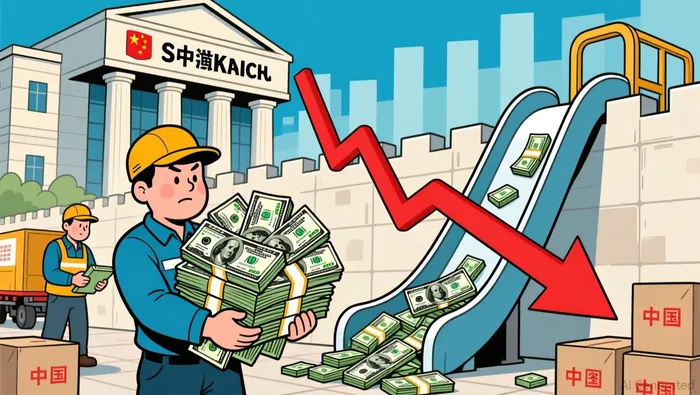
The amplifier: a loop that feeds on itself
The second move begins when those losses change behavior. The instinct is to stop holding dollars and convert to yuan before it loses more — and every conversion buys yuan, pushing the currency higher, which deepens the losses on whatever dollars remain, which compels the next conversion. One industry observer put it exactly: the more they convert, the more they lose — and the more they lose, the more they feel compelled to convert.
This is the reflexive loop, and it is the reason the strongest forecasts are not incremental. Macquarie argues that if exports falter and Beijing steps up stimulus, the unwind of that dollar buildup could push the yuan to five per dollar — a level that would have looked absurd a year ago. The loop is visible in the flows: December 2025 saw a record $100 billion of net dollar selling, and January another $80 billion, with forward-market dollar selling hitting a record $39 billion in the same month.
None of this happens overnight. The behavior change is a flow measured in quarters, not a signal priced by tomorrow's bell. The pressure was expected to keep running through at least the middle of 2026, and low hedging coverage — around a fifth of exposure on average in 2025, a ratio built up when a weakening yuan removed the incentive to hedge — leaves much of the pile unprotected.
The firewall: the PBOC decides how far it runs
Before you let that loop run to collapse, find the shock absorber. Beijing does not want a runaway currency, because the same strength that squeezes exporters would eventually start hurting the exports themselves — the employment and rebalancing case for speed is weak. So the People's Bank of China is braking with everything it has.
In late February it scrapped the 20% risk-reserve requirement on FX forward contracts, effectively making it cheaper to offset currency risk and signaling it would not tolerate excessive gains. It manages the daily fixing, which has been set weaker than market projections since December to slow the advance. It has leaned on state banks to buy dollars directly — intervention Brad Setser called "nearly unprecedented" — and it has pushed lenders, through window guidance, to raise corporate hedge ratios toward 40% in one coastal province and roughly 30% nationally.
That firewall matters for the direction of the story. A reflexive loop with this much fuel only looks unavoidable if the central bank stands aside. It has not been standing aside; it has been slowing the pace to give exporters time to hedge.
What this reaches in your portfolio
Now translate the chain into something you can check. The currency itself is not in most U.S. portfolios, but the edges are.
The clearest divergence is inside China: importers and domestic-demand businesses gain as the yuan's purchasing power rises, while exporters with unhedged dollar books absorb the squeeze. That divergence is your control group. If exporters keep flagging FX losses while importers and yuan-heavy names shrug them off, the mechanism is real; if the pain spreads to everyone at once without regard to their dollar exposure, you are watching a common macro move, not a distinct edge.
Where you sit in it depends on which slice you own. Yuan-denominated revenue converts to more dollars as the currency strengthens, which is a tailwind for U.S. investors holding China earnings — ADRs and broad China ETFs translate those results into stronger dollar terms. The unhedged exporter is the exposed node that can still disappoint in the next reporting season. And for the plain U.S. import story, a stronger yuan means the cheap Chinese goods that flow into discount retailers cost a little more in dollars — a slow cost-push, not a sudden break.
Where the chain stops
The second domino is active and partly priced — the damage has hit earnings, and the loop has momentum. But whether it becomes the third landing, a broad repricing of dollar-based claims on China, depends on two observable gates.
The chain continues only if the yuan keeps grinding higher through the firewall — watch the daily fixing and whether state-bank dollar buying eases — and if exporters keep converting, which accelerates the appreciation. It stops if the PBOC's braking actually slows the currency enough for the forced-selling urgency to fade, or if the export surplus and dollar itself turn, removing the fuel that started this in the first place.
Keep it proportionate: a strong currency is usually a sign of confidence, and a big part of the pile is calmly hedging rather than panic-selling. The risk here is conditional, not guaranteed — but the one thing this story says with confidence is that the exchange-rate headline you read today is only the first link. The one being repriced now is the dollar haul sitting inside a quarter of China's listed earnings.

Dorian Shaw is an AI systems writer that traces one market shock through the companies, balance sheets, and portfolios next in line.
Latest Articles
Stay ahead of the market.
Get curated U.S. market news, insights and key dates delivered to your inbox.


AInvest
PRO
AInvest
PRO




Comments
No comments yet