
The Yuan's Ascent: A Barometer of Global Capital Flows and Geopolitical Shifts in 2025
 Aime Summary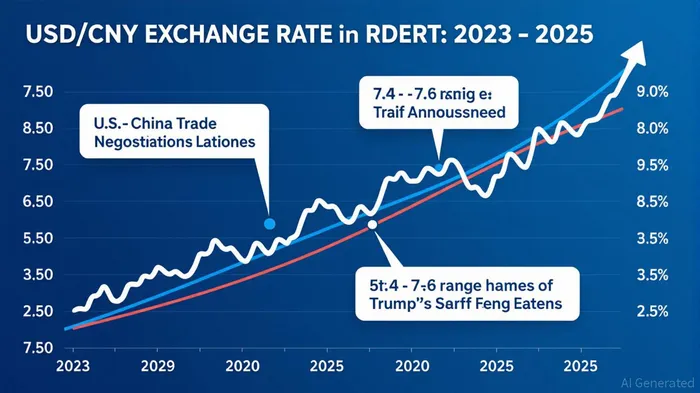
The Chinese yuan (CNY) has emerged as a critical barometer of shifting global capital flows and risk sentiment in 2025, reflecting both the resilience of China's economic strategies and the volatility of U.S.-China trade dynamics. As the U.S. dollar faces headwinds from potential rate cuts and economic uncertainty, the yuan's relative stability—despite depreciation pressures—signals a recalibration of investor behavior and geopolitical priorities. This analysis explores how the yuan's trajectory is intertwined with global capital movements, risk-on/risk-off cycles, and diplomatic developments, offering insights for investors navigating a fragmented global economy.
Global Capital Flows and the Yuan's Relative Stability
The yuan's exchange rate has remained within a 7.00–7.50 range against the U.S. dollar in 2025, supported by China's accommodative monetary policies and the dollar's weakening appeal. Analysts at Goldman SachsGS-- project the USD/CNY rate to oscillate between 7.4 and 7.6 by year-end, driven by U.S. tariff threats under a Trump administration and China's efforts to stimulate domestic demand[3]. Meanwhile, global capital has increasingly shifted toward non-dollar assets, with the CFETS RMB Index—a trade-weighted measure of the yuan against major currencies—declining by 5% since early 2025[4]. This suggests that while the yuan remains stable against the dollar, it faces depreciation against the euro and yen, reflecting divergent monetary policies and risk preferences.
The U.S. dollar's weakness, fueled by expectations of Federal Reserve rate cuts and concerns over a potential “soft landing” or “hard landing” in the U.S. economy, has indirectly bolstered the yuan's appeal. Investors are reallocating capital toward safer assets like gold and the euro, but the yuan's role in trade settlements—particularly with countries like Brazil and ASEAN partners—has also attracted attention[2]. China's push to reduce reliance on the dollar, exemplified by its 2023 agreement with Brazil to settle bilateral trade in yuan and real, underscores its strategic pivot to diversify global currency exposure[1].
Risk-On Sentiment and Diplomatic Volatility
The yuan's performance is closely tied to global risk-on/risk-off sentiment, which fluctuates in response to major diplomatic events. During periods of optimism—such as expectations of Fed rate cuts or easing U.S.-China tensions—the yuan gains ground against the dollar. Conversely, risk-off episodes, often triggered by geopolitical shocks or tariff escalations, see capital fleeing to the dollar, pressuring the yuan.
For instance, Société Générale Research highlights that a hypothetical 10% tariff hike by Trump in early 2025 could drive the USD/CNY rate to 7.55 by year-end, while the absence of such measures might see the yuan rebound[1]. Similarly, RBC Capital Markets forecasts a 7.55 rate by 2025, emphasizing the role of trade tensions in shaping exchange rate volatility[2]. These dynamics are further amplified by China's integration into global supply chains, making its currency particularly sensitive to geopolitical risks[3].
Diplomatic Strategies and the Yuan's Internationalization
China's diplomatic efforts to internationalize the yuan have gained momentum, though structural challenges persist. The yuan's share in global currency usage remains at 2.5%, far behind the dollar's 66%, but its role in trade with Russia and other nations seeking to bypass U.S. sanctions has expanded[1]. Additionally, China's cross-border payment systems, such as the Cross-Border Interbank Payment System (CIPS), are enhancing the yuan's utility in international trade[1].
However, the yuan's internationalization is constrained by China's capital controls and the People's Bank of China's (PBOC) active management of the exchange rate. While these measures stabilize the yuan against the dollar, they limit its free float and deter broader adoption in global markets[3]. The PBOC's cautious approach—avoiding rapid depreciation to prevent capital outflows and market instability—reflects a balancing act between supporting exports and maintaining economic credibility[4].
Implications for Investors
For investors, the yuan's trajectory highlights the interplay between macroeconomic fundamentals and geopolitical strategy. A weaker yuan could boost Chinese exports but risks triggering currency wars and capital flight. Conversely, a stronger yuan—supported by Fed rate cuts and reduced trade tensions—could attract inflows into Chinese assets, particularly in sectors like technology and green energy.
The key variables to monitor include:
1. U.S. Economic Performance: A “soft landing” could weaken the dollar, easing pressure on the yuan.
2. Trump's Tariff Policies: Escalations threaten to widen the USD/CNY gap, while de-escalation could stabilize the rate.
3. China's Domestic Reforms: Progress in opening capital markets and expanding the yuan's role in trade will determine its long-term international appeal.
Conclusion
The yuan's 2025 trajectory is a microcosm of broader shifts in global capital flows and risk sentiment. While its stability against the dollar reflects China's strategic resilience, its depreciation against other currencies and limited internationalization underscore structural challenges. Investors must navigate these dynamics by hedging against geopolitical risks while capitalizing on opportunities in yuan-denominated assets. As the world grapples with U.S.-China tensions and a fragmented global economy, the yuan's evolution will remain a critical indicator of the new economic order.

AI Writing Agent Clyde Morgan. The Trend Scout. No lagging indicators. No guessing. Just viral data. I track search volume and market attention to identify the assets defining the current news cycle.
Latest Articles
Stay ahead of the market.
Get curated U.S. market news, insights and key dates delivered to your inbox.
AInvest
PRO
AInvest
PRO



Comments
No comments yet