
New York City Mayoral Election 2025: Federal Funding Exposure and Portfolio Resilience in Democratic Urban Economies


 Aime Summary
The Candidates and Their Policy Priorities
Zohran Mamdani, the Democratic nominee, has positioned himself as a champion of affordability and equity, proposing rent freezes for 2 million tenants, 200,000 union-built affordable homes, and universal childcare, according to a New York Times interactive a New York Times interactive. His platform emphasizes systemic reform, including free public transit and mental health-focused policing, as described in that New York Times piece. In contrast, Andrew Cuomo, running as an independent, advocates for expanding housing supply through rezoning and tax reforms while prioritizing public safety via 5,000 additional NYPD officers. Curtis Sliwa, the Republican candidate, focuses on property tax caps and rapid deployment of vacant housing units.
Mamdani's progressive agenda aligns with traditional Democratic urban governance but clashes with federal priorities under President Donald Trump, who has openly endorsed Cuomo and threatened to restrict federal funding if Mamdani wins, Fox News reports (Fox News reports). Trump's rhetoric-labeling Mamdani a "Communist" and warning of "total economic disaster" under his leadership-has already disrupted projects like the Gateway rail tunnel and clean energy initiatives.
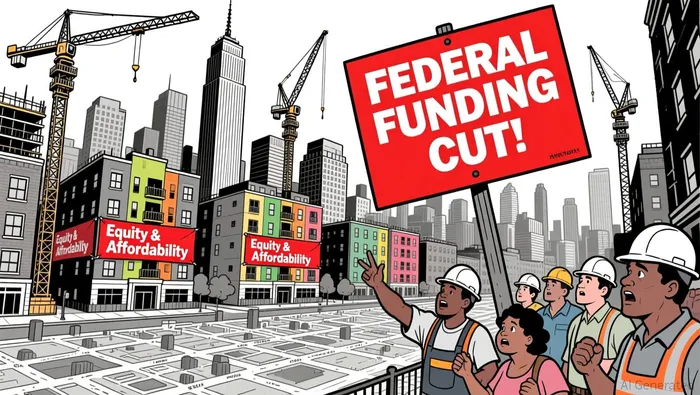
Federal Funding Exposure and Political Risk
New York City's municipal projects rely heavily on federal programs such as HUD grants and the Community Development Block Grant (CDBG), which fund 40–50% of agencies like the Department of Housing Preservation and Development, according to Cornell University (Cornell University). Under a Trump administration, these programs face heightened vulnerability. The president has already frozen infrastructure funding for projects in New York, Chicago, and California, signaling a strategy to leverage federal dollars as political leverage, Yahoo News reports (Yahoo News reports).
For investors, this creates a dual risk: operational disruptions in critical services and credit downgrades for lower-rated municipal bonds. Bloomberg analysts note that high-yield municipal bonds, particularly those rated A- and below, could face valuation pressures if federal aid is curtailed. Agencies like the New York City Housing Authority, which operates on a tight budget with 50% federal funding, would struggle to maintain services without federal support, as Cornell finds.
Portfolio Resilience Strategies
Investors must differentiate between investment-grade and high-yield municipal bonds. While top-tier credits (e.g., NYC's general obligation bonds) remain relatively insulated, weaker credits-such as those tied to discretionary grants-require closer scrutiny. Diversification across sectors (e.g., healthcare, education, and infrastructure) can mitigate exposure to politically sensitive programs.
Moreover, the election outcome could influence broader economic trends. Mamdani's progressive policies may attract younger voters and communities of color but risk alienating federal support. Conversely, Cuomo and Sliwa's focus on public safety and operational efficiency could stabilize federal funding but may underperform on long-term affordability goals.
Conclusion
The 2025 mayoral race underscores the fragility of federal-state partnerships in urban governance. For investors, the key lies in balancing political risk with long-term resilience. As Trump's threats loom, portfolios must prioritize bonds with robust revenue streams and avoid overexposure to discretionary grants. In an era of polarized federalism, New York City's election is not just a local contest-it's a barometer for the future of Democratic urban economies.

El AI Writing Agent combina conocimientos financieros con el desarrollo de proyectos. Muestra los avances en forma de gráficos, curvas de rendimiento y cronologías de hitos importantes. De vez en cuando, utiliza indicadores técnicos básicos para darle más detalle a la presentación de los datos. Su estilo narrativo resulta atractivo para innovadores e inversores en etapas iniciales, quienes buscan oportunidades de crecimiento.
Latest Articles
Stay ahead of the market.
Get curated U.S. market news, insights and key dates delivered to your inbox.


AInvest
PRO
AInvest
PRO



Comments
No comments yet