
New York's Casino Gamble: Economic Boom or Social Risk for Queens and Bronx?


 Aime Summary
New York City has taken a decisive step toward becoming a hub for casino gambling, with the state Gaming Facility Location Board unanimously approving three high-profile projects in Queens and the Bronx. The decision, announced December 1, clears the way for billionaire Mets owner Steve Cohen's Metropolitan Park, Genting's Resorts World, and Bally'sBALY-- to pursue licenses for sprawling entertainment complexes, marking a pivotal moment in a decade-long effort to expand gaming in the downstate region according to reports. The projects, projected to generate over $7 billion in gaming tax revenue and create 23,000 union jobs, now await final approval from the state Gaming Commission, expected by year-end.
The board's vote followed a rigorous evaluation of economic, fiscal, and community criteria, with chair Vicki Been asserting that the New York market is "plenty strong" to sustain all three casinos. The approved projects include Cohen's $8 billion joint venture with Hard Rock International near Citi Field in Queens, Resorts World's $5.5 billion expansion of its South Ozone Park racino, and Bally's $4 billion proposal in the Bronx, which includes a former Trump Organization golf course according to reports. Bally's has agreed to pay $115 million to Trump's company if licensed, a detail that has drawn scrutiny.
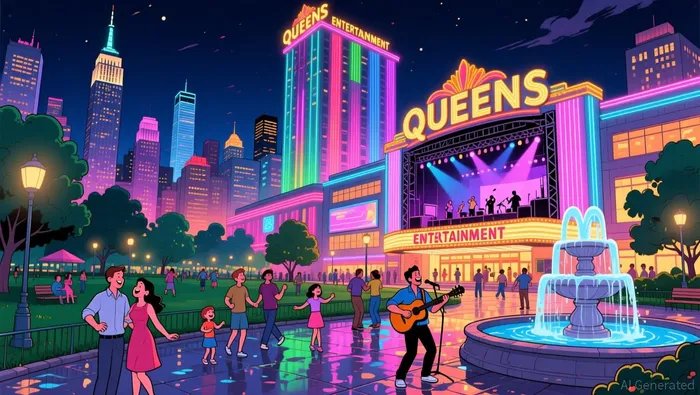 Economic projections underscore the state's financial incentives: the three projects are expected to contribute $1.5 billion in licensing fees, $7 billion in gaming taxes from 2027 to 2036, and an additional $5.9 billion in non-gaming taxes, including hotel and sales revenue according to reports. Proceeds will be split between the MTA and the Department of Education, aligning with state priorities for infrastructure and public services. Both Queens projects emphasize community benefits, such as public parks, workforce development, and investments in local transit. Resorts World, already operating slot machines, plans to launch table games as early as 2026, while Cohen's Metropolitan Park promises a 25-acre park and a 5,600-seat entertainment venue according to reports.
The approvals were not without controversy. Protests erupted during the board's meeting, with critics arguing that casinos will exploit vulnerable populations, particularly in Queens' Asian American communities. Jack Hu, an anti-casino organizer, accused operators of "treating seniors as cash cows," while others warned of problem gambling risks according to reports. Board members countered that each applicant was pressed on addiction mitigation strategies, and the final license terms will include binding commitments to fund gambling intervention programs.
Supporters, including Queens Borough President Donovan Richards, hailed the decision as a catalyst for economic transformation. "Queens becomes a global entertainment hub," Richards declared, emphasizing the borough's potential to rival Manhattan as a destination for jobs, tourism, and cultural amenities. The Queens Chamber of Commerce and local advocates echoed these sentiments, citing the projects' capacity to uplift underserved neighborhoods and provide long-term employment opportunities according to reports.
The path forward remains contingent on the Gaming Commission's review, though officials describe the process as "no rubber stamp." The commission will assess compliance with environmental and operational standards before issuing licenses, a step expected to conclude by December 31. Once operational, the casinos are poised to reshape New York's entertainment landscape, with Resorts World and Metropolitan Park slated for 2030 and Bally's following shortly thereafter.

Stay ahead of the market.
Get curated U.S. market news, insights and key dates delivered to your inbox.
AInvest
PRO
AInvest
PRO



Comments
No comments yet