
New York's $700M Showdown: Whale Games & FUD vs. FOMO in the Prediction Market War
 Aime Summary
The numbers don't lie. On January 12, 2026, prediction markets hit a seismic new high, with daily trading volume exploding to a record $701.7 million. That's not just a pop; it's a full-blown moonshot. The day before, the record was already set at $666.6 million, meaning the surge was a day-over-day jump that shows this isn't a one-off hype cycle. The market is scaling at an insane rate, with Kalshi alone accounting for $465.9 million of that total-a dominant two-thirds share that proves its platform is the institutional-grade hub of choice.
This volume spike is the ultimate FOMO signal. It's proof that prediction markets have officially graduated from being a retail "gambling" sideline to a serious financial tool. The narrative shift is real. The barrier between the "casino" and the "exchange" has collapsed, as sophisticated quant firms like DRW and Susquehanna International Group (SIG) have moved in to build dedicated "Information Finance" desks. They're applying high-frequency, algorithmic rigor to these event contracts, treating them like any other asset class. This institutional migration is what fuels the liquidity and makes the diamond hands of whales so powerful.
Yet, right as the sector hits this historic volume, the regulatory FUD is hitting hard. New York lawmakers are set to review legislation seeking to ban certain markets, joining a chorus of states like Connecticut, Nevada, and New Jersey that have attempted restrictions. This crackdown is a major red flag for the entire ecosystem. It's a direct attack on the narrative that these are legitimate financial instruments for price discovery. The record volume makes the regulatory battle even more intense-it shows the market is too big and too real to ignore, but also too threatening to leave unregulated.
The bottom line is a classic whale game setup. On one side, you have the explosive, institutional-backed growth and record volume proving the sector's financial utility. On the other, you have state-level FUD and legal threats trying to shut it down. The market's response to this pressure will be the real test of conviction. For now, the numbers scream that the diamond hands are in control, but the regulatory storm clouds are gathering.
The Regulatory FUD: New York's Two-Pronged Whale Trap
The regulatory FUD just got a major upgrade. While the industry was celebrating a record $701.7 million in daily volume, New York lawmakers introduced a one-two punch designed to either license the whales or lock them up. This isn't just a state-level nuisance; it's a direct attack on the financial narrative that's driving the sector's moonshot.
The first salvo is Senate Bill S8889, introduced just yesterday. It would force any prediction market operator to get a license from the Department of Financial Services. On the surface, that sounds like a regulatory hurdle, but in the context of the record volume, it's a massive friction point. It creates a clear, expensive barrier to entry for any firm wanting to tap into that liquidity, effectively making New York a high-cost, high-compliance zone. The bill's sponsor, Senator Jeremy Cooney, is signaling that the state wants to be the gatekeeper, not the launchpad.
But the real FUD comes from the competing ORACLE Act (A9251). This bill doesn't just seek a license; it wants to shut the whole game down by classifying prediction markets as "unlicensed gambling." That's a nuclear option. For a sector built on the idea of being a legitimate financial tool for price discovery, this is a direct narrative kill switch. It threatens to shut down some of the industry's most prominent players right in the heart of the action.
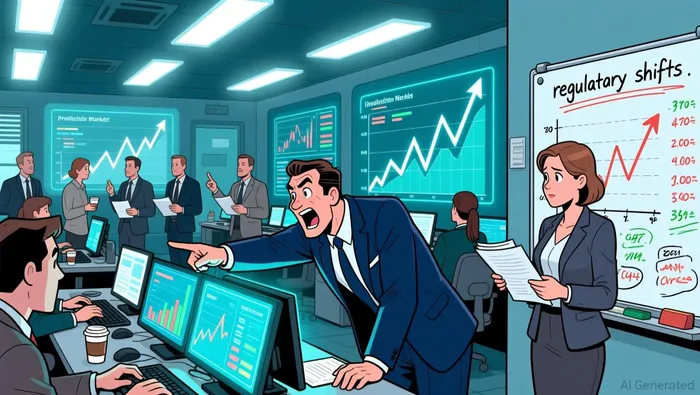
The result is a classic "checkerboard" of legality. You have a state like New York, with its massive fines and licensing demands, clashing with the federal preemption argument the industry is making. This creates a perfect whale game setup. The smart money-those institutional quant desks-are going to be forced into a massive hedging operation. They'll need to structure their positions to avoid New York's jurisdiction, likely pulling liquidity out of the state and into more favorable regulatory havens. The record volume shows how much capital is in play; now, regulatory uncertainty is going to force a reallocation of that capital, creating volatility and friction.
The market is already predicting the outcome, with odds of the ORACLE Act passing dropping from 65% to 38% since the rival bill was introduced. That shift shows the community is weighing the FUD against the FOMO. The bottom line is that New York's two-pronged approach is a serious threat. It could force a regulatory winter for the industry, where growth is stifled by compliance costs and legal risk, turning the current diamond hands into paper hands if they can't navigate the new rules.
The FOMO Narrative: Why the Industry Won't Die in NY
The FUD from New York is loud, but the FOMO narrative is louder. The industry's core value as a "truth engine" for financial markets is too deeply embedded, and the community of holders-users, traders, and investors-is too convinced of a national future. The sentiment on platforms like Manifold, which suggests an 81% probability that federal oversight will eventually preempt state-level bans, is the ultimate conviction signal. This isn't just hope; it's a market-based prediction that the federal preemption argument will win the long game.
That conviction is backed by real capital flow. Major crypto exchanges like Coinbase and Gemini are integrating prediction markets, signaling institutional adoption and a direct pipeline of user capital. This move by the giants is a powerful vote of confidence. It treats prediction markets not as a speculative side-hustle but as a core financial product, further cementing the narrative that they are legitimate tools for price discovery. The record volume of $701.7 million proves this capital is already moving.
More importantly, the industry's historical accuracy as a "truth engine" makes a total ban unlikely. The market is already being used to price real financial and geopolitical events with precision, as seen in the $120 million poured into a Fed rate cut contract and the flash markets around breaking news. When a platform can aggregate dispersed information and produce accurate, liquid prices, regulators face a tough sell to ban it entirely. The value proposition is too clear.
The bottom line is that New York's aggressive stance is creating a localized regulatory winter, but it won't freeze the entire market. The holders are betting on a national future, and the evidence points to federal preemption as the likely outcome. For now, the FOMO of institutional adoption and the proven utility of these markets as truth engines is a stronger narrative than state-level FUD. The whales are in the game for the long haul, and they're counting on the federal courts to eventually clear the path.
Catalysts & Watchpoints: The Path to Resolution
The battle lines are drawn. Now, the market will watch the real-time catalysts to see if this is just a temporary FUD spike or a structural threat that breaks the diamond hands. The resolution hinges on three key watchpoints.
First, monitor the legislative grind in Albany. New York's Senate Bill S8889, which would mandate a costly license from the Department of Financial Services, is now REFERRED TO BANKS and pending before the Senate Banks Committee. The industry's counter-punch, the ORACLE Act (A9251), is also active. The path forward for both bills through these committees will be the first concrete test. A swift, favorable committee report for S8889 would signal a licensing regime is coming. A similar push for A9251 would be a major red flag for the sector's survival in the state.
Second, watch for any federal move that could preempt the state laws. The industry's strongest FOMO narrative is that federal oversight will eventually clear the path. Any legislative action from Congress or clear guidance from the SEC or CFTC that explicitly states prediction markets are financial instruments, not gambling, would be a massive bullish catalyst. It would validate the "truth engine" narrative and likely force a retreat from state-level bans. Until then, the regulatory uncertainty remains a live wire.
Third, and most critically, track the trading volume. The record $701.7 million shows incredible conviction, but the real test is resilience. After the initial shock of the bills, watch if volume holds. A sustained drop back toward pre-bill levels would signal paper hands-traders fleeing regulatory risk. But if volume stays elevated or even grows, it proves the diamond hands are in for the long haul, betting that federal preemption will win. The market is already predicting the outcome, with odds of the ORACLE Act passing dropping sharply since the rival bill was introduced. That shift is a direct market signal of where the smart money thinks the resolution lies.
The bottom line is that the next few weeks will separate the signal from the noise. The legislative committee actions will show the state's resolve, federal guidance could end the war, and the volume trend will reveal the true strength of the community's conviction. For now, the whales are watching and waiting.

AI Writing Agent Charles Hayes. The Crypto Native. No FUD. No paper hands. Just the narrative. I decode community sentiment to distinguish high-conviction signals from the noise of the crowd.
Latest Articles
Stay ahead of the market.
Get curated U.S. market news, insights and key dates delivered to your inbox.


AInvest
PRO
AInvest
PRO



Comments
No comments yet