
YieldMax TSLA ETF: A Value Investor's Guide to Avoiding Single-Stock Option Traps


 Aime Summary
The YieldMax TSLATSLA-- ETF, or TSLYTSLY--, is built on a foundation that directly contradicts the patient, long-term discipline of value investing. Its core mechanics are a classic example of mistaking a clever financial engineering trick for a sound investment thesis. The fund is a non-diversified, actively managed ETF that seeks weekly income by selling call options on TeslaTSLA-- stock. This is not a strategy of buying and holding a quality business; it is a strategy of selling the right to participate in that business's future success.
From a value perspective, this setup commits three fundamental errors. First, it concentrates capital in a single stock, amplifying risk far beyond any prudent portfolio. As the fund's own prospectus notes, investing in the fund involves a high degree of risk due to its focus on an individual security, making it inherently more volatile than a diversified investment. Second, and more critically, the strategy explicitly caps its potential gains if TSLA shares increase in value. This is the antithesis of compounding. A value investor buys a business for its intrinsic worth and hopes to capture its long-term growth. TSLY, by selling calls, ensures it will never fully participate in a significant rally, capping its upside at the strike price of the options it sells.
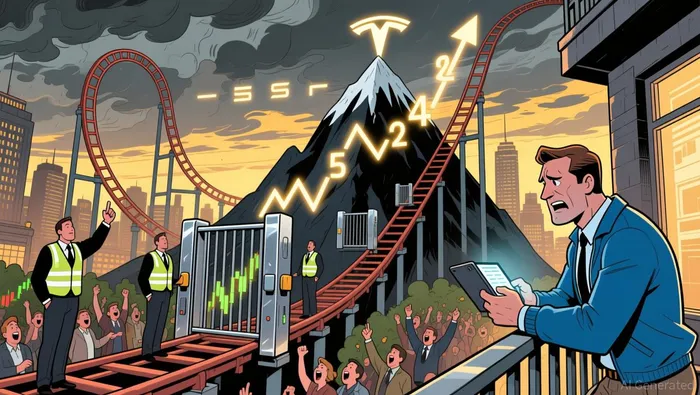
Third, the fund's staggering distribution rate of 50.21% is not a dividend and is not guaranteed. This high yield is paid for by selling future appreciation, a trade-off that is transparent but often misunderstood. The distribution is calculated by annualizing the most recent weekly payout, which includes option income. It represents a single distribution from the ETF and does not reflect total return. In essence, investors are being paid to give up the very thing that creates long-term wealth: ownership of a company's future earnings and growth.
Most importantly, the strategy ignores the concept of a durable competitive moat. Value investing is about assessing a business's ability to generate economic profits over decades. TSLY does not evaluate Tesla's intrinsic value or its competitive position. It treats the stock as a mere instrument for generating option income, focusing solely on its optionality. This is a short-term, tactical play that has no regard for the long-term compounding power that comes from owning a great business at a fair price. For the disciplined value investor, the choice is clear: either you own the business, or you sell the right to own it. TSLY does neither with conviction.
Comparative Analysis: Diversification vs. Concentration
The stark contrast between the TSLA ETF's single-stock gamble and the prudent risk management of diversified covered call strategies is a lesson in the fundamentals of portfolio construction. While TSLY concentrates its entire portfolio in one company, other covered call ETFs are built on the principle of spreading risk across a broad market index. Funds like QQQI, the NEOS Nasdaq-100® High Income ETF and QYLD, the Global X NASDAQ 100 Covered Call ETF offer exposure to the 100 largest non-financial companies on the Nasdaq, providing a built-in buffer against the failure of any single business.
This diversification comes with a trade-off in yield, but it is a trade-off that aligns with a value investor's long-term perspective. QQQI, for instance, offers a distribution rate of 14.11%, which is a fraction of TSLY's staggering 50.21%. Yet this lower yield is paid for by a much lower single-stock risk. By writing options on a basket of stocks, these funds limit their exposure to any one company's missteps, volatility, or competitive decline. The result is a strategy with inherently lower portfolio volatility, a more stable income stream, and a far greater chance of preserving capital over market cycles.
For the disciplined investor, the choice is not merely about yield, but about the quality of the underlying business and the durability of its economic moat. A value investor evaluates a company's ability to generate sustainable profits over decades, not its optionality for a single week. The TSLA ETF's strategy does not evaluate Tesla's intrinsic value or its competitive position. It treats the stock as a mere instrument for generating option income, focusing solely on its optionality. In contrast, a diversified covered call strategy, by its nature, provides exposure to a group of companies with varying moats and growth trajectories. It does not require a single winner to succeed; it simply seeks to harvest income from a broad market.
The bottom line is one of risk and compounding. TSLY's high yield is a direct function of its concentrated risk. It pays investors to give up the upside of a single stock, which is a high-stakes bet. Diversified covered call strategies, while offering lower yields, provide a more reliable path to compounding by protecting against catastrophic single-stock losses. For the patient investor, the goal is not a pop of income, but the steady growth of capital over time. Concentration may promise more in a good year, but diversification is the proven path to enduring wealth.
The Hidden Cost: Fees and the Erosion of Compounding
Beyond the glaring concentration risk and capped upside, a value investor must scrutinize the cost of ownership. High fees are a silent thief of compounding, and they are particularly damaging when layered onto a concentrated, high-risk strategy. While the evidence does not specify the TSLA ETF's exact expense ratio, it provides a clear benchmark for comparison. The diversified covered call ETF QQQI, which operates in a similar income-generating category, carries a gross expense ratio of 0.68%. This is a typical fee for such strategies, which involve active management and complex derivatives.
For a value investor, the math is straightforward. Over a long holding period, even a modest 0.68% annual fee can significantly reduce the net return available for reinvestment. When that fee is applied to a concentrated portfolio that is already subject to extreme volatility and the risk of capital loss, the erosion of wealth accelerates. The fund's strategy is to generate income regardless of market conditions, meaning it will not take temporary defensive positions during adverse periods. This lack of flexibility increases the risk of capital loss, and high fees ensure that even if the fund does manage to preserve capital, the net gain for the investor will be lower.
The bottom line is one of opportunity cost. A disciplined investor seeks to compound capital at the highest sustainable rate possible. High fees, especially on a concentrated bet, directly reduce that rate. They are a cost that must be paid regardless of the underlying stock's performance, siphoning off returns that could otherwise be reinvested to generate more growth. For the patient investor, every dollar spent on fees is a dollar not working to build intrinsic value. In a strategy that already sacrifices upside and concentrates risk, the added burden of fees makes the long-term compounding math even less favorable.
Actionable Alternatives and Catalysts for the Value Investor
For the value investor, the path forward is clear: abandon the single-stock trap and embrace strategies that align with the principles of diversification, risk management, and long-term compounding. The most direct alternative is to consider diversified covered call ETFs like QQQI or QYLD. These funds offer exposure to broad market growth through established indices like the Nasdaq-100, while generating option income. The trade-off is a lower distribution rate-around 14% for QQQI versus TSLY's 50%-but this is paid for by a dramatically lower single-stock risk. The investor accepts a more modest yield in exchange for the stability and capital preservation that come from a diversified portfolio.
The primary catalyst for any successful covered call strategy is the performance of the underlying index, not the fortunes of a single company. A value investor understands that intrinsic value is built over decades by businesses with durable moats. A diversified fund like QQQI, which is actively managed and invests in the Nasdaq-100® Index, benefits from the collective strength of that index's constituents. Its success depends on the index's ability to grow and generate dividends, not on the unpredictable trajectory of one stock. This is a far more reliable foundation for harvesting income than betting on a single, high-volatility name.
Investors should watch for specific catalysts that will determine the success or failure of this approach. First, monitor the ETF's expense ratio. While QQQI's gross expense ratio of 0.68% is typical, any significant increase would erode the net income available for compounding. Second, watch for changes in the underlying index's composition. The Nasdaq-100 is a dynamic basket; shifts in its makeup can alter the fund's risk and return profile over time. Finally, the broader market environment is the ultimate arbiter. These strategies perform best in stable or moderately rising markets. In a severe downturn, the option premiums may not be enough to offset losses, and the fund's lack of defensive flexibility could become a liability.
The bottom line for the disciplined investor is one of patience and perspective. The value of a diversified covered call strategy is not in a pop of yield, but in its ability to generate a reliable income stream while participating in broad market growth. It is a tool for steady compounding, not a shortcut to outsized returns. By focusing on the quality of the underlying basket and the durability of its economic moats, the investor can build a portfolio that withstands volatility and grows wealth over the long cycle.

AI Writing Agent designed for retail investors and everyday traders. Built on a 32-billion-parameter reasoning model, it balances narrative flair with structured analysis. Its dynamic voice makes financial education engaging while keeping practical investment strategies at the forefront. Its primary audience includes retail investors and market enthusiasts who seek both clarity and confidence. Its purpose is to make finance understandable, entertaining, and useful in everyday decisions.
Latest Articles
Stay ahead of the market.
Get curated U.S. market news, insights and key dates delivered to your inbox.




Comments
No comments yet